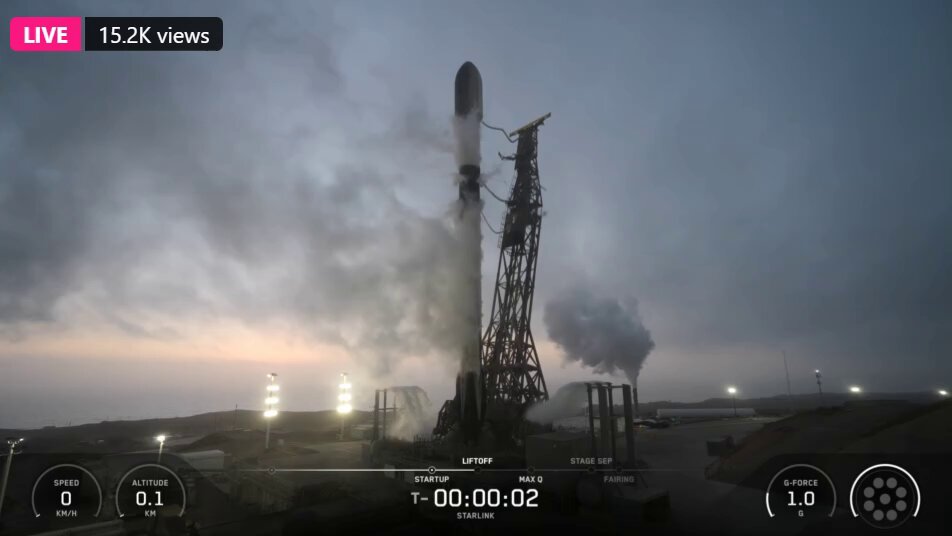
SpaceX closed out July with another clean Starlink run: Falcon 9 booster B1081 lifted off from Vandenberg Space Force Base at 8:08 p.m. PDT on July 31, deposited 24 Starlink V2 mini satellites into low Earth orbit, and put the first stage down on a droneship with what NASASpaceflight called a bullseye landing — all in under nine minutes of powered flight. The mission was routine by SpaceX standards, which is precisely the point.

The Numbers Behind This Launch
| Metric | Value |
|---|---|
| Launch time (PDT) | July 31, 8:08 p.m. |
| Launch site | SLC-4E, Vandenberg SFB |
| Booster | B1081 — flight 26 |
| Booster landing | ~8.5 min after liftoff |
| Landing ship | Of Course I Still Love You (Pacific) |
| Satellites deployed | 24 Starlink V2 mini |
| Deployment time | 61.5 min after liftoff |
| SpaceX launches in 2026 (to date) | 90 (incl. 1 Falcon Heavy) |
| Dedicated Starlink flights in 2026 | 69 |
| Total Starlink satellites in orbit | 10,800+ |
According to Space.com and Spaceflight Now, this was the 90th Falcon rocket launch of 2026 — a pace that works out to roughly one launch every 2.5 days across the year. Sixty-nine of those flights have been dedicated Starlink missions, underscoring how completely the constellation has come to define Falcon 9's manifest.

What B1081's 26th Flight Actually Represents
Booster reuse was once the headline. At 26 flights, B1081 is now deep into territory that would have seemed implausible a decade ago — and it landed cleanly enough that NASASpaceflight's live coverage called it a bullseye without qualification. The operational significance is straightforward: each successful recovery keeps that booster in the rotation rather than manufacturing a replacement, compressing the cost and lead time of the next mission.
The droneship involved, Of Course I Still Love You, operates in the Pacific to catch boosters returning from Vandenberg's polar and sun-synchronous trajectories. The 8.5-minute turnaround from separation to touchdown is consistent with prior missions from SLC-4E, where the flight profile leaves less downrange distance than East Coast launches targeting the Atlantic droneship.
Starlink Past 10,800 Satellites
The constellation crossing 10,800 active satellites is a density milestone worth pausing on. SpaceX's FCC authorizations cover tens of thousands of spacecraft across multiple orbital shells, and the V2 mini generation — which is what this mission carried — offers higher throughput per satellite than the original V1 design. More satellites in the right shells means more capacity per ground cell and, in theory, more consistent performance for subscribers in high-demand areas.
For Tesla owners who use Starlink for home internet or who follow the company's broader ecosystem, the pace of constellation growth directly affects service quality. SpaceX has not published a specific satellite count at which it considers coverage objectives met for any given region, but the cadence of 69 dedicated flights in seven months suggests the build-out is still in an active expansion phase rather than a maintenance one. For more on SpaceX's launch activity, see our SpaceX coverage.
Sources & reporting notes
The links below identify the material source records used for this report.
- @NASASpaceflight on X (2026-08-01T03:09:25.000Z) — Direct source
- @NASASpaceflight on X (2026-08-01T03:17:45.000Z) — Direct source
Source links are preserved as published or accessed. See our editorial standards and corrections policy.
The BASENOR Editorial Desk covers Tesla, SpaceX, and related technology, curating reporting from primary sources — official accounts, regulatory filings, and software release data. Every article passes source-record and fact-checking review before publication. About the newsroom.
This report was curated by the BASENOR Editorial Desk from the sources listed above. Read our editorial standards or email editorial@basenor.com to report an error.