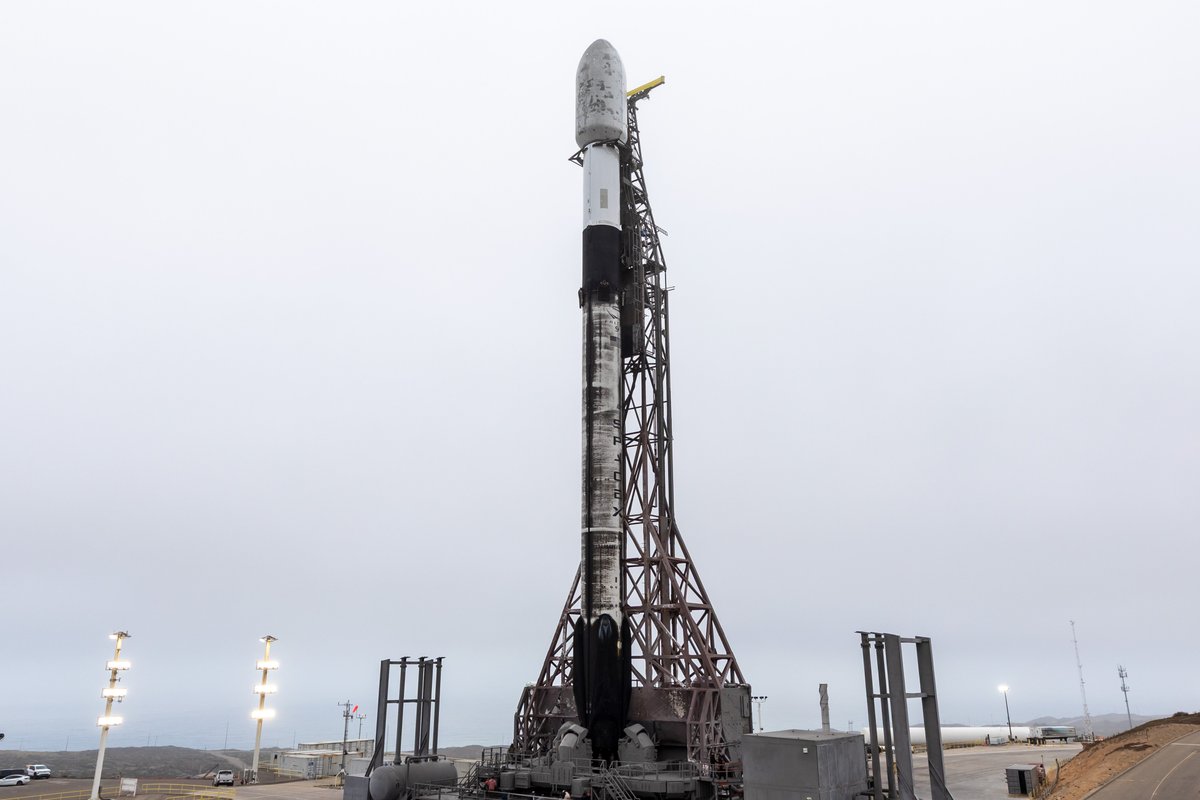
SpaceX has stood up its Falcon 9 rocket at Space Launch Complex 4E (SLC-4E) at Vandenberg Space Force Base in California, signaling the final countdown to tonight's USSF-259 mission — a classified launch for the United States Space Force. The four-hour launch window opens at 6:00 p.m. PT on September 15, 2026, with a backup opportunity available Wednesday at the same time.

What's Flying Tonight
USSF-259 carries a classified payload for the U.S. Space Force. According to mission tracking sources, the payload is possibly a batch of classified Low Earth Orbit satellites built on SpaceX's Starshield satellite bus — though the government has not confirmed specifics, and the webcast will cut off after booster landing precisely because of the payload's classified nature.
The rocket itself is a Falcon 9 Block 5 variant. The first stage booster, designated B1097, will be making its 13th flight — a figure that continues to illustrate how aggressively SpaceX has pushed reusability economics. After stage separation, B1097 will attempt a landing on the Of Course I Still Love You droneship, stationed in the Pacific Ocean.
Mission Details at a Glance
| Detail | Info |
|---|---|
| Launch Site | SLC-4E, Vandenberg Space Force Base, CA |
| Launch Window | 6:00 p.m. PT, Sept 15 (01:00 UTC Sept 16); 4-hour window |
| Rocket | Falcon 9 Block 5 |
| Booster | B1097 — 13th flight |
| Landing Target | Of Course I Still Love You droneship, Pacific Ocean |
| Customer | U.S. Space Force |
| Payload | Classified |
| Webcast | Begins ~10 min before liftoff; ends after booster landing |
The Reusability Story Behind B1097
A booster on its 13th flight is no longer a headline in isolation — it's a data point in a much larger argument SpaceX has been making to the U.S. government for years: reusability drives down cost per launch without sacrificing reliability. The fact that the Space Force is routinely manifesting classified national security payloads on flight-proven hardware represents a meaningful shift from the expendable-rocket era that defined military space launch for decades.
The Starshield program — SpaceX's national security-focused satellite network derived from Starlink hardware — has been a significant driver of Falcon 9's launch cadence out of Vandenberg. While the government does not confirm individual mission payloads, the pattern of polar-orbit launches from SLC-4E aligns with LEO constellation deployment.
Local Impact: Sonic Booms Expected
Residents in Santa Barbara, San Luis Obispo, and Ventura counties should expect one or more sonic booms during the launch sequence, according to local advisories. The booms are a byproduct of the booster's supersonic return to the droneship — a sound that has become familiar to the California Central Coast but still catches first-timers off guard.
Live coverage will stream on SpaceX's website and its X account beginning approximately ten minutes before liftoff. As with all classified USSF missions, the webcast will end once the first stage lands — upper stage operations and payload deployment will not be shown. For more on SpaceX's launch cadence and national security missions, see our SpaceX coverage.
Sources & reporting notes
The links below identify the material source records used for this report.
- @SpaceX on X (2026-09-15T16:47:13.000Z) — Direct source
Source links are preserved as published or accessed. See our editorial standards and corrections policy.
The BASENOR Editorial Desk covers Tesla, SpaceX, and related technology, curating reporting from primary sources — official accounts, regulatory filings, and software release data. Every article passes source-record and fact-checking review before publication. About the newsroom.
This report was curated by the BASENOR Editorial Desk from the sources listed above. Read our editorial standards or email editorial@basenor.com to report an error.