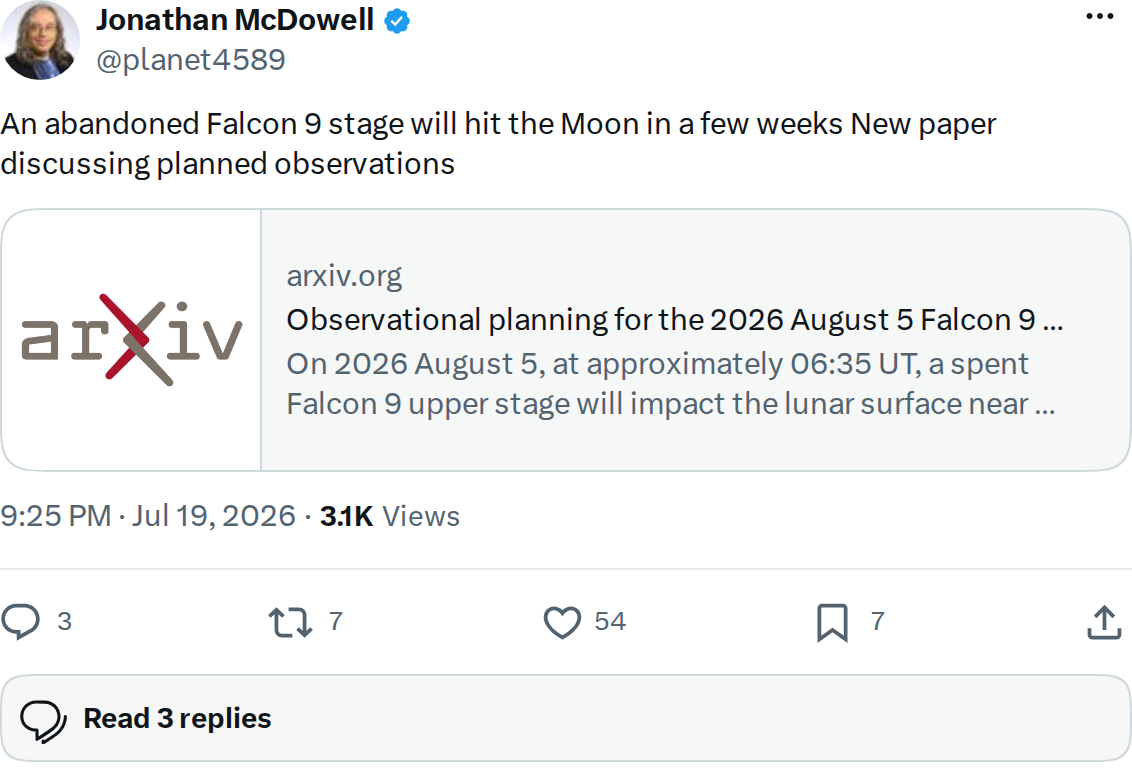
A discarded SpaceX Falcon 9 upper stage is on a collision course with the Moon, and astronomers are treating it as an unexpected scientific gift. The rocket body — launched in January 2025 and left in a chaotic orbit ever since — is now projected to slam into the lunar surface on August 5, 2026, giving researchers a rare, unplanned chance to study what happens when a large artificial object hits the Moon at high speed.

Jonathan McDowell, the Harvard-Smithsonian astrophysicist who tracks virtually every object in orbit, flagged a new paper on July 19 outlining planned observations of the incoming stage. McDowell has been one of the most consistent voices cataloguing orbital debris, and his note carries weight: this impact is real, it's imminent, and the science community is already mobilizing around it.
What's Actually Hitting the Moon
The object is designated 2025-010D (NORAD catalog number 62719) — the upper stage from a Falcon 9 launched on January 15, 2025, as part of a dual-payload mission that carried Firefly Aerospace's Blue Ghost lander and iSpace's Hakuto-R lander toward the Moon. The upper stage completed its job delivering those spacecraft, but without enough fuel to deorbit or escape Earth-Moon space, it was left in an unstable high-Earth orbit. Gravitational perturbations from the Moon gradually reshaped that orbit over 18 months until an impact became inevitable.
The stage is not a small piece of hardware. According to tracking data, it measures approximately 13.8 meters (45 feet) tall and 3.7 meters (12 feet) in diameter, with an estimated mass of around four metric tons. It will strike the lunar surface at over two kilometers per second — roughly 5,400 mph — near the Einstein crater on the Moon's western limb, the transitional zone between the near and far sides. The impact is currently timed for around 06:35–06:44 UTC on August 5, 2026, though those figures will be refined as the date approaches. The orbital calculations were originally made by astronomer Bill Gray of Project Pluto in September 2025.
The Scientific Opportunity
Intentional lunar impactors have a track record of producing useful science. NASA's LCROSS mission in 2009 deliberately crashed a spent Centaur rocket stage into the Moon's south pole, confirming the presence of water ice in the resulting debris plume. This Falcon 9 impact is unplanned, but the physics are similar: a large, fast-moving mass excavating a fresh crater and ejecting subsurface material that would otherwise be inaccessible.
The primary scientific interest is in the regolith composition of the Einstein crater region — a part of the Moon that has received relatively little close attention compared to the equatorial and polar zones targeted by recent lander missions. An impact of this scale could eject material from several meters below the surface, giving spectroscopic instruments a look at layers that haven't seen sunlight in billions of years.
NASA's Lunar Reconnaissance Orbiter (LRO) is expected to image the resulting crater, as it did after the accidental 2022 lunar impact of what was initially misidentified as a SpaceX Falcon 9 stage but later attributed to a Chinese Long March rocket body. LRO's before-and-after imagery of that 2022 impact produced a double-crater formation that surprised researchers and revised assumptions about the object's mass distribution. The 2025-010D impact will be another data point in understanding how artificial objects behave differently from natural meteorite strikes.
Whether the impact itself will be visible from Earth is a separate question. The Moon will be up in early morning skies for parts of the Americas around the projected impact time, but the flash from an object this size — while energetically significant — is generally considered too brief and too faint for amateur equipment to reliably detect. Professional observatories and orbital assets are the practical tools here.
A Pattern Worth Watching
This is not the first time a Falcon 9 upper stage has ended up on an uncontrolled trajectory toward the Moon, and it likely won't be the last. The January 2025 mission that produced 2025-010D was a trans-lunar injection — the kind of high-energy departure from Earth orbit that leaves upper stages in orbits too energetic to decay naturally back into Earth's atmosphere but not energetic enough to escape the Earth-Moon system entirely. Managing the long-term fate of these stages is an open problem in the commercial lunar economy, one that will only grow as more private lander missions launch.
The new paper McDowell referenced outlines the observational campaign being organized around the August 5 event. With roughly two weeks remaining before impact, the refinement window for orbital predictions is narrowing — which means the scientific community's preparation timeline is also compressing. August 5 is the date to watch.
Sources & reporting notes
The links below identify the material source records used for this report.
- @planet4589 on X (2026-07-19T21:25:50.000Z) — Direct source
Source links are preserved as published or accessed. See our editorial standards and corrections policy.
The BASENOR Editorial Desk covers Tesla, SpaceX, and related technology, curating reporting from primary sources — official accounts, regulatory filings, and software release data. Every article passes source-record and fact-checking review before publication. About the newsroom.
This report was curated by the BASENOR Editorial Desk from the sources listed above. Read our editorial standards or email editorial@basenor.com to report an error.