📌 UPDATE — May 12, 2026
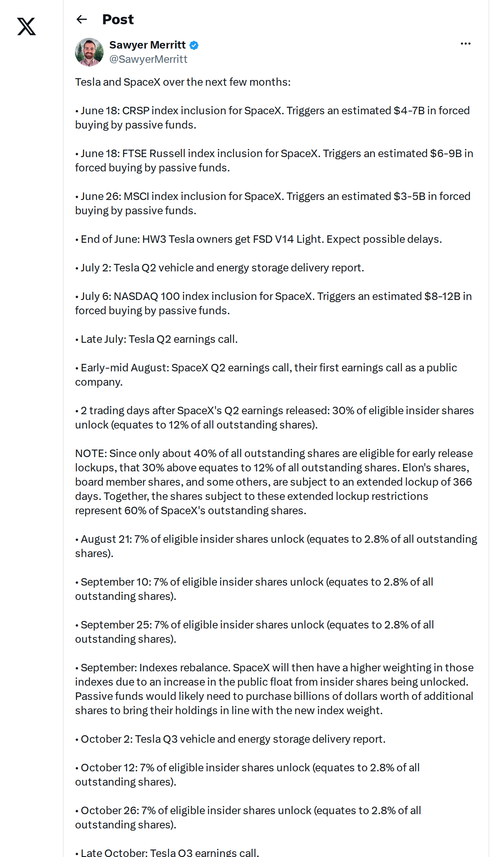
The SpaceXAI trademark filings are drawing fresh attention to SpaceX's unmatched strategic position in orbital datacenter launch services. Tech commentator Sawyer Merritt highlighted that Google holds approximately 6% of SpaceX, reinforcing a deep financial alignment between two of the most AI-hungry companies on the planet. With Starship's unrivaled payload capacity and launch cadence, analysts and observers increasingly view SpaceX as the default — and likely only viable — provider for getting large-scale orbital compute infrastructure off the ground. No competitor currently comes close to matching SpaceX's throughput for the kind of heavy, repeated launches that orbital datacenters would demand.

— @SawyerMerritt via X · May 12, 2026
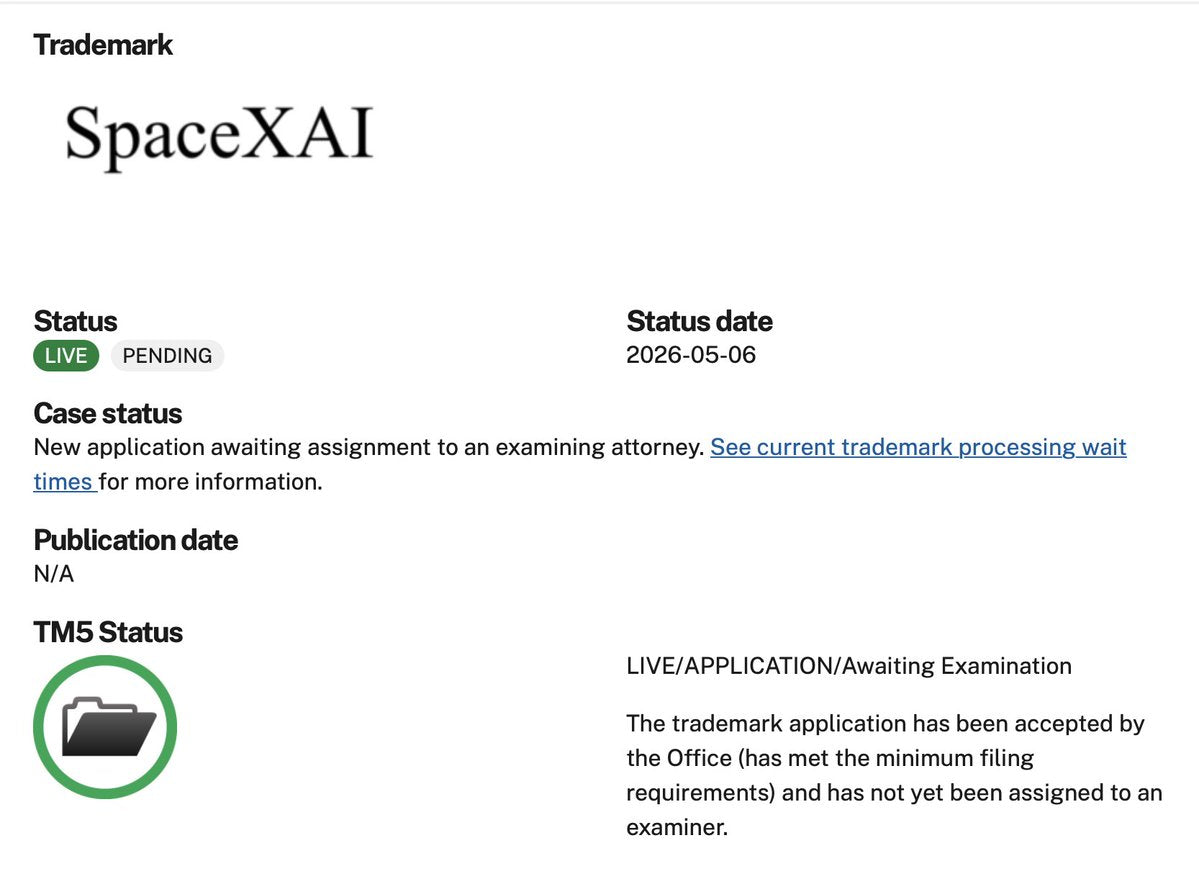
SpaceX has filed two trademark applications with the United States Patent and Trademark Office for the wordmark SpaceXAI, signaling a formal push into satellite-based AI computing infrastructure. The filings, submitted on May 7, 2026, arrive weeks after SpaceX completed its all-stock acquisition of xAI on February 2, 2026 — and days after Elon Musk announced xAI would be dissolved as a standalone company and fully absorbed into SpaceX under the SpaceXAI identity.

What the Two Filings Actually Cover
The trademark applications are broad but deliberate. According to the USPTO filings, the first covers "satellite-based data center services and orbital computing infrastructure" alongside "cloud computing and software as a service (SaaS) featuring artificial intelligence for data processing." The second filing extends into GPS services using satellite constellations, internet server hardware, ISP services, cloud storage, and social networking.
Together, they sketch out a vertically integrated AI platform: SpaceXAI would own the satellites, the orbital compute layer, the cloud infrastructure, and the software sitting on top of it. That's a scope no existing cloud provider — terrestrial or otherwise — currently matches.

The Orbital Compute Vision
SpaceXAI's long-term strategy, according to reporting from multiple outlets, is to move AI computing infrastructure off Earth entirely. The plan involves using Starship to launch a constellation of up to one million satellites that would form a solar-powered supercomputer in orbit. SpaceX has estimated that space-based AI compute could become the lowest-cost method for generating compute within two to three years — a claim that, if it holds, would fundamentally disrupt the economics of terrestrial data centers.
That ambition is already backed by real hardware on the ground. SpaceXAI's Colossus 1 supercomputer — described as one of the world's largest and fastest-deployed AI systems — delivers over 300 megawatts of compute power through a cluster of more than 220,000 NVIDIA GPUs, including H100, H200, and GB200 accelerators. Musk has stated that SpaceXAI has already migrated its own AI training workloads to a next-generation Colossus 2, freeing Colossus 1 for external customers.
The Anthropic Deal Puts Colossus 1 to Work
The first major external customer is Anthropic. An agreement announced on May 6–7, 2026 gives Anthropic access to the full Colossus 1 cluster, with Anthropic expecting to utilize 100% of its capacity before the end of May. The deal will substantially expand compute available to Claude Pro and Claude Max subscribers, as well as API users. Anthropic has also expressed interest in collaborating with SpaceXAI on developing "multiple gigawatts of orbital AI compute capacity" — language that maps directly onto the trademark filings.
The Anthropic partnership is notable precisely because it's a competitor-adjacent relationship: Anthropic's Claude competes with Grok, the AI product that originated at xAI. That SpaceXAI is willing to sell compute to a rival model maker suggests the orbital infrastructure play is being positioned as a platform business, not just a captive resource for Grok.
Why the Trademark Matters Beyond Branding
Trademark filings are often dismissed as administrative housekeeping, but these two applications carry strategic weight. By formally registering SpaceXAI across satellite infrastructure, SaaS, ISP services, and social networking, SpaceX is staking legal territory across the full stack of what a space-based AI cloud would need. The social networking inclusion is particularly interesting — it echoes the xAI-era integration with X (formerly Twitter) and suggests that identity isn't going away under the new structure.
The integration of xAI into SpaceX also consolidates Musk's AI assets under a single corporate entity with rocket launch capability, satellite manufacturing, and a global ISP already operating at scale through Starlink. Whether orbital compute becomes commercially viable on the timeline SpaceX projects remains to be seen — but the trademark filings confirm the company is treating it as a real product category, not a thought experiment. For our SpaceX coverage, this marks one of the most consequential structural moves since Starlink's commercial launch.

Sarah focuses on Tesla Energy, SpaceX missions, and the broader Musk AI portfolio. Former data analyst in clean energy. Based in San Francisco.
Sources verified at publish time. Spotted an inaccuracy? Email editorial@basenor.com.