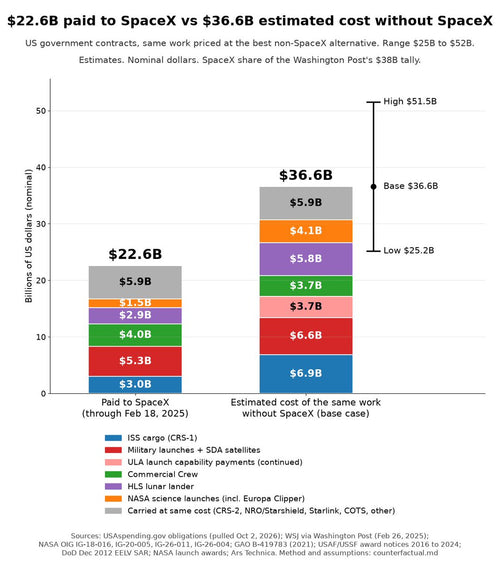
The News: The Pentagon has confirmed SpaceX saved the U.S. government over $40 billion through lower launch prices and superior contract execution — directly rebutting claims that SpaceX is simply handed government business.
Why It Matters: SpaceX's cost advantage over legacy aerospace programs is now quantified at a scale that reshapes how the U.S. funds and conducts space operations — with ripple effects across NASA, the Space Force, and the broader commercial space industry.
Source: @SawyerMerritt on X
The $40 Billion Question: Did SpaceX Earn It?
A persistent narrative in aerospace circles holds that SpaceX's government contract wins are the product of political connections rather than competitive merit. Sawyer Merritt pushed back hard on that framing this week, citing Pentagon data that puts a concrete dollar figure on what SpaceX's competitive pricing has actually delivered for U.S. taxpayers.

The figure — over $40 billion saved — comes directly from Pentagon leadership, attributed to former Air Force Gen. John Hyten, who served as Vice Chairman of the Joint Chiefs of Staff, and later cited by NASA Administrator Bill Nelson. This isn't a SpaceX press release. It's the U.S. military's own accounting of what competitive launch procurement has delivered.
📊 Key Figures
| Metric | Value | Context |
|---|---|---|
| Government savings (Pentagon estimate) | $40B+ | vs. legacy launch costs |
| SpaceX launch cost (typical) | <$75M | per launch |
| SLS (Space Launch System) cost | Billions | per launch |
| Falcon Heavy vs. Delta IV Heavy savings | >60% | Space Force heavy missions |
| Falcon Heavy cost (military) | <$150M | most missions |
| 2025 Pentagon contract (national security) | $5.9B | 28 missions, April 2025 |
| Total government contracts (since 2008) | $20B+ awarded | ~$9B paid by June 2025 |
| Potential total contract value | $89B+ | upon full completion |
How SpaceX Actually Wins Contracts
SpaceX President Gwynne Shotwell has been direct about the company's procurement approach: "We earned that. We bid it, we were the lowest price, best bidder, we won, and we execute." That's not spin — it's a description of how competitive federal procurement is supposed to work.
The numbers back it up. A single SLS launch costs billions of dollars — a program that has faced years of delays and cost overruns. A comparable SpaceX Falcon 9 mission runs under $75 million. For the heaviest payloads, Falcon Heavy has cut Space Force launch costs by more than 60% compared to the Delta IV Heavy it replaced, with most military missions priced below $150 million.
In April 2025, that track record translated into a landmark deal: SpaceX won 28 national security flight missions in a Pentagon contract valued at $5.9 billion, cementing its position as the U.S. military's primary launch provider through the 2030s. A subsequent Trump administration review of SpaceX's federal contracts — specifically examining whether any could be terminated as wasteful — concluded that most were essential and irreplaceable.
🔭 The BASENOR Take
Timeline: SpaceX has been building this position since 2008, accumulating over $20 billion in government contracts. The $40B savings figure reflects nearly two decades of competitive pricing against legacy contractors.
Impact Level: 🔴 High — This isn't just about SpaceX's balance sheet. It reframes the entire debate about government aerospace spending and competitive procurement.
Confidence: ⬛⬛⬛⬛⬜ High — The $40B figure comes from Pentagon leadership, not SpaceX marketing. The contract values and launch cost comparisons are independently verified.
The debate over SpaceX's government contracts tends to generate more heat than light. Critics conflate winning a lot of contracts with being handed contracts — but those are fundamentally different things. The procurement data tells a straightforward story: SpaceX bids lower, delivers on schedule, and has built a launch cadence that legacy programs simply cannot match.
What makes the $40 billion figure particularly striking is its source. This isn't a number SpaceX invented to defend itself — it comes from the Pentagon's own internal accounting, surfaced by the Vice Chairman of the Joint Chiefs. When the military's own leadership quantifies the savings from competitive launch procurement at that scale, it's difficult to argue the contracts aren't earned on merit.
For the broader aerospace industry, SpaceX's dominance creates a structural challenge for traditional defense contractors. Defense Secretary Pete Hegseth acknowledged as much during a January 2026 visit to Starbase, where he praised SpaceX's operational model and criticized legacy contractors for a "risk-averse culture" that has historically driven cost overruns. The pressure to compete — or lose relevance in national security launch — is now existential for those players.
One genuine complication worth noting: in February 2026, two Democratic senators requested a Pentagon review of SpaceX over allegations of undisclosed Chinese investment, citing national security concerns. The Department of Defense had not publicly responded as of that time. That thread remains open — and depending on how it develops, could introduce new scrutiny into future contract awards. For now, though, SpaceX's market position as the dominant U.S. government launch provider appears firmly intact. For more on SpaceX's trajectory, see our SpaceX coverage.
Sources & reporting notes
The links below identify the material source records used for this report.
- @SawyerMerritt on X (2026-03-18T23:46:57.000Z) — Direct source
Source links are preserved as published or accessed. See our editorial standards and corrections policy.
The BASENOR Editorial Desk covers Tesla, SpaceX, and related technology, curating reporting from primary sources — official accounts, regulatory filings, and software release data. Every article passes source-record and fact-checking review before publication. About the newsroom.
This report was curated by the BASENOR Editorial Desk from the sources listed above. Read our editorial standards or email editorial@basenor.com to report an error.