Tesla's 2025 Impact Report has put hard numbers behind the Cybercab for the first time, and they're significant. The document confirms the autonomous two-seater as the centerpiece of Tesla's Robotaxi fleet strategy — and reveals efficiency and emissions figures that put it in a class of its own among electric vehicles on the road today.
What Tesla's Impact Report Actually Says
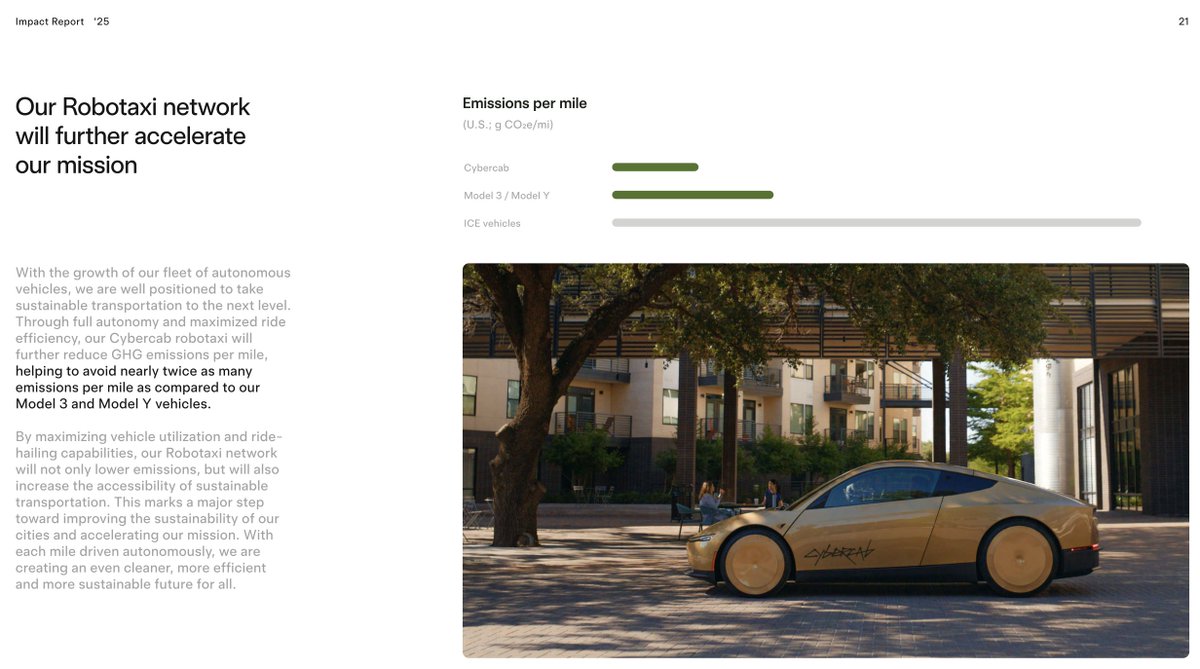
The report makes three concrete claims about the Cybercab that are worth examining closely. First, it will serve as the primary vehicle in Tesla's Robotaxi fleet — not a supplementary option alongside Model 3 or Model Y, but the anchor of the entire autonomous ride-hail operation. Second, it's engineered to deliver at least 6.1 miles per kWh from its next-generation powertrain. Third, Tesla projects it will help avoid nearly twice as many greenhouse gas emissions per mile compared to Model 3 and Model Y.

To put 6.1 mi/kWh in context: the Model 3 Long Range — Tesla's most efficient current production vehicle — typically achieves around 4.0–4.5 mi/kWh in real-world conditions. The Cybercab's target represents a roughly 35–50% improvement in energy efficiency, which directly translates to lower per-mile operating costs for a fleet running vehicles around the clock.
Why No Steering Wheel Changes Everything for Fleet Economics
The design decision to eliminate the steering wheel, pedals, and traditional controls isn't just a philosophical statement about autonomy — it has tangible downstream effects on the vehicle's economics and passenger experience.

Removing the traditional driver cockpit frees up meaningful cabin space in a vehicle that, according to the EPA Certificate of Conformity issued in May 2026, is designed as a two-seater. That space reallocation, combined with weight reduction from eliminating those components, feeds directly into the efficiency target. Fewer mechanical systems also means fewer failure points — a significant consideration when a vehicle needs to operate continuously in a commercial fleet environment with minimal downtime.
For fleet operators, the math is straightforward: lower energy consumption per mile plus reduced maintenance complexity equals a structurally lower cost-per-mile than any human-driven Tesla variant currently in service.
The Emissions Claim in Perspective

Tesla's claim that the Cybercab will avoid nearly twice as many GHG emissions per mile as Model 3 and Model Y requires some unpacking. The comparison isn't purely about the vehicle itself — it reflects a lifecycle calculation that accounts for how the vehicle is used. A Robotaxi operating at high utilization rates (many trips per day, minimal idle time) displaces far more internal combustion vehicle miles than a personally-owned EV that sits parked for the majority of its life. The efficiency gains compound when you factor in that each Cybercab replaces multiple car trips that would otherwise be taken in gas-powered vehicles.
Tesla's Impact Reports have historically used well-to-wheel emissions accounting, which includes upstream energy generation. At 6.1 mi/kWh, the Cybercab's energy draw per mile is low enough that even on a grid with significant fossil fuel generation, the per-mile carbon footprint undercuts conventional vehicles by a substantial margin.

What This Means for Tesla's Robotaxi Rollout
The Impact Report framing is deliberate. By publishing these figures in a formal sustainability document rather than a product marketing page, Tesla is speaking to institutional investors, regulators, and fleet procurement decision-makers — audiences that weigh lifecycle emissions and total cost of ownership alongside consumer appeal. Anchoring the Cybercab as the primary fleet vehicle, not an experimental one, signals that Tesla's internal planning treats it as a production-ready platform, not a concept waiting for regulatory clearance.
The EPA conformity certification secured in May 2026 already cleared a significant regulatory hurdle. The Impact Report's efficiency and emissions data now gives Tesla a documented baseline to reference in future regulatory filings and fleet partnership negotiations.
Whether the 6.1 mi/kWh target holds in real-world commercial deployment — with climate control running continuously, varied passenger loads, and stop-and-go urban driving — will be the figure to watch once fleet operations scale. That's the number that will ultimately determine whether the Cybercab's economics live up to what Tesla's own report is now on record claiming.
Related Gear
Gear up your Tesla with tested, custom-fit BASENOR accessories — shop Tesla accessories →
🚕 Following the Robotaxi rollout? See every operating city, launch date and announced market in our Tesla Robotaxi Tracker.
Sources & reporting notes
The links below identify the material source records used for this report.
- @SawyerMerritt on X (2026-07-07T17:35:44.000Z) — Direct source
- @SawyerMerritt on X (2026-07-07T17:33:00.000Z) — Direct source
- @SawyerMerritt on X (2026-07-07T17:17:29.000Z) — Direct source
- @wholemars on X (2026-07-07T17:44:54.000Z) — Direct source
Source links are preserved as published or accessed. See our editorial standards and corrections policy.
The BASENOR Editorial Desk covers Tesla, SpaceX, and related technology, curating reporting from primary sources — official accounts, regulatory filings, and software release data. Every article passes source-record and fact-checking review before publication. About the newsroom.
This report was curated by the BASENOR Editorial Desk from the sources listed above. Read our editorial standards or email editorial@basenor.com to report an error.