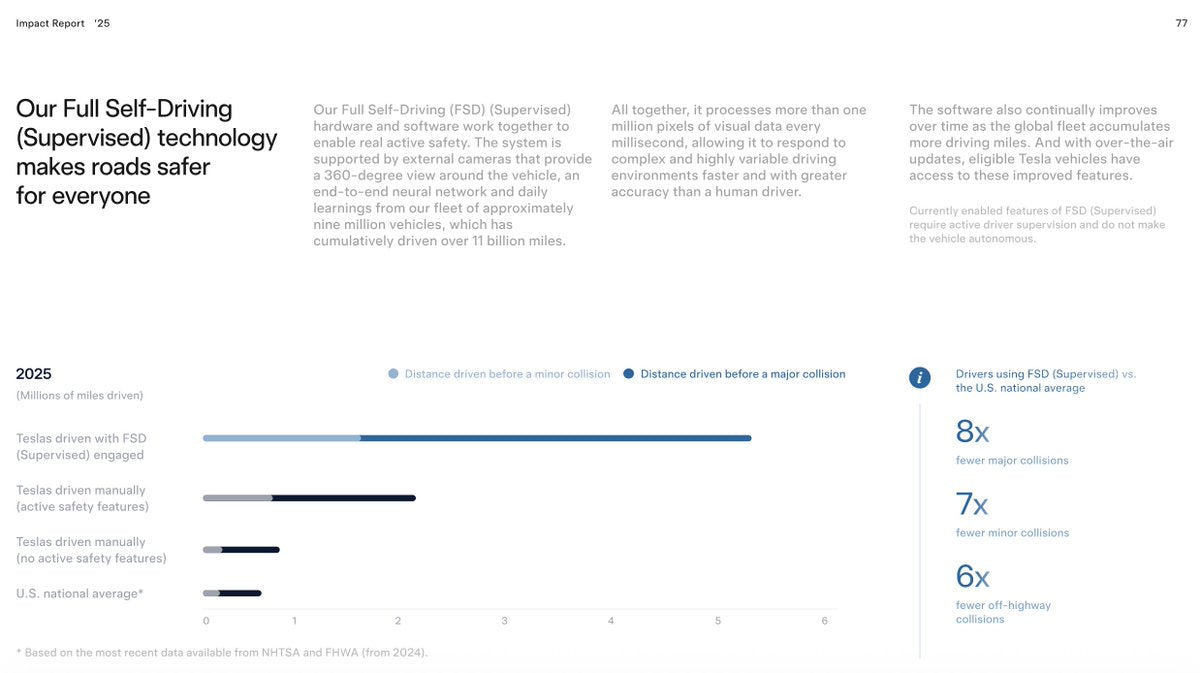
Tesla's Full Self-Driving system is doing something remarkable every time your car is on the road: processing one million pixels of visual data every single millisecond. That figure, highlighted by Whole Mars Catalog on X, puts the raw computational scale of FSD into perspective — and raises a few obvious questions worth answering.

What does '1 million pixels per millisecond' actually mean?
It means Tesla's FSD hardware is ingesting and analyzing one billion pixels of visual data every second. Your car's cameras are constantly feeding raw image data into the onboard computer, and the system has to make sense of all of it — identifying lane markings, pedestrians, traffic signals, vehicles, and obstacles — in real time. One millisecond is one-thousandth of a second, so this isn't a peak burst figure; it's the sustained throughput required to keep autonomous decision-making responsive at highway speeds.
Which hardware is doing this processing?
The figure aligns closely with the capabilities of Tesla's HW3 FSD Computer, which Tesla introduced in 2019. According to technical documentation, HW3's integrated Image Signal Processor was designed to handle eight HDR cameras and process up to 1 billion pixels per second. The system runs two redundant custom FSD chips, each capable of 72 TOPS (trillion operations per second), for a combined 144 TOPS of neural network performance. Tesla's newer HW4 hardware, which began shipping in early 2023, pushes that further — achieving approximately 1.3 gigapixels per second of inference throughput (an unverified community estimate), roughly three to five times the processing power of HW3.
How does the camera hardware feed all that data?
On HW3 vehicles, eight cameras use Onsemi AR0136A sensors at 1.2-megapixel resolution each, with the system capable of processing frames at 2,300 frames per second — a 21x improvement over the previous HW2.5 generation. HW4 vehicles step up to 5-megapixel cameras, a significant resolution jump that dramatically increases the raw pixel volume the computer must handle. According to reports, FSD v13.2.1 — released in late 2024 — was the first software version to natively utilize the full resolution of all cameras on HW4-equipped cars, meaning the hardware's potential was only recently being fully unlocked at the software level.
Why does pixel throughput matter for self-driving performance?
More pixels mean more detail. A higher-resolution image gives the neural network more data to work with when identifying a partially obscured stop sign, a cyclist at dusk, or a pothole in poor lighting. The jump from HW3's 1.2-megapixel cameras to HW4's 5-megapixel units isn't just a spec upgrade — it's roughly 4x more raw pixel data per frame for the system to analyze. Processing that volume without latency is what separates a system that reacts in time from one that doesn't. The 1 million pixels per millisecond figure is essentially the floor Tesla has set for what real-time autonomous vision requires.
Does this affect owners on HW3 versus HW4?
Yes, meaningfully. HW3 owners are working with a proven, capable system — 144 TOPS and 2,300 fps image processing is still substantial — but the ceiling is lower. HW4 owners have hardware that processes higher-resolution camera feeds at greater throughput, and as Tesla's software continues to evolve to exploit that resolution (as it did with v13.2.1), the real-world gap in FSD capability between the two generations is likely to widen over time. If you're on HW3 and wondering about an upgrade path, Tesla has historically offered hardware upgrade programs, though availability and pricing vary by region and vehicle model.
The 1 billion pixels per second benchmark is a useful reminder that FSD isn't primarily a software story — it's a hardware-plus-software story. The neural networks running on these chips are only as good as the data pipeline feeding them, and Tesla has spent years engineering that pipeline to be extraordinarily fast. For our full coverage of FSD developments, see our FSD coverage.
Related Gear
Gear up your Tesla with tested, custom-fit BASENOR accessories — shop Tesla accessories →
📋 Tracking Tesla software? See every firmware, FSD and app version in one place in our Tesla Software Update Tracker.
Sources & reporting notes
The links below identify the material source records used for this report.
- @wholemars on X (2026-07-07T18:00:13.000Z) — Direct source
Source links are preserved as published or accessed. See our editorial standards and corrections policy.
The BASENOR Editorial Desk covers Tesla, SpaceX, and related technology, curating reporting from primary sources — official accounts, regulatory filings, and software release data. Every article passes source-record and fact-checking review before publication. About the newsroom.
This report was curated by the BASENOR Editorial Desk from the sources listed above. Read our editorial standards or email editorial@basenor.com to report an error.