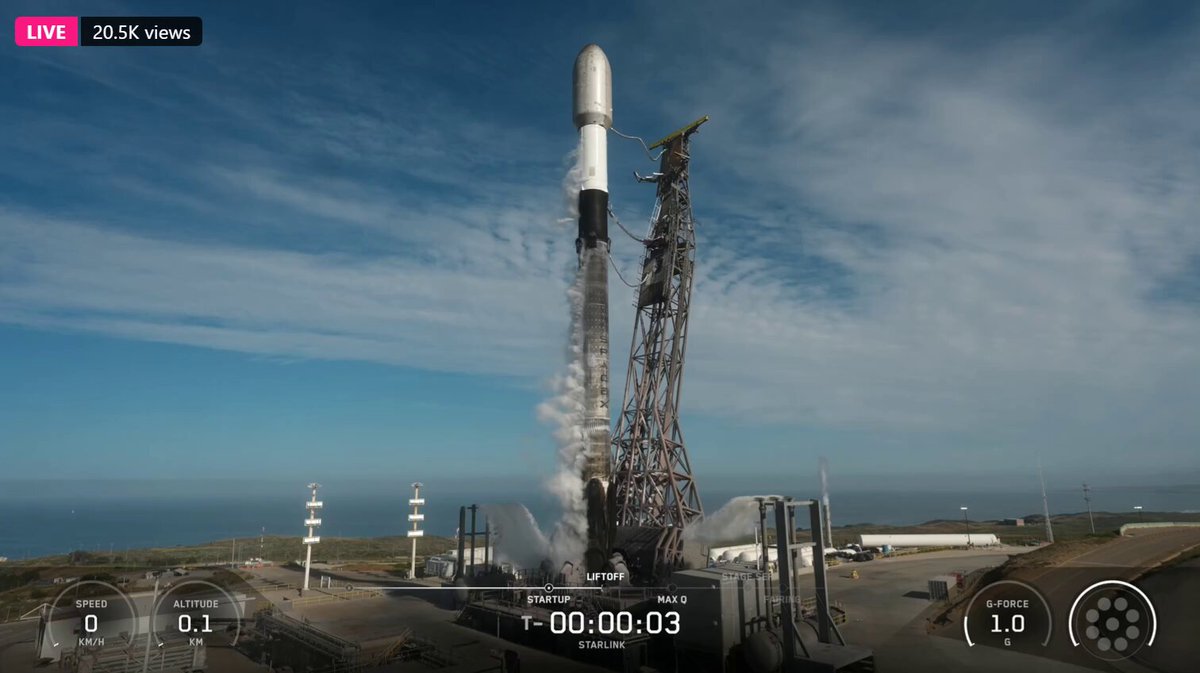
The News: SpaceX launched Starlink Group 17-22 from Vandenberg Space Force Base and landed the Falcon 9 booster for the 600th time in company history.
Why It Matters: The 600th booster landing is a landmark in reusable rocketry — one that directly funds the infrastructure behind Tesla, Starlink, and SpaceX's broader ambitions.
Sources: @NASASpaceflight · @SpaceX
SpaceX Hits 600 Booster Landings With Starlink Group 17-22 Launch
On April 19, 2026, SpaceX crossed a milestone that would have seemed like science fiction a decade ago: the 600th successful landing of a Falcon rocket booster. It happened during the Starlink Group 17-22 mission, lifted off from Vandenberg Space Force Base in California aboard Falcon 9 booster B1097 on its eighth flight.

📊 Key Figures
| Metric | Value | Context |
|---|---|---|
| Booster Landing Number | 600 | Historic milestone |
| Booster | B1097 | 8th flight |
| Mission | Starlink Group 17-22 | Vandenberg SFB, CA |
| SpaceX Engagement (600th landing tweet) | 5,335 likes · 683 RTs | 147K+ views in ~1 hour |

🔭 The BASENOR Take
Timeline: SpaceX's first successful booster landing was December 21, 2015. It took roughly a decade to reach 600 — but the pace has accelerated sharply. The first 100 landings took years; the most recent 100 have come in a matter of months.
Impact Level: High
Confidence: Confirmed — Official SpaceX Source
Analysis: Every recovered booster is a booster SpaceX doesn't have to build from scratch. At an estimated $50M+ per new Falcon 9 first stage, reusability is the single biggest cost lever in the industry — and 600 landings means that lever has been pulled hundreds of times over. For Starlink subscribers and Tesla owners who rely on SpaceX's financial health to fund Elon Musk's broader technology ecosystem, this number matters more than it might appear on the surface.
📰 Deep Dive
The number 600 is more than a round figure — it represents a complete transformation of how humanity accesses space. When SpaceX first landed a Falcon 9 booster back in 2015, the aerospace industry was broadly skeptical that routine reuse was practical at scale. Today, recovering a booster is so routine that a mission's landing footage barely trends unless it's a milestone number like this one.
Booster B1097, flying its eighth mission, is itself a testament to that maturity. A rocket that has now survived eight round trips to the edge of space and back is not an experiment — it's a workhorse. SpaceX's ability to certify boosters for double-digit flights has compressed launch costs in ways that are still rippling through the satellite and defense industries.
For the Starlink constellation specifically, this cadence of reuse is what makes rapid network expansion financially viable. Each Starlink Group mission adds dozens of satellites to a constellation that now provides internet service globally — including to Tesla vehicles via the Starlink-Tesla partnership. The economics of that network rest squarely on the back of reusable boosters like B1097.
The road to 1,000 landings — once unthinkable — now looks like a matter of when, not if. With Starship's own reusability program maturing in parallel, SpaceX is building toward a future where the cost of reaching orbit continues to fall. For owners of Tesla's ecosystem, that trajectory has direct implications: cheaper satellite internet, more ambitious infrastructure, and a company with the financial runway to keep pushing boundaries across all of its ventures. For more on SpaceX's broader milestones, see our SpaceX coverage.
Sources & reporting notes
The links below identify the material source records used for this report.
- @NASASpaceflight on X (2026-04-19T16:04:09.000Z) — Direct source
- @SpaceX on X (2026-04-19T16:12:50.000Z) — Direct source
Source links are preserved as published or accessed. See our editorial standards and corrections policy.
The BASENOR Editorial Desk covers Tesla, SpaceX, and related technology, curating reporting from primary sources — official accounts, regulatory filings, and software release data. Every article passes source-record and fact-checking review before publication. About the newsroom.
This report was curated by the BASENOR Editorial Desk from the sources listed above. Read our editorial standards or email editorial@basenor.com to report an error.