
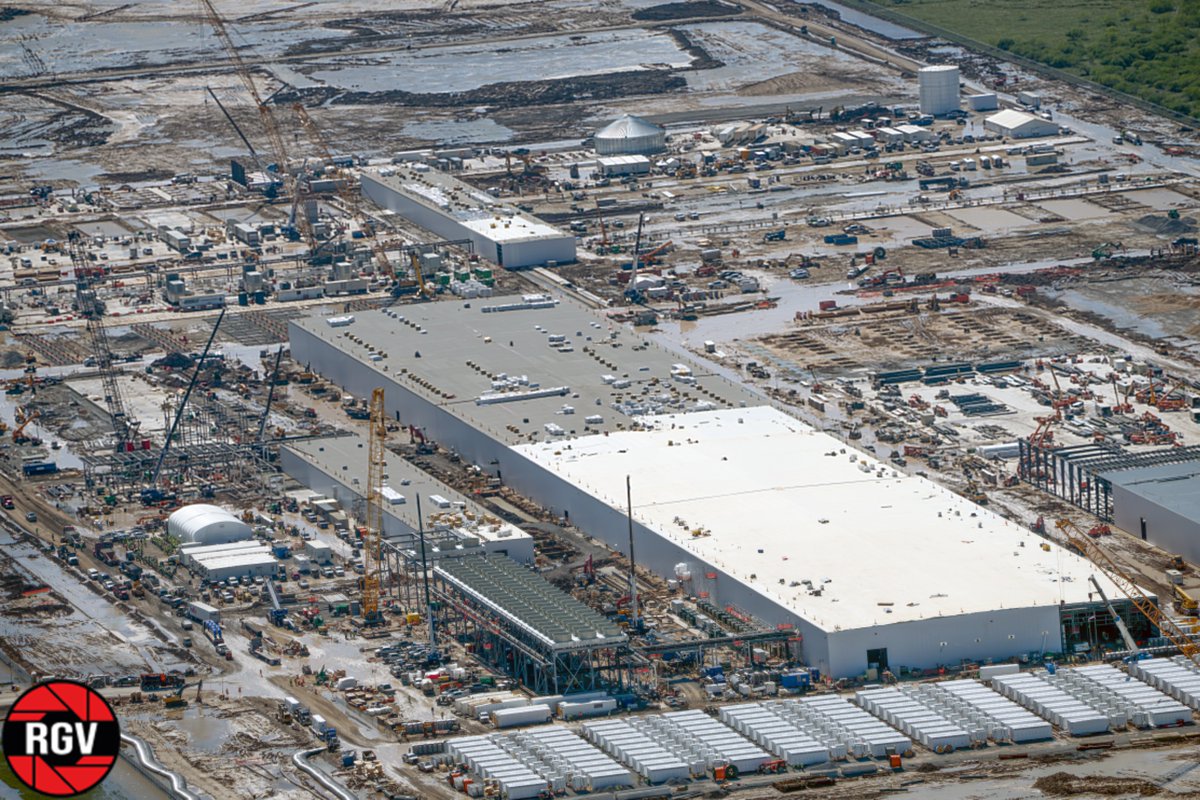
SpaceX has installed more than $250 million worth of Tesla Megapacks at its new data center at Starbase, Texas — a site that was still bare dirt less than 90 days ago. The scale and speed of the buildout, flagged on Wednesday night by Tesla investor Sawyer Merritt, underscore how aggressively Elon Musk's two companies are now co-engineering an independent power grid to feed SpaceX's compute ambitions.

The Megapack farm visible in the latest aerial imagery is part of a much larger infrastructure push at the southern tip of Texas, where SpaceX is building a self-contained energy and compute campus alongside its Starship launch operations. It is also the latest confirmation that SpaceX has become one of Tesla Energy's single largest customers — a relationship that is now visible on both companies' financial statements.
A data center built in under 90 days
Merritt's post emphasized the pace: the parcel hosting the new facility was undeveloped dirt roughly three months ago. Construction tempo at Starbase has consistently outrun traditional industrial timelines — the nearby Gigabay expansion and launch-pad rebuilds have moved on similar cycles — but standing up a data center shell and a nine-figure battery installation inside a quarter is unusual even by SpaceX standards.
The energy build is tied to a broader $24 billion initial investment at Starbase for a gas-fired power plant and "super-compute facility," according to filings reviewed by the Texas Tribune. The explicit goal, per planning documents, is for the campus to generate its own electricity and operate independently of the public grid. In that architecture, Megapacks are not a backup — they are the buffer that makes a private, gas-plus-storage grid viable for 24/7 AI workloads.
Key figures
| Metric | Figure | Source |
|---|---|---|
| Megapacks installed at Starbase site | $250M+ worth | @SawyerMerritt, aerial imagery |
| Time from bare dirt to installed Megapacks | Under 90 days | @SawyerMerritt |
| SpaceX Megapack purchases, Q2 2026 (Memphis) | $295M | SpaceX financial filing |
| SpaceX Megapack spending, H1 2026 | $329M total | SpaceX financial filing |
| Megapacks at Colossus + Starbase (combined) | 1,377 units | SemiAnalysis, Nov 5, 2026 |
| Tracked SpaceX data center capacity | Up to 9 GW | SemiAnalysis |
| Starbase campus initial investment | $24B (phase 1) | Texas Tribune / planning filings |
At current Megapack 2XL specs — roughly 3.9 MWh of storage per unit — $250 million buys on the order of 150–200 units depending on configuration and software bundles. That is consistent with the density visible in the Starbase imagery, and it slots neatly beneath the 1,377-unit combined figure that analysts at SemiAnalysis attributed to SpaceX's "Colossus and Starbase" sites earlier this month.
How Starbase fits into SpaceX's compute strategy
Starbase has always been a launch facility first, but the campus is quietly being re-pitched as a compute node. Our earlier coverage of the Gigabay expansion showed how the physical footprint has already outgrown what Starship assembly alone needs. The data center visible today is the logical next step: co-locate compute with cheap on-site gas power, a captive battery buffer, and SpaceX's own Starlink backhaul.
That mirrors the Memphis playbook. In Q2 2026, SpaceX disclosed $295 million of Megapack purchases to power AI data centers in Memphis — the Colossus cluster xAI is building. As detailed in our Memphis data center breakdown, those sites also depend heavily on Tesla battery storage to smooth gas-turbine output and ride through grid events. Starbase appears to be a direct replication of that model, this time on SpaceX-controlled land with fewer local-grid constraints.
Zoom out further and the pattern is consistent. According to SemiAnalysis, SpaceX is now Tesla's largest Megapack customer, with purchases potentially reaching up to roughly 8 GWh across its sites — a significant chunk of which has already been delivered to Colossus 2. A large signed-but-unbilled Megapack order attributed to SpaceX is also expected to show up in future Tesla disclosures. The Starbase installation is another visible piece of that backlog landing on concrete.
Why Tesla owners should care
Even if you'll never see a Megapack on your driveway, the Starbase install matters for Tesla shareholders and the broader Tesla Energy thesis. Three reasons:
- Megapack is no longer a sideshow. SpaceX alone is tracking toward multi-hundred-million-dollar annual spend on Megapacks. That gives Tesla Energy a predictable, high-margin anchor customer independent of utility RFP cycles.
- Deployment speed is the product. The sub-90-day Starbase buildout is a demonstration — to hyperscalers watching Colossus, Memphis, and now Starbase — that Megapack can move at AI-datacenter timelines. That's the pitch Tesla has been making to Microsoft, Meta, and Amazon-scale buyers.
- Vertical integration is tightening. SpaceX designs the launch vehicles, builds the compute, owns the Starlink backhaul, and now buys the batteries from Tesla. For investors who own both the public stock and SpaceX exposure via secondaries, the capital is increasingly recycling inside the Musk ecosystem.
What to watch next
- Tesla's Q4 2026 Energy deployment number. A Starbase install of this size should be visible in GWh deployed when Tesla reports in late January.
- SpaceX's next financial disclosure. The H2 2026 filing will show whether Megapack spending accelerated from the $329M H1 pace.
- Starbase gas plant permits. The Megapacks only make sense paired with on-site generation; watch Texas PUC and TCEQ filings for the gas-plant timeline.
- Starmind satellite constellation ramp. As covered in our FCC Starmind clearance piece, orbital compute is coming — but ground-based Starbase is where the first workloads will run.
Editor's view
The headline here is not really the $250 million — it's the 90 days. Hyperscalers have spent the last decade telling the market that data centers are three-to-five-year projects, gated by transformers, interconnects, and power purchase agreements. SpaceX and Tesla are demonstrating, in public, a parallel stack that doesn't wait for any of that: self-generate the power, self-buffer with Megapacks, self-build the shell. If that model holds, Megapack's addressable market stops looking like a utility product and starts looking like a core piece of AI infrastructure. Starbase is the proof of concept.
Related Gear
Gear up your Tesla with tested, custom-fit BASENOR accessories — shop Tesla accessories →
Sources & reporting notes
The links below identify the material source records used for this report.
- @SawyerMerritt on X (2026-11-27T01:52:14.000Z) — Direct source
Source links are preserved as published or accessed. See our editorial standards and corrections policy.
The BASENOR Editorial Desk covers Tesla, SpaceX, and related technology, curating reporting from primary sources — official accounts, regulatory filings, and software release data. Every article passes source-record and fact-checking review before publication. About the newsroom.
This report was curated by the BASENOR Editorial Desk from the sources listed above. Read our editorial standards or email editorial@basenor.com to report an error.