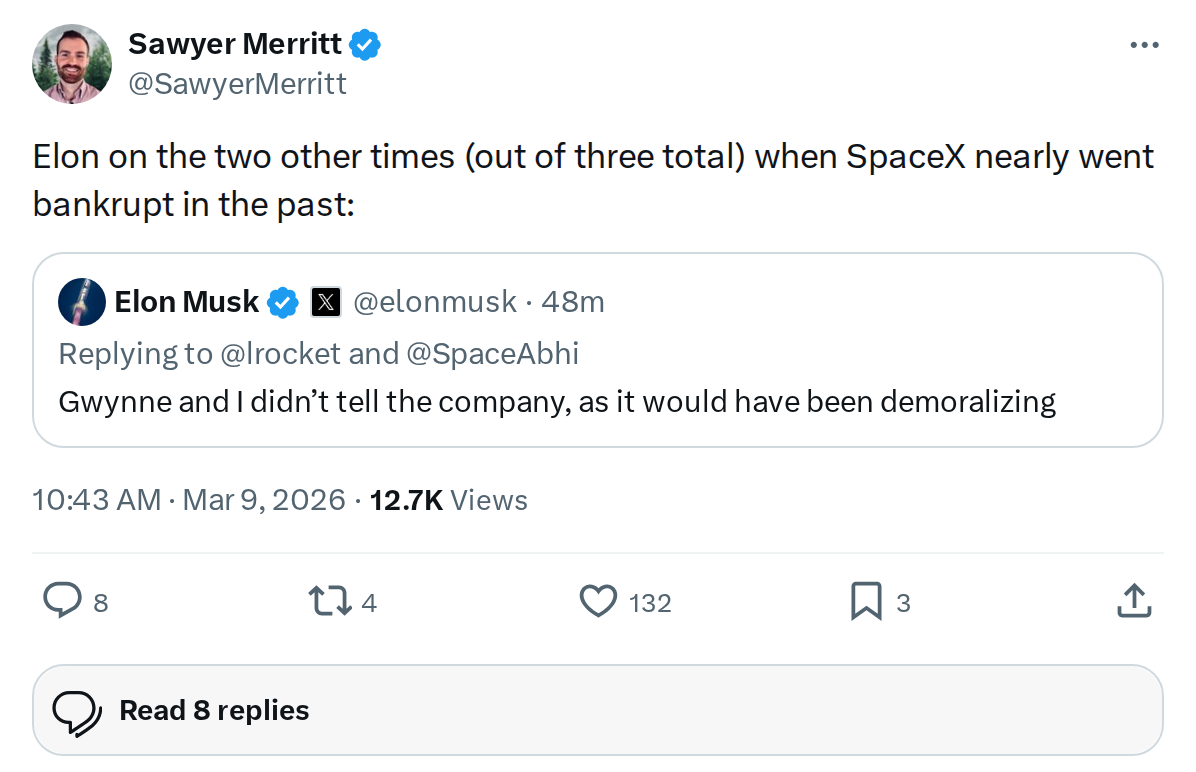
The News: Elon Musk has discussed the two additional times — out of three total — when SpaceX came within striking distance of bankruptcy.
Why It Matters: SpaceX is the backbone of Starlink, which is now a critical revenue engine for Tesla's broader ecosystem and Musk's long-term vision. Understanding how close it came to not existing at all reframes just how improbable the company's current dominance really is.
Source: @SawyerMerritt on X

Three Times SpaceX Nearly Died
Most people know SpaceX as the company that routinely lands orbital rockets on drone ships and is building humanity's most powerful launch vehicle. What fewer people fully appreciate is that the company nearly ceased to exist — not once, but at least three times. Musk's latest discussion brings the two lesser-known near-death experiences back into focus.
📊 Key Figures
| Crisis | Year | Key Metric | What Saved It |
|---|---|---|---|
| Falcon 1 Failures | 2008 | 3 consecutive launch failures; $100M personal investment exhausted | 4th Falcon 1 reaches orbit; $1.6B NASA CRS contract |
| Raptor Engine Crisis | Late 2021 | Production rate critically below target; Starlink V1 financially weak | Emergency production ramp; Starship program acceleration |
Crisis #1 — 2008: The Falcon 1 Gauntlet
The first and most widely documented crisis came in 2008. SpaceX had burned through the $100 million Musk personally invested to fund the company's early launches, and the first three Falcon 1 flights had all failed. The company was, by any conventional measure, out of road.
Everything hinged on a fourth launch. In September 2008, Falcon 1 successfully reached orbit — the first privately developed liquid-fueled rocket to do so. Within months, NASA awarded SpaceX a $1.6 billion contract for 12 Commercial Resupply Services flights to the International Space Station. Musk has since confirmed the sequence of events bluntly: "It's true." Without that fourth flight, SpaceX would have been wound down before Falcon 9 ever existed.
Crisis #2 — Late 2021: The Raptor Production Emergency
The second near-bankruptcy is less cinematic but arguably more instructive about how fragile even a successful rocket company can be. In a November 2021 internal memo, Musk warned SpaceX employees directly that the company faced a "genuine risk of bankruptcy" if it could not dramatically accelerate Raptor engine production for the Starship program.
The memo described the Raptor production crisis as "much worse than it had seemed a few weeks ago." The core problem was financial interdependence: the existing Starlink V1 satellite constellation was described as "financially weak," and the more capable — and commercially viable — Starlink V2 satellites required Starship to launch them. No Starship, no V2. No V2, no sustainable Starlink revenue. No Starlink revenue, no SpaceX.
Musk set a target of launching Starship at least once every two weeks through 2022 to avoid the death spiral. He later clarified publicly that while bankruptcy was "unlikely," it was "not impossible" if a severe global recession cut off capital access while the company was burning billions on both Starlink and Starship simultaneously.
🔭 The BASENOR Take
Timeline: Crisis 1 — 2008 | Crisis 2 — Late 2021 | Current status — Operational and dominant
Impact Level for Tesla Owners: Medium — Contextual / Long-term relevance
Confidence in sourcing: High — Multiple verified primary accounts; Musk's own words on record
Why does SpaceX's financial history matter to Tesla owners specifically? Because Starlink and SpaceX are not separate from the Tesla story — they are deeply intertwined with Musk's resource allocation, attention, and long-term capital strategy. A SpaceX that collapsed in 2008 or 2021 would have fundamentally altered the trajectory of everything else Musk was building, including Tesla.
The 2021 Raptor crisis is particularly worth understanding. It reveals that even after SpaceX had become a credible, NASA-contracted launch provider, the company's survival was still contingent on executing a single, extraordinarily complex engineering program on schedule. The margin for error at the frontier of aerospace is razor-thin — and the same engineering-first, production-rate-obsessed culture that pulled SpaceX through that crisis is the same culture Musk has repeatedly tried to instill at Tesla's Gigafactories.
For those following our SpaceX coverage, this discussion also reframes the current Starship program. Every successful Starship flight today is built on the foundation of two near-misses that most of the public never fully registered when they happened. The company that is now routinely catching Super Heavy boosters with mechanical arms came within a single rocket launch — and a single production memo — of never reaching this point at all.
📰 Deep Dive
What makes Musk's framing notable is the phrasing: two other times, out of three total. That implies there is a third near-bankruptcy event that has been discussed separately — likely the well-documented 2008 crisis being counted as the first, with the 2021 Raptor memo representing the second, and a third event that may relate to the early Starlink deployment period or another internal crisis not yet fully public. The exact sequencing Musk uses matters, and it suggests there may be more detail in the original discussion worth examining closely.
The 2008 survival story has become something of a founding myth in Silicon Valley — the fourth launch as a metaphor for perseverance. But the 2021 memo is a different kind of story. It is a warning issued from inside a company that had already proven it could reach orbit, already won NASA contracts, and was already launching astronauts. The fact that even that version of SpaceX was one bad production quarter away from insolvency is a sobering data point about the economics of building at the frontier of space technology.
For Tesla owners and investors watching Musk's portfolio of companies, the pattern is consistent: Musk has repeatedly placed his companies in positions of existential risk in pursuit of ambitious timelines, and has — so far — navigated out of each crisis through a combination of engineering execution, personal capital deployment, and well-timed external contracts. Whether that pattern holds as the scale of ambition continues to grow is the central question surrounding every company he leads.
🚀 Following the Starship program? See every test flight, official outcome and the next launch window in our SpaceX Starship Tracker.
Sources & reporting notes
The links below identify the material source records used for this report.
- @SawyerMerritt on X (2026-03-09T02:43:59.000Z) — Direct source
Source links are preserved as published or accessed. See our editorial standards and corrections policy.
The BASENOR Editorial Desk covers Tesla, SpaceX, and related technology, curating reporting from primary sources — official accounts, regulatory filings, and software release data. Every article passes source-record and fact-checking review before publication. About the newsroom.
This report was curated by the BASENOR Editorial Desk from the sources listed above. Read our editorial standards or email editorial@basenor.com to report an error.