The News: SpaceX has confirmed Super Heavy Booster 19 is ready for a multi-day preflight test campaign at the newly activated Orbital Launch Pad 2 at Starbase, Texas — the first time a Super Heavy booster equipped with Raptor 3 engines will be tested on the pad.
Why It Matters: Raptor 3 represents a generational leap in engine performance. This test campaign validates both the new engine and a brand-new launch pad simultaneously — two firsts at once. Success here clears the path toward Starship's next integrated flight.
Sources: @SpaceX · @NASASpaceflight · @SawyerMerritt
Super Heavy Booster 19 Rolls to Pad 2
SpaceX announced on March 9, 2026 that Super Heavy Booster 19 (B19) is ready to begin preflight testing — and this isn't a routine checkout. B19 is the first Super Heavy booster to carry next-generation Raptor 3 engines, and it's sitting on Orbital Launch Pad 2, a facility that has never before been used for a hot-fire test. Two firsts, one campaign.

B19 was rolled to Pad 2 on March 7, 2026, arriving with a partial load of 10 Raptor 3 engines installed. The testing sequence, as outlined by SpaceX and corroborated by NASASpaceflight, will progress through several stages over the coming days.

📊 Key Figures
| Metric | Value | Context |
|---|---|---|
| Raptor 3 Thrust (sea level) | 280 metric tons | Target: >300 tf |
| Specific Impulse | 350 seconds | Best-in-class for a full-flow staged combustion engine |
| Chamber Pressure | 350 bar | Achieved in ground testing |
| Engine Mass | 1,525 kg | 1,720 kg incl. vehicle-side hardware |
| Cumulative Run Time | >40,000 seconds | As of February 2, 2026 |
| Engines on B19 (test config) | 10 | Partial load; static fire will use all 10 |
| V3 Booster Height vs V2 | +1.5 meters | Taller airframe with integrated hot stage ring |
| Grid Fin Size vs V2 | ~50% larger | 3 fins per booster on V3 design |
The Test Sequence: What's Coming This Week
According to NASASpaceflight, which tracks Starbase operations closely, the test campaign will follow a progressive path designed to validate both the booster and the new pad infrastructure simultaneously:
Booster 19 Test Sequence at Pad 2
Systems checkout with no propellant — validating pad connections, ground support equipment, and vehicle interfaces at Pad 2 for the first time.
First cryogenic prop loads at Pad 2, exercising the new propellant loading systems SpaceX explicitly called out as a test objective.
The headline event: the first-ever ignition of a Super Heavy booster running Raptor 3 engines. All 10 installed engines will fire simultaneously.
After testing, B19 is expected to return to the integration tower for remaining engine installation before flight.

New Photos: Booster Version 3 Up Close
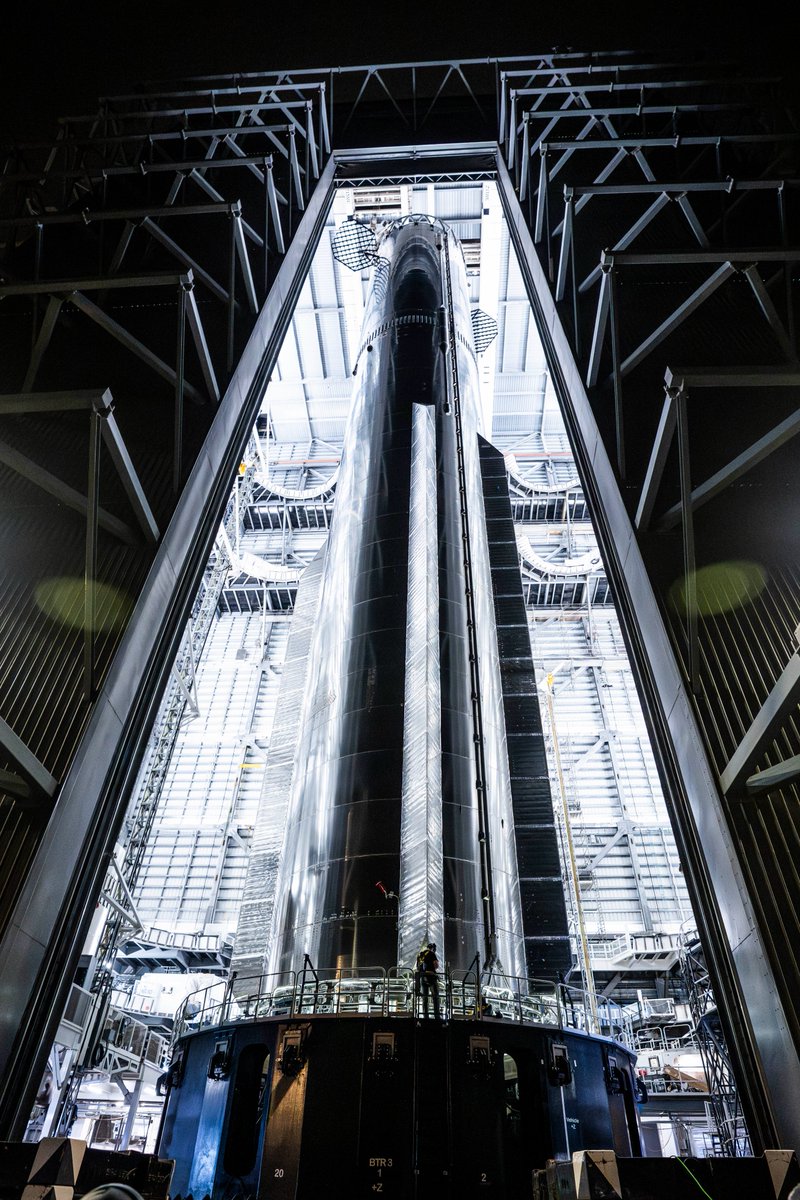
New photos of the Super Heavy V3 booster surfaced alongside the SpaceX announcement, giving the clearest look yet at the updated airframe. The V3 design is visually distinct from its predecessors — it stands approximately 1.5 meters taller than V2, features an integrated hot stage ring, and carries three enlarged grid fins that are roughly 50% larger than those on V2 boosters.

What Is Raptor 3 and Why Does It Matter?
Raptor 3 isn't just an incremental upgrade — it's a fundamental redesign of one of the most advanced rocket engines ever built. SpaceX has consolidated the engine's external plumbing and sensors directly into the main structure, dramatically simplifying the design and reducing potential failure points. The result is a cleaner, lighter engine that's easier to manufacture at scale.
The performance numbers back up the redesign. At 280 metric tons of thrust with a specific impulse of 350 seconds, Raptor 3 already exceeds the performance of earlier variants — and SpaceX's stated goal is to push beyond 300 tons of thrust with a thrust-to-weight ratio greater than 200. With over 40,000 seconds of accumulated ground test time as of February 2026, the engine has earned its place on a flight vehicle. This week's static fire will be the first time that accumulated confidence translates to pad-level validation.
🔭 The BASENOR Take
This test campaign is a convergence of multiple program milestones that SpaceX has been building toward for months. Pad 2's activation is strategically significant: with Pad 1 undergoing redesigns to meet new standards, having a second operational launch pad gives SpaceX redundancy and the ability to sustain a higher flight cadence going forward.
The Raptor 3 static fire is arguably the more consequential milestone. SpaceX has invested enormous engineering effort into this engine generation, and pad-level validation with an actual flight booster is the final proof point before it goes on a mission. The fact that B19 arrives with only 10 of its eventual full complement of engines is deliberate — it reduces risk for first-time pad operations while still providing a meaningful multi-engine test.
Meanwhile, Ship 39 — the first V3 upper stage prototype — successfully completed cryoproof tests on March 8, 2026. Both halves of the next Starship stack are progressing in parallel. The question is no longer whether Raptor 3 works; SpaceX has logged the run time to prove it does. This week is about proving it works at the pad, with the full ground system, under real flight-preparation conditions. That's the last box to check before integrated flight testing resumes.
📰 Deep Dive
The activation of Pad 2 is more than a logistical milestone — it signals SpaceX's intent to build a genuine launch cadence at Starbase. Orbital Launch Pad 1 has handled every Starship integrated flight test to date, but its current redesign means it's temporarily out of rotation. Pad 2 stepping in ensures the program doesn't stall. More importantly, once both pads are operational, SpaceX gains the infrastructure to support the kind of rapid reuse turnaround that makes Starship's economics work.
The choice to test B19 with only 10 Raptor 3 engines rather than a full complement is a textbook example of SpaceX's iterative risk management. By limiting the number of new engines firing simultaneously during first-time pad operations, the team can isolate any anomalies to either the pad systems or the engines without compounding variables. After this campaign, B19 is expected to return to the integration tower to receive the remaining engines before being cleared for flight.
For those tracking the broader Starship program, the parallel progress of Ship 39 — which cleared cryoproof testing just one day before this announcement — suggests SpaceX is actively managing both halves of the stack toward a common flight readiness date. The Raptor 3 era isn't approaching. Based on what's happening at Starbase this week, it's already here. Follow our SpaceX coverage for updates as the static fire window opens.
🚀 Following the Starship program? See every test flight, official outcome and the next launch window in our SpaceX Starship Tracker.
Sources & reporting notes
The links below identify the material source records used for this report.
- @SawyerMerritt on X (2026-03-09T14:51:17.000Z) — Direct source
- @NASASpaceflight on X (2026-03-09T14:53:28.000Z) — Direct source
- @SpaceX on X (2026-03-09T14:50:16.000Z) — Direct source
- @SpaceX on X (2026-03-09T14:49:29.000Z) — Direct source
Source links are preserved as published or accessed. See our editorial standards and corrections policy.
The BASENOR Editorial Desk covers Tesla, SpaceX, and related technology, curating reporting from primary sources — official accounts, regulatory filings, and software release data. Every article passes source-record and fact-checking review before publication. About the newsroom.
This report was curated by the BASENOR Editorial Desk from the sources listed above. Read our editorial standards or email editorial@basenor.com to report an error.