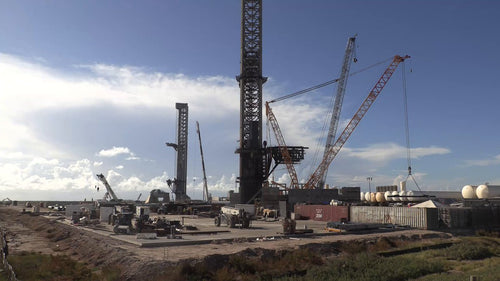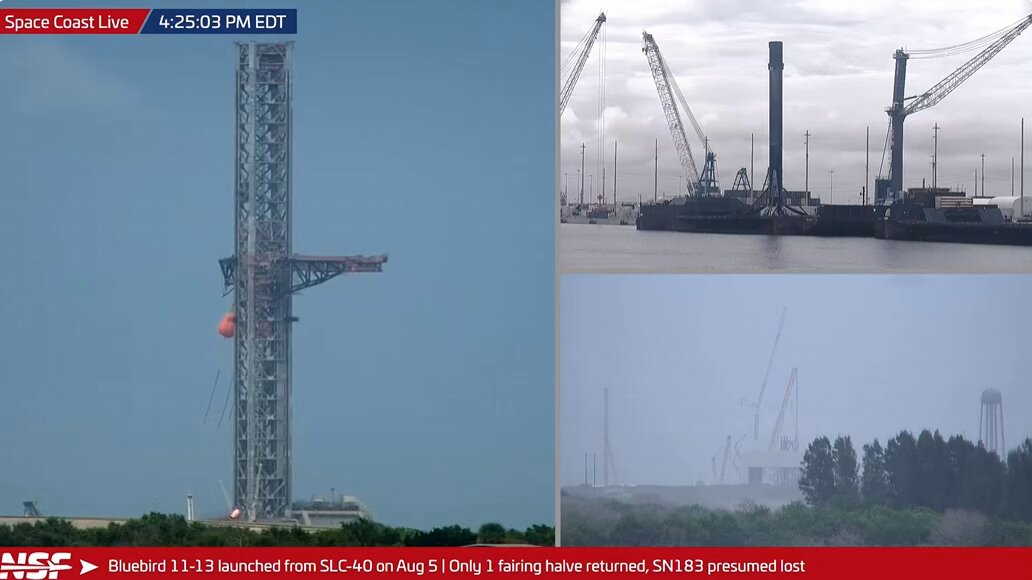
SpaceX has brought its ballast ball load-testing rig to Launch Complex 39A at Kennedy Space Center, where engineers are stress-testing the Mechazilla tower's chopstick arms — the same catch system that will be responsible for grabbing returning Super Heavy boosters in Florida. The activity, spotted and reported by NASASpaceflight on August 7, marks a concrete step toward the first Starship launch from the East Coast.

What the Ballast Balls Actually Do
The "infamous ballast balls" are a load-testing method SpaceX has used previously at its Starbase facility in Boca Chica, Texas. The technique involves hanging weighted spheres from the chopstick arms to simulate the enormous mechanical stress the arms will experience when catching a returning Super Heavy booster — a vehicle that stands roughly 70 meters tall and weighs hundreds of tonnes even after propellant is expended. Before any catch attempt can be trusted with real hardware, the structural integrity of the arms must be verified under controlled, measurable loads. The ballast ball approach lets engineers dial in precise force values and confirm the system behaves within design tolerances.
The fact that this same methodology is now being applied at LC-39A signals that the Florida tower has reached a stage of construction where structural validation is the next logical gate. You don't load-test a system that isn't close to ready.
Why LC-39A Is a Big Deal for Starship
SpaceX's Starbase site in Texas has been the exclusive home of Starship flight testing since the program began. LC-39A changes that equation significantly. According to reporting from Space.com and Teslarati, the FAA approved SpaceX in February 2026 to conduct up to 44 Starship-Super Heavy launches and 88 landings per year from LC-39A — a rate that would be impossible to achieve from a single Texas pad. The approval followed a 16-month environmental review completed in late January 2026.
Infrastructure at LC-39A now includes a launch mount, flame trench, water deluge system, propellant handling systems, and the Mechazilla catch tower. SpaceX has also reorganized pad operations at Kennedy Space Center to support this: all Falcon 9 Dragon crew and cargo missions have been shifted to SLC-40, leaving LC-39A dedicated exclusively to Falcon Heavy and Starship. That kind of operational separation doesn't happen unless a launch cadence is genuinely expected.
SpaceX is targeting a first Starship launch from LC-39A before the end of 2026, according to verified reporting.
Context From the Texas Program
Mechazilla's chopstick catch system has already proven itself at Starbase. SpaceX successfully caught the Super Heavy booster with the tower arms in October 2024, then repeated the feat in March 2025. Those catches validated the core concept — but each new tower is its own engineering system that must be independently certified.
The Texas program is also pushing the envelope further. On August 4, 2026, Elon Musk stated that SpaceX plans to attempt catching the Starship upper stage — the Ship itself — with the tower on its 14th test flight, tentatively scheduled for late August, pending regulatory approval. That attempt will happen at Starbase, not LC-39A, but it underscores how rapidly the catch-and-reuse architecture is maturing across the program.
Load testing the Florida chopsticks now, while the Texas team prepares for a Ship catch, suggests SpaceX is deliberately advancing both sites in parallel rather than waiting for one to fully prove out before investing in the other.
What Comes After Load Testing
Structural load testing is typically followed by dynamic testing, fit checks with actual hardware interfaces, and eventually full system integration reviews before a tower is cleared for operational use. None of those steps happen overnight, but the presence of ballast ball testing at LC-39A in early August is consistent with a late-2026 first launch target. The critical path items — FAA approval, infrastructure construction, and now structural validation — are checking off in sequence.
For the broader Starship program, a second operational launch site isn't just a redundancy play. It's the foundation of the launch cadence SpaceX needs to support NASA's Artemis lunar missions, Starlink V3 constellation deployment, and eventual point-to-point commercial flights. The ballast balls at LC-39A are, in that sense, a small but tangible sign that the Florida chapter of Starship is moving from construction to certification. For more on the Starship program's trajectory, see our SpaceX coverage.
🚀 Following the Starship program? See every test flight, official outcome and the next launch window in our SpaceX Starship Tracker.
Sources & reporting notes
The links below identify the material source records used for this report.
- @NASASpaceflight on X (2026-08-07T20:32:14.000Z) — Direct source
Source links are preserved as published or accessed. See our editorial standards and corrections policy.
The BASENOR Editorial Desk covers Tesla, SpaceX, and related technology, curating reporting from primary sources — official accounts, regulatory filings, and software release data. Every article passes source-record and fact-checking review before publication. About the newsroom.
This report was curated by the BASENOR Editorial Desk from the sources listed above. Read our editorial standards or email editorial@basenor.com to report an error.