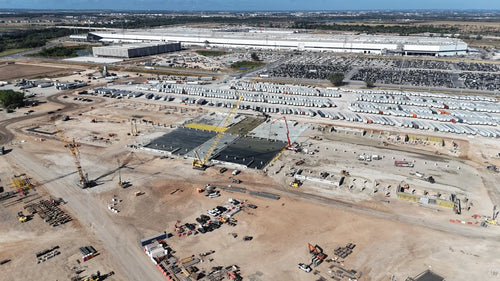
SpaceX is stacking Starship vehicles faster than it is flying them. Ship 41 rolled to the launch site at Starbase on September 23 — the vehicle slated to attempt the program's first orbital flight as early as Monday, September 28 — while Ship 44 was simultaneously being readied for stacking in Mega Bay 2. The back-to-back production tempo signals that SpaceX is no longer treating each vehicle as a one-off prototype.

What Flight 14 Is Actually Attempting
This is not another suborbital hop or high-altitude test. According to SpaceX's published mission profile, Ship 41 paired with Super Heavy Booster 21 (B21) is targeting a genuine orbital flight — approximately 275 kilometers altitude, roughly six orbits, and a mission duration of nearly 10 hours. The payload manifest includes 26 Starlink V3 satellites, which would mark the first orbital deployment of next-generation V3 hardware from a Starship. Each V3 satellite is rated at 1 Tbps of capacity, making this a commercially meaningful demonstration, not just an engineering shakedown.
The September 28 target (launch window opens 7:15 a.m. CT, 75 minutes long) is pending final FAA sign-off. The previous target date of September 22 slipped, so regulatory timing remains the gating factor rather than vehicle readiness.
For the recovery profile, SpaceX has opted for a controlled splashdown for B21 in the Gulf of Mexico rather than a tower catch, while Ship 41 will execute a deorbit burn and splashdown in the Pacific west of Chile. Both vehicles are expendable on this flight — the orbital objective takes priority over hardware recovery.
The TPS Detail That Matters
NASASpaceflight's coverage also highlighted something easy to overlook: Ship 41 is flying with thermal protection system tiles refurbished from Ship 40. The practice of reusing TPS hardware across vehicles — what NSF calls the "Ship 40 TPS refly on Ship 41" — is a quiet but meaningful shift. Heat shield tiles have historically been a production bottleneck and a post-flight inspection headache for reusable spacecraft programs. SpaceX validating tile reuse at the vehicle level, rather than just individual tile replacement, is an incremental step toward the rapid-reuse cadence the program needs at scale.
The Production Pipeline Is the Real Story
The more telling detail from NASASpaceflight's reporting is not Ship 41's arrival — it's Ship 44 already queuing for stacking in Mega Bay 2 while Ship 41 hasn't launched yet. That is at least three vehicles (S41, S42, S43 presumably in various build stages, S44 entering the stack sequence) in the pipeline simultaneously. For context, the early Starship program saw long gaps between vehicles as SpaceX iterated on design. The current cadence looks closer to how SpaceX runs Falcon 9 production, where vehicles are built ahead of manifest demand rather than to order.
SpaceX's own documentary series — Episode 3 of which dropped alongside this activity — is providing unusual behind-the-scenes visibility into the development process. The combination of public-facing content and accelerating hardware throughput suggests the company is deliberately building a narrative around Starship's maturation as a reliable launch system, not just a test program.
What Comes Next
The immediate watch item is FAA approval for the September 28 window. Booster 21 completed a full 33-engine static fire on August 28 and passed cryogenic proof testing in late July, so the vehicle stack is ready. If the FAA clears the flight and weather cooperates, Flight 14 would be the program's most ambitious mission to date — orbital velocity, satellite deployment, and a 10-hour endurance profile all in one attempt.
With Ship 44 already entering the stacking queue, SpaceX is clearly not waiting to see how Flight 14 goes before pressing forward. That confidence in the production line — or at least the willingness to absorb the cost of parallel builds — is as significant a development signal as anything happening on the launch pad. For more on SpaceX's Starship program, see our SpaceX coverage.
🚀 Following the Starship program? See every test flight, official outcome and the next launch window in our SpaceX Starship Tracker.
Sources & reporting notes
The links below identify the material source records used for this report.
- @NASASpaceflight on X (2026-09-23T02:06:00.000Z) — Direct source
- @NASASpaceflight on X (2026-09-23T02:43:30.000Z) — Direct source
Source links are preserved as published or accessed. See our editorial standards and corrections policy.
The BASENOR Editorial Desk covers Tesla, SpaceX, and related technology, curating reporting from primary sources — official accounts, regulatory filings, and software release data. Every article passes source-record and fact-checking review before publication. About the newsroom.
This report was curated by the BASENOR Editorial Desk from the sources listed above. Read our editorial standards or email editorial@basenor.com to report an error.