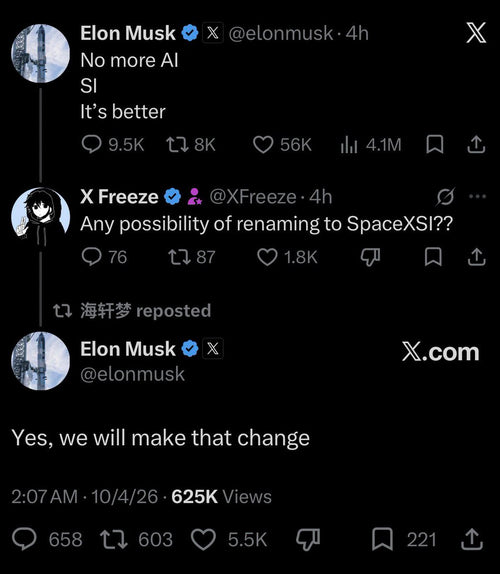
Elon Musk posted a brief link to a "SpaceX company update" on August 12, 2026 — and the 29-minute all-hands video behind it turned out to be one of the most consequential strategic statements the company has made since going public. The headline: artificial intelligence is now positioned to become SpaceX's dominant revenue engine, potentially overtaking Starlink, launch services, and everything else combined before the year is out.

The AI Pivot, by the Numbers
Musk told employees that SpaceX's AI revenue is projected to surpass all other business lines as soon as September 2026, with the gap widening significantly in Q4. The ambition doesn't stop there: SpaceX aims to scale its AI compute capacity from a current 1.4 gigawatts to 10 gigawatts by end of 2027. According to Musk's own projections shared in the meeting, that 10 GW capacity could generate between $300 billion and $500 billion in annual revenue.
To put that in context: Starlink, which has been SpaceX's primary growth story for the past several years, generated revenue in the tens of billions annually. The AI figures Musk cited would represent a step-change in the company's scale entirely.
| Metric | Figure |
|---|---|
| Current AI compute capacity | 1.4 GW |
| Target AI compute capacity (end of 2027) | 10 GW |
| Projected annual AI revenue at 10 GW | $300B – $500B |
| Expected AI revenue leadership | September 2026 |
| Musk's projected AI share of SpaceX value (5-year horizon) | ~99% |
| EchoStar spectrum acquisition value | $19.6B |
Starmind, xAI, and the Infrastructure Behind the Bet
The AI strategy isn't purely theoretical. SpaceX has already acquired xAI — the startup Musk founded in 2023 that developed the Grok chatbot and operates the Colossus supercomputer cluster — folding that compute and model development capability directly into the SpaceX organization. The company's AI megaconstellation has been named Starmind, signaling that the satellite network itself is being repositioned as AI infrastructure, not just communications.
Separately, SpaceX is acquiring $19.6 billion worth of spectrum licenses from EchoStar, a move that significantly expands its direct-to-device capabilities. That deal now reads less like a connectivity play and more like foundational plumbing for an AI-over-satellite delivery model.
Musk's framing during the all-hands was unambiguous: "AI has become an extremely important part of SpaceX's future" and the company "must win on AI, because the future is overwhelmingly AI and robots." He projected that AI will constitute roughly 99% of SpaceX's total value within five years.
The Public Company Context
This update lands at a pivotal moment in SpaceX's corporate history. The company released its Q2 2026 earnings on August 4 — its first earnings report as a public company — and shares rose 21% following the lockup expiration on 911.5 million insider shares, defying widespread expectations of a selloff. That stock performance gives Musk a strong platform from which to make bold forward-looking claims to employees and investors alike.
The all-hands also touched on SpaceX's longer-term ambitions beyond Earth orbit. Musk reaffirmed the goal of making lunar travel broadly accessible, referencing "Moonbase Alpha" and noting that Starship is designed to deliver up to 100 tons of cargo directly to the lunar surface. In February 2026, he had already announced a strategic reprioritization toward establishing a self-sustaining lunar city before scaling Mars operations — and that sequencing appears unchanged.
What This Means Going Forward
For anyone tracking SpaceX as a public company, the signal from this update is clear: the investment thesis has shifted. Starlink remains a massive, cash-generating business, and Starship remains the long-term infrastructure play for interplanetary ambitions. But AI compute — delivered via Starmind, powered by xAI's models, and running on a rapidly scaling gigawatt-class infrastructure — is now where SpaceX is placing its largest strategic bet.
Whether the $300B–$500B revenue projection materializes on Musk's timeline is a separate question. What's not in doubt is that SpaceX is no longer just a rocket company, or even just a satellite internet company. The all-hands framing suggests the company sees itself competing in a market that didn't exist for it two years ago — and believes it can win it. For more on SpaceX's trajectory, see our SpaceX coverage.
Sources & reporting notes
The links below identify the material source records used for this report.
- @elonmusk on X (2026-08-12T05:21:20.000Z) — Direct source
Source links are preserved as published or accessed. See our editorial standards and corrections policy.
The BASENOR Editorial Desk covers Tesla, SpaceX, and related technology, curating reporting from primary sources — official accounts, regulatory filings, and software release data. Every article passes source-record and fact-checking review before publication. About the newsroom.
This report was curated by the BASENOR Editorial Desk from the sources listed above. Read our editorial standards or email editorial@basenor.com to report an error.