Turbine blades are among the most punishing components in any rocket engine — spinning at extreme speeds inside a furnace of superheated gas — and SpaceX spent years trying to stop them from cracking. A candid reply from Elon Musk this week put that engineering struggle on the record, while a separate report and a recently surfaced job listing reveal how SpaceX plans to solve the problem at scale: by building its own dedicated blades and vanes foundry.
The Cracking Problem, in Musk's Own Words
Musk's reply — "We spent so many years on the turbine blade cracking problem" — is brief, but the weight of it is real. Turbine blade failures are not a niche concern. In high-performance rocket engines like the Raptor, turbine blades in the turbopumps operate under thermal and mechanical stresses that push materials to their absolute limits. A crack propagating through a blade can cascade into a catastrophic engine failure in milliseconds.
The fact that SpaceX spent years on this specific failure mode — not months, years — speaks to how genuinely hard the problem is. It also helps explain why SpaceX has historically been reluctant to outsource critical propulsion components: when the tolerances are this tight, supply chain dependencies become existential risks.
A Factory Built Around the Problem
The engineering effort Musk described isn't just historical. According to a report from The Information, SpaceX is now building a dedicated turbine-blade factory — a facility purpose-built to manufacture these components in-house at production scale.
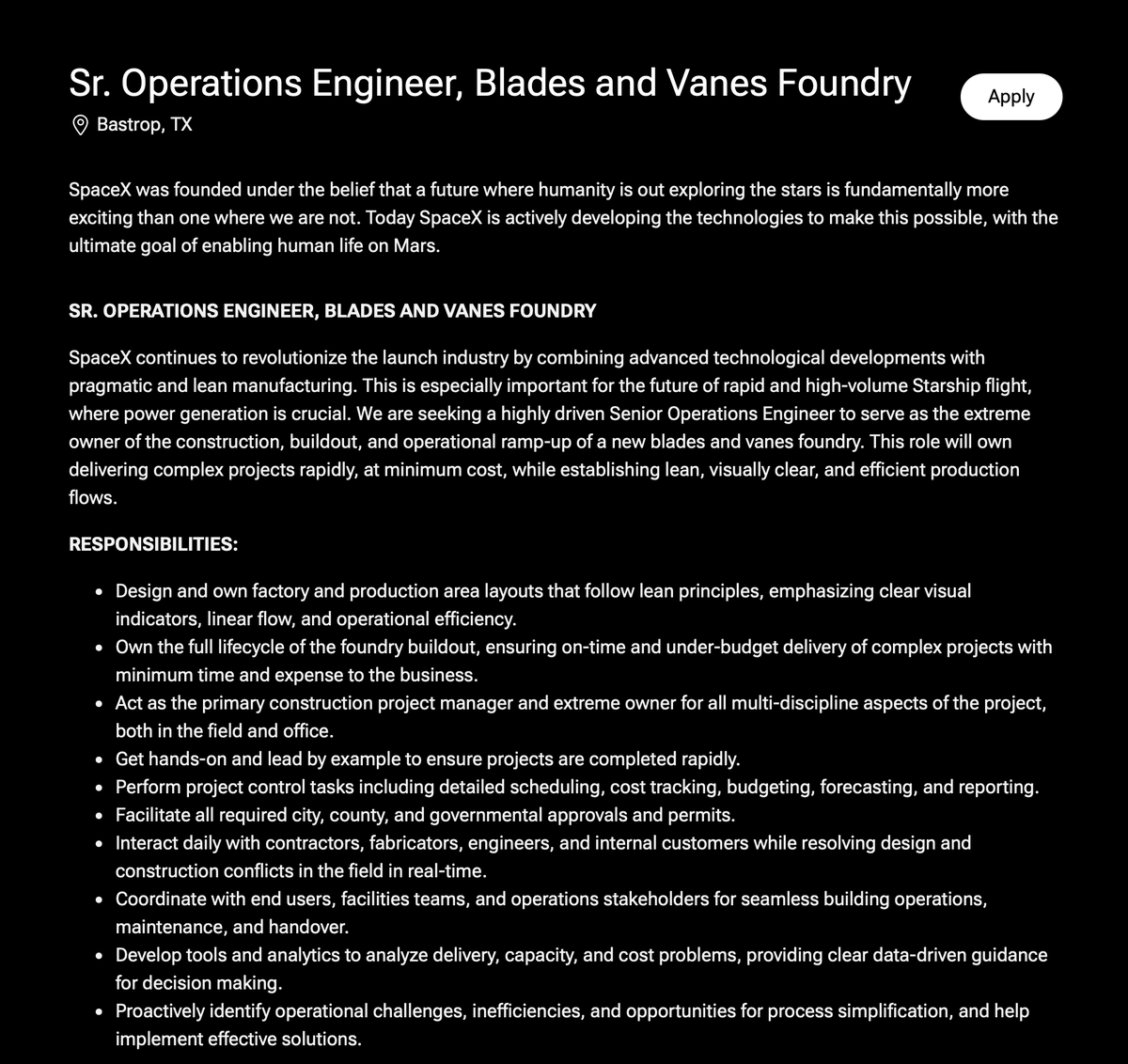
That report, as commentator Sawyer Merritt noted, wasn't entirely a surprise. SpaceX had already posted a job listing for a Senior Operations Engineer to lead a blades and vanes foundry — responsible for "the construction, buildout, and operational ramp-up" of the facility. The listing predates The Information's reporting by several months, meaning the factory plan was already in motion well before it became public news.

Why This Investment Makes Strategic Sense
SpaceX's decision to vertically integrate turbine blade manufacturing follows the same logic that drove it to build its own Merlin engines, design its own avionics, and manufacture its own carbon fiber structures. Third-party aerospace suppliers operate on long lead times, conservative design cycles, and pricing structures that don't match SpaceX's iteration pace.
For the Raptor engine — which SpaceX needs in the hundreds to fully outfit Starship — turbine blade supply is a genuine production bottleneck. A dedicated foundry gives SpaceX direct control over material composition, casting geometry, heat treatment, and quality inspection. More importantly, it allows engineers to iterate on blade design rapidly when new cracking modes are discovered, rather than waiting months for a supplier to produce revised parts.
The job listing's language — "extreme owner" of the buildout and ramp-up — is consistent with SpaceX's internal culture of moving fast and treating manufacturing as an engineering discipline, not a logistics one.
What It Signals for Starship's Production Trajectory
Starship's long-term ambition — Mars colonization, point-to-point Earth transport, Starlink satellite deployment — requires a Raptor engine that can be manufactured reliably and cheaply at scale. Turbine blades are a critical node in that supply chain. Solving the cracking problem in the lab is one thing; solving it at a foundry producing hundreds of blades per month is an entirely different engineering and operational challenge.
The combination of Musk's admission about the years spent on the problem and the concrete steps now being taken to own that manufacturing process suggests SpaceX views turbine blade production as a solved-enough problem to industrialize — and a strategic asset worth protecting. Whether the new foundry comes online in time to support Starship's next major production ramp will be worth watching closely.
🚀 Following the Starship program? See every test flight, official outcome and the next launch window in our SpaceX Starship Tracker.
Sources & reporting notes
The links below identify the material source records used for this report.
- @elonmusk on X (2026-08-29T23:24:23.000Z) — Direct source
- @SawyerMerritt on X (2026-08-29T23:54:51.000Z) — Direct source
Source links are preserved as published or accessed. See our editorial standards and corrections policy.
The BASENOR Editorial Desk covers Tesla, SpaceX, and related technology, curating reporting from primary sources — official accounts, regulatory filings, and software release data. Every article passes source-record and fact-checking review before publication. About the newsroom.
This report was curated by the BASENOR Editorial Desk from the sources listed above. Read our editorial standards or email editorial@basenor.com to report an error.