30-Second Brief
The News: SpaceX successfully completed a full water deluge test at Starbase Orbital Launch Pad 2 in Boca Chica, Texas, validating the pad's readiness for Starship Flight 12 operations.
Why It Matters: Pad 2 is the launch site for Starship Flight 12 — the first-ever flight of the Block 3 Super Heavy booster and V3 Starship. Clearing this milestone puts SpaceX on track for an early March 2026 launch attempt.
Source: @NASASpaceflight on X
Starbase Pad 2 Passes Full Water Deluge Test — Starship Flight 12 is Getting Very Close
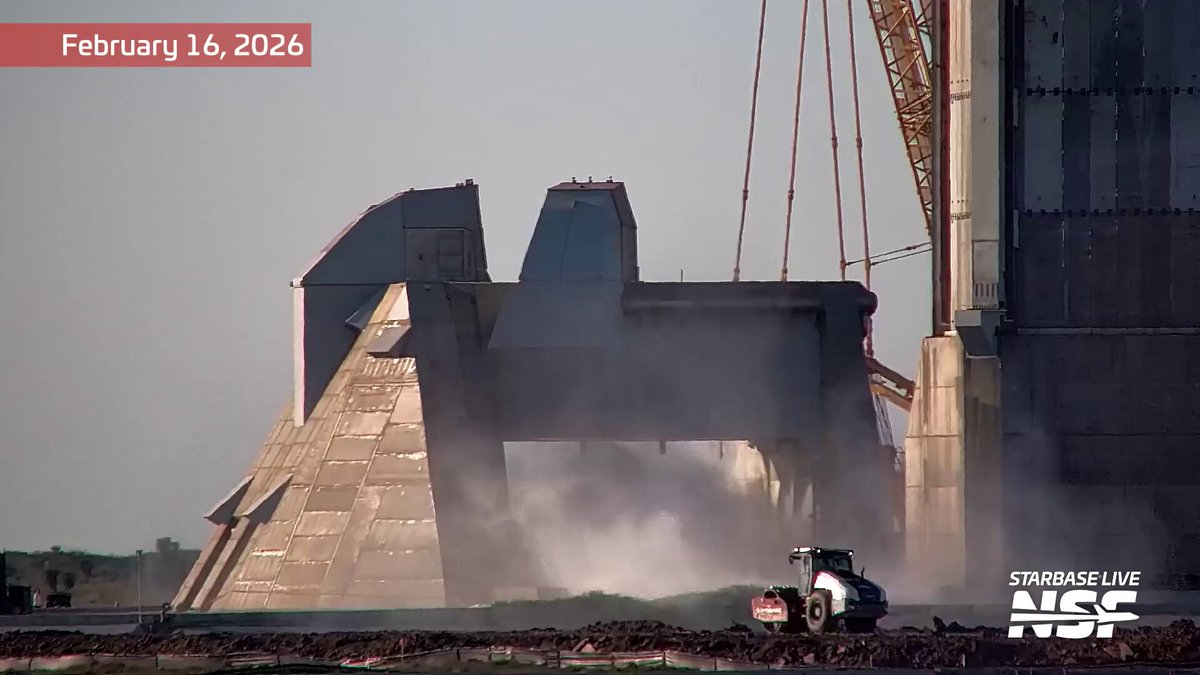
SpaceX has completed a full water deluge system test at Starbase Orbital Launch Pad 2, clearing one of the final major infrastructure hurdles before Starship Flight 12. The successful test — captured in striking footage — validates that the pad's fire suppression system can handle the brutal acoustic and thermal forces generated by Super Heavy's 33 Raptor 3 engines. Next up: hosting Booster 19 for its static fire sequence.

📊 Key Figures
| Metric | Detail | Context |
|---|---|---|
| Water Capacity | ~350,000 gallons | Higher volume than Pad 1 system |
| Super Heavy Thrust | ~17 million lbs | Generated by 33 Raptor 3 engines |
| Raptor 3 Engine Inventory | 3 full stacks | Enough to outfit three complete Starship vehicles |
| Target Launch Window | Early March 2026 | Per Elon Musk; pending static fire results |
| Booster 19 Grid Fins | 3 (down from 4) | Part of Block 3 design changes |
🔭 The BASENOR Take
Timeline
Early March 2026
Impact Level
High — Direct path to Flight 12
Confidence
Medium-High — Static fire still pending
A successful water deluge test is not a headline milestone most news outlets bother covering — but it matters enormously to the launch schedule. Without it, no static fire. Without a static fire, no Flight 12.
Why Pad 2 Is a Bigger Deal Than Pad 1
Pad 1 — the original Starbase launch mount — was essentially rebuilt from scratch after Starship's first integrated flight test in April 2023 left it heavily damaged. The lack of a water deluge system on Pad 1 at that point was a hard lesson. Pad 2 was engineered from the ground up with those lessons baked in.
According to reporting by NASASpaceflight, Pad 2's deluge architecture is significantly more capable than Pad 1's retrofit system. The flame trench features an advanced diverter-shaped structure that discharges water simultaneously from the flame bucket halves, ridge, and a steel plate on top of the launch mount. The system operates at higher pressures and greater volume — essential when you're dealing with approximately 17 million pounds of thrust from 33 Raptor 3 engines at ignition.
Perhaps the most operationally significant upgrade: embedded sump pumps in the flame trench allow the pad to be rapidly drained and reset for retesting. On Pad 1, turnaround between tests took considerably longer. Pad 2 is designed for a cadence, not just a single flight.
What's Actually Flying on Flight 12
This isn't an incremental update to an already-flown configuration. Flight 12 marks the debut of two firsts simultaneously:
- Booster 19 — the first Block 3 Super Heavy. It features Raptor 3 engines, an integrated interstage, and a redesigned three-grid-fin configuration (previous boosters used four). It recently completed cryogenic proof testing.
- Ship 39 — confirmed as the first Version 3 Starship upper stage, in production since at least March 2025.
The previous booster slated for Flight 12, Booster 18, was scrapped after it sustained severe damage during ground testing in November 2025. That setback pushed the schedule, and Booster 19 became the replacement. SpaceX's Raptor 3 engine inventory — sufficient for three complete stacks as of February 2026 — means the production pipeline is not the bottleneck here.
📰 Deep Dive
The sequence from here is predictable but not guaranteed: Booster 19 rolls to Pad 2, a static fire is conducted to verify all 33 Raptor 3 engines ignite correctly under real launch conditions, the data is reviewed, and — if results are clean — SpaceX files for a launch license and targets its early March window. Any anomaly during the static fire could reset that timeline by weeks.
What makes this moment genuinely significant is the convergence of hardware and infrastructure maturity. SpaceX is not just testing a rocket — it is commissioning an entirely new launch facility designed to support a much higher flight cadence than Pad 1 alone can provide. A fully operational Pad 2 means SpaceX can, in theory, have one vehicle being prepped while another is already on the pad. That is the kind of operational tempo required for the Starship program's long-term ambitions.
For context on the scale of what SpaceX has built: the water deluge system alone processes roughly 350,000 gallons in a single firing sequence. The fact that it can be reset rapidly via the embedded sump pump system is not just a convenience — it is a fundamental shift in how quickly teams can troubleshoot and retest without rolling hardware back to the build site.
With the water deluge test now in the books, the critical path to Flight 12 runs directly through Booster 19's static fire. SpaceX has consistently compressed timelines when hardware and infrastructure are both ready. The early March 2026 target is ambitious but within reach — assuming the static fire goes cleanly.
🚀 Following the Starship program? See every test flight, official outcome and the next launch window in our SpaceX Starship Tracker.
Sources & reporting notes
The links below identify the material source records used for this report.
- @NASASpaceflight on X (2026-02-19T01:34:51.000Z) — Direct source
Source links are preserved as published or accessed. See our editorial standards and corrections policy.
The BASENOR Editorial Desk covers Tesla, SpaceX, and related technology, curating reporting from primary sources — official accounts, regulatory filings, and software release data. Every article passes source-record and fact-checking review before publication. About the newsroom.
This report was curated by the BASENOR Editorial Desk from the sources listed above. Read our editorial standards or email editorial@basenor.com to report an error.