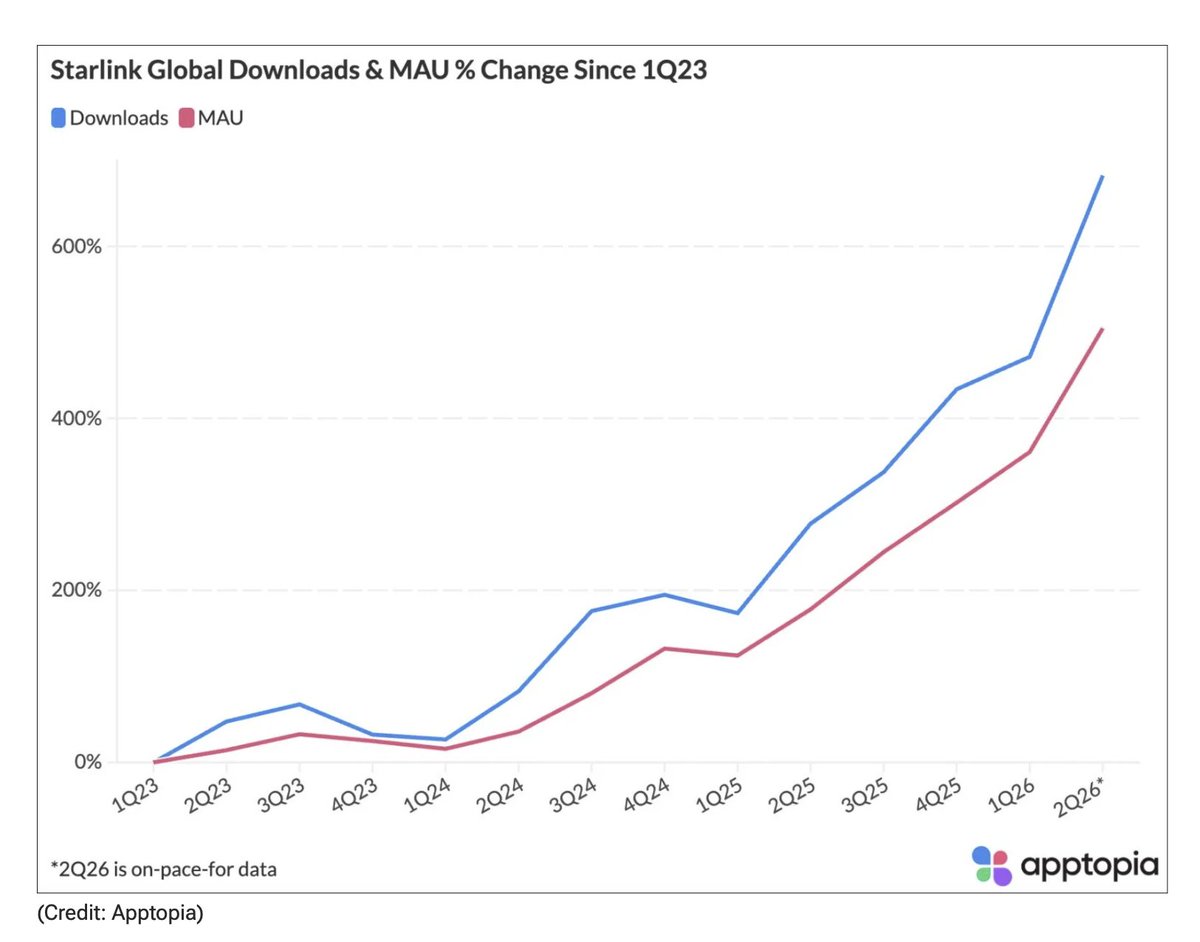
Starlink's user growth isn't just continuing — it's compounding. According to app analytics firm Apptopia, the Starlink mobile app has been hitting new monthly download records consistently through 2026, and June is on track to be the biggest month yet, with 3.8 million downloads projected. That's more than double the pace from a year ago, and the acceleration shows no sign of plateauing.

The Numbers Behind the Acceleration
Apptopia's PR director Adam Blacker put it plainly: downloads have been hitting new monthly highs consistently, and June is on pace to do the same. But the raw trajectory is what makes this story worth paying attention to.
| Period | Downloads | YoY Change |
|---|---|---|
| Q4 2025 | 2.6M | — |
| Q1 2026 | 2.78M | +109% YoY |
| Q2 2026 (projected) | 3.8M | ~+111% YoY est. |
| vs. Q1 2023 | — | +682% since Q1 2023 |
US downloads alone spiked 223% year-over-year in Q1 2026, reaching 1.2 million — the highest single-quarter domestic figure on record, according to Apptopia data. Monthly active users are tracking similarly, with global MAUs more than doubling year-over-year in Q1 2026, and US MAUs up nearly 150% over the same period.
12 Million Customers and Counting
The app download surge doesn't exist in a vacuum. On June 4, Starlink officially confirmed 12 million active customers across more than 160 countries — up from 9 million just nine months earlier. The pace of net additions has been extraordinary: after reaching 10.2 million in March 2026, Starlink added roughly 27,700 new customers per day on average, hitting 12 million in approximately 53 days.
Brazil has emerged as a particularly striking growth market. According to Apptopia data, Brazil's monthly active users surged approximately 450% year-over-year in Q1 2026, and the country now accounts for 13% of Starlink's global user base — up from under 5% a year ago. That kind of geographic diversification matters: it signals that Starlink's growth is no longer primarily a US phenomenon.

Direct-to-Cell Is Adding Another Layer
Starlink Mobile — the Direct-to-Cell service that works through partner carriers without any hardware — is running on a separate but equally aggressive growth curve. As of March 2026, 16 million unique users had accessed Starlink Mobile through partner carriers worldwide, with 10 million active monthly. SpaceX has projected adding 52,000 new Starlink Mobile users per day throughout 2026, targeting 25 million active users by year-end.
That's a meaningful distinction: traditional Starlink requires a dish and a subscription. Direct-to-Cell lowers the barrier to entry dramatically, and its user numbers suggest it's pulling in a different — and much larger — addressable market.
What's Driving the Curve
App download velocity is a leading indicator, not a lagging one. People download the app before they subscribe, before they order hardware, before they commit. Consistently breaking monthly records through the first half of 2026 — with June on pace to outpace every prior month — suggests the top of the funnel is widening faster than at any point in the service's history.
The combination of expanding geographic availability, Direct-to-Cell partnerships with major carriers, and growing awareness in markets like Brazil and Southeast Asia appears to be compounding simultaneously. Whether the conversion rate from download to paid subscriber holds at historical levels will determine how quickly Starlink closes the gap toward its 25 million active user target by end of 2026. At the current pace of roughly 27,700 net additions per day, that milestone is within reach — but would require the acceleration to hold rather than revert. June's numbers will be the next real test.
Sources & reporting notes
The links below identify the material source records used for this report.
- @SawyerMerritt on X (2026-06-11T14:20:43.000Z) — Direct source
- @SawyerMerritt on X (2026-06-11T14:20:43.000Z) — Direct source
Source links are preserved as published or accessed. See our editorial standards and corrections policy.
The BASENOR Editorial Desk covers Tesla, SpaceX, and related technology, curating reporting from primary sources — official accounts, regulatory filings, and software release data. Every article passes source-record and fact-checking review before publication. About the newsroom.
This report was curated by the BASENOR Editorial Desk from the sources listed above. Read our editorial standards or email editorial@basenor.com to report an error.