When Starship Flight 14 lifted off from Starbase, Texas on September 28, 2026, it wasn't just carrying 26 Starlink V3 satellites into orbit — it was carrying the infrastructure to watch itself do it. Starlink's own network provided live, in-orbit views during the mission, a quiet but significant demonstration of how tightly SpaceX's two flagship programs are now woven together.

What Actually Happened Up There
Flight 14 was Starship's first confirmed orbital mission, according to SpaceX. The vehicle launched at 12:48:59 UTC and successfully deployed its payload before performing an earlier-than-planned deorbit — the mission ran roughly 3 hours and 9 minutes instead of the intended 10 hours, due to an engine issue during ascent. Despite the shortened timeline, the core objectives were met.
The payload itself was the story: 26 operational Starlink V3 satellites, three of which were equipped with cameras specifically to photograph Starship's heat shield from orbit. That's not just a PR move. SpaceX needs high-resolution imagery of the heat shield in the post-deployment environment to validate its condition before future crewed missions. Using Starlink hardware to do the surveying closes a loop that previously required ground-based tracking or recovery analysis.

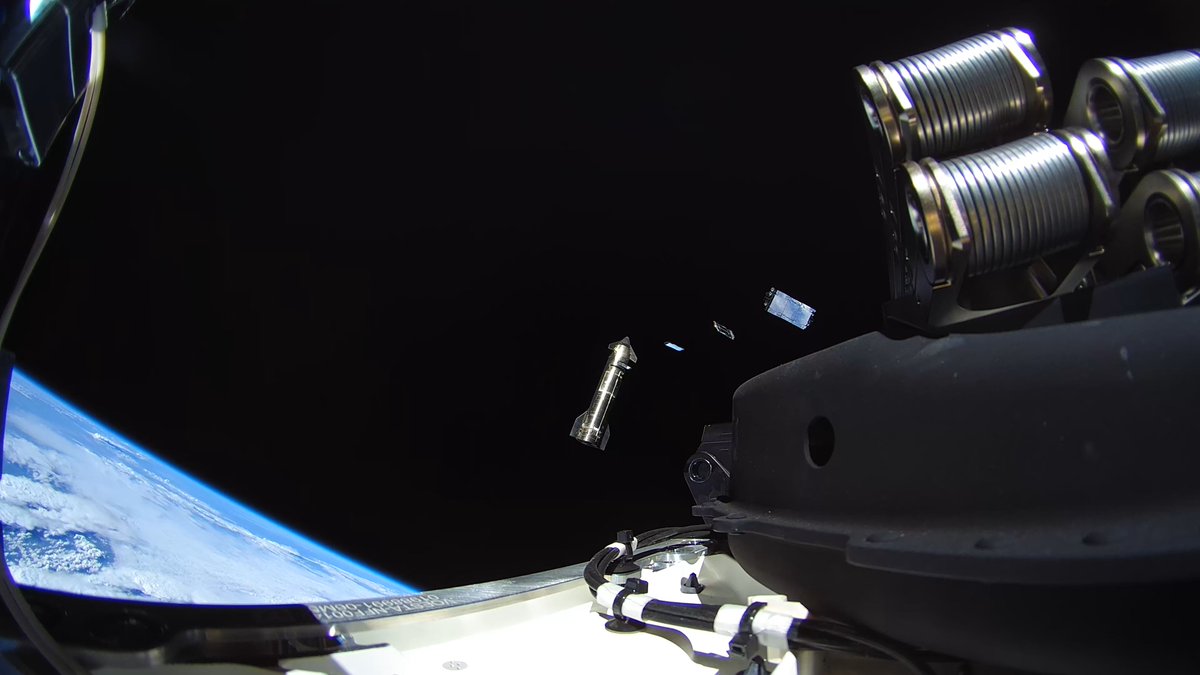
Contact was established with all 26 deployed satellites shortly after separation, via a combination of laser links, ground stations, and Starlink user terminals, according to SpaceX. Images captured by an orbiting V3 satellite — showing its own deployment and that of a subsequent satellite — were released publicly.
Why Starlink V3 Required Starship in the First Place
The V3 generation represents a meaningful step-change in the constellation's capability, and its size is precisely why Starship became necessary. Each V3 satellite weighs approximately 2,000 kilograms (around 4,400 pounds) — substantially heavier than previous versions — making Falcon 9 an inefficient launch vehicle for deploying them at scale.

On the performance side, V3 satellites are designed to support 1 Tbps of downlink capacity and 160 Gbps of uplink — roughly a 10x improvement in downlink and a 22x increase in uplink compared to V2, according to SpaceX. Each satellite also carries six high-capacity 400 Gbps space lasers for inter-satellite traffic routing within the mesh network. That kind of bandwidth headroom is what makes real-time orbital video transmission — like what we saw during Flight 14 — operationally viable rather than just a demonstration stunt.

The Bigger Picture
Flight 14 is the clearest illustration yet of SpaceX's vertical integration strategy playing out in real time. Starship carries Starlink. Starlink monitors Starship. The data flows back through the same network that commercial and government customers use daily. Each program accelerates the other's development cadence in ways that would be impossible if they were separate companies — or even separate divisions operating in silos.
The shortened mission duration is worth noting honestly: an engine anomaly during ascent forced an early deorbit, and the full six-orbit profile wasn't completed. But the primary payload deployment succeeded, and the in-orbit communications demonstration worked as intended. For a program that spent years not reaching orbit at all, a 3-hour orbital mission with 26 satellites deployed and live imagery returned is a different category of outcome than the earlier test flights.
What comes next is the question. With V3 satellites now confirmed deployable via Starship, SpaceX can begin building out the high-capacity layer of the constellation in earnest. The pace of that buildout — and whether Starship's flight rate can support it — will determine how quickly the network's theoretical bandwidth ceiling translates into real-world service improvements for subscribers on the ground.
🚀 Following the Starship program? See every test flight, official outcome and the next launch window in our SpaceX Starship Tracker.
Sources & reporting notes
The links below identify the material source records used for this report.
- @Starlink on X (2026-10-04T00:29:38.000Z) — Direct source
Source links are preserved as published or accessed. See our editorial standards and corrections policy.
The BASENOR Editorial Desk covers Tesla, SpaceX, and related technology, curating reporting from primary sources — official accounts, regulatory filings, and software release data. Every article passes source-record and fact-checking review before publication. About the newsroom.
This report was curated by the BASENOR Editorial Desk from the sources listed above. Read our editorial standards or email editorial@basenor.com to report an error.