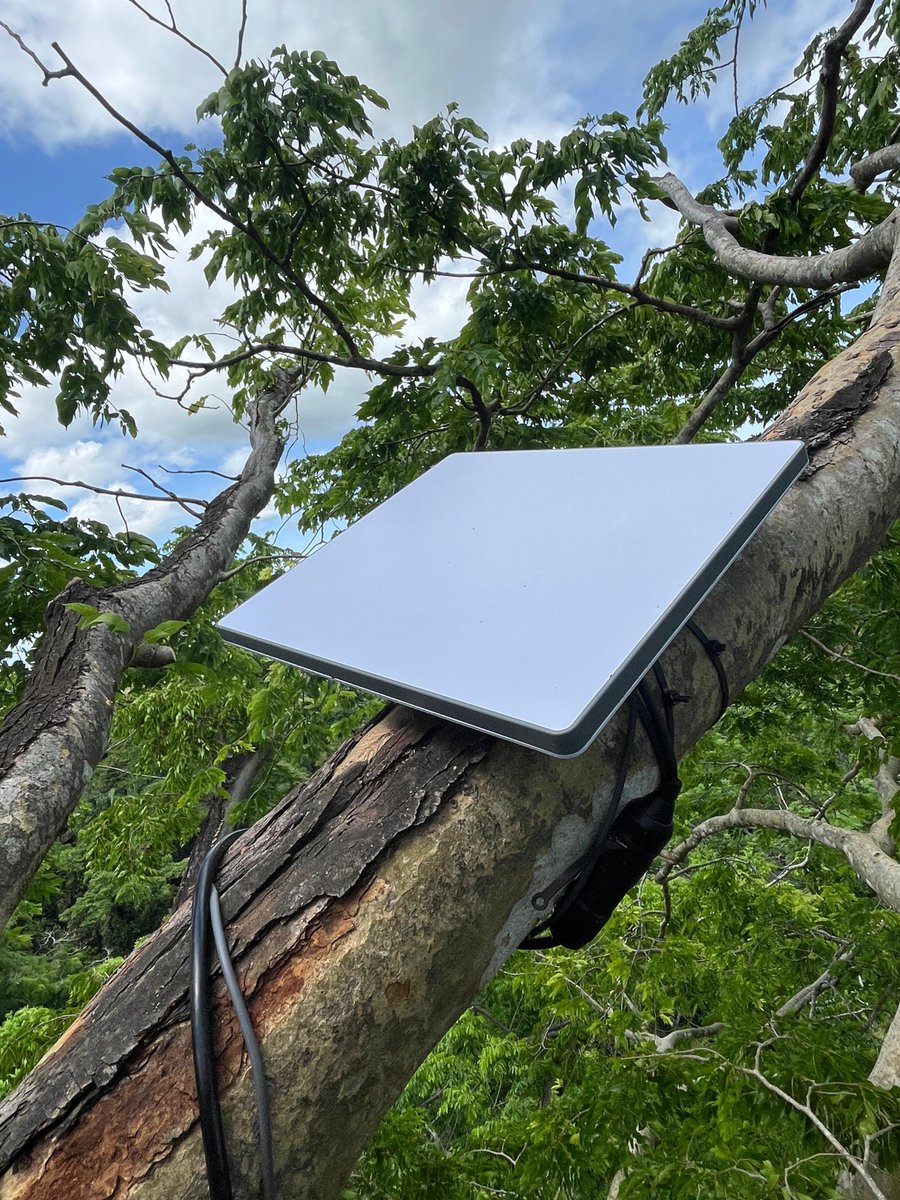
Satellite connectivity is doing more than keeping remote workers online — it's now helping scientists uncover animal behaviors that would otherwise go undetected for years. Starlink announced this week that it is providing connectivity to Project SPARROW, a Microsoft AI for Good Lab initiative operating in remote parts of Colombia, where researchers are using AI-powered data analysis to dramatically accelerate biodiversity research and conservation work.

The Problem Starlink Is Solving
Field research in Colombia's remote ecosystems has long faced a brutal bottleneck: the recordings. Audio and video captures from wildlife monitoring equipment accumulate faster than any team can manually review them. According to Starlink's announcement, the process previously required thousands of hours of human review time — a pace that made real-time conservation response essentially impossible.
Without reliable connectivity, researchers couldn't push that data to cloud-based AI tools efficiently. The recordings would pile up, insights would lag by weeks or months, and the window to act on a behavioral discovery or a conservation threat would close before anyone even knew it had opened.
What Project SPARROW Actually Does
Project SPARROW is a Microsoft AI for Good Lab initiative designed to bridge exactly that gap. The project deploys sensors and recording equipment in biodiverse but infrastructure-poor regions, then uses AI models to process the resulting data — identifying species, flagging unusual behaviors, and surfacing conservation-relevant signals at a speed no human review team could match.
The Colombia deployment represents one of the more demanding real-world tests for this kind of system. The country is among the most biodiverse on Earth, hosting a disproportionate share of the world's bird, amphibian, and plant species — many of them in precisely the remote, difficult-to-reach terrain where ground-based internet infrastructure doesn't exist.
Starlink's low-Earth orbit network fills that gap. By providing the uplink that connects field equipment to cloud AI infrastructure, it removes the last physical barrier between raw sensor data and actionable scientific insight.
Why the Connectivity Layer Matters
It's easy to underestimate how much the connectivity problem has historically constrained field science. Researchers in remote areas have typically operated in a kind of data isolation — collecting everything locally, then physically transporting drives or waiting for infrequent satellite windows to upload batches. That workflow is incompatible with AI tools that require continuous or near-continuous data streams to function effectively.
Starlink's constellation, operating at altitudes roughly 60 times lower than traditional geostationary satellites, delivers the latency and bandwidth profile that makes real-time or near-real-time AI processing viable in the field. For Project SPARROW, that means researchers can access processed, AI-analyzed results from recordings without waiting for a return trip to a city with fiber internet.
The practical implication is a compression of the research cycle. Discoveries that might have taken months to surface from a backlog of unreviewed recordings can now emerge within hours or days of the original capture. For conservation work — where the response window to a habitat threat or a newly identified endangered behavior can be narrow — that acceleration is genuinely consequential.
The Broader Pattern
This deployment fits a pattern that has become increasingly visible over the past two years: Starlink positioning itself not just as a consumer broadband alternative, but as critical infrastructure for high-value, low-volume use cases where no other connectivity option exists. Maritime, aviation, disaster response, and now field science have all become active verticals.
For SpaceX, each of these deployments serves a dual purpose — generating revenue from a segment that traditional ISPs have never served, while accumulating the kind of mission-critical use cases that make the network harder to displace competitively. A biodiversity research program that restructures its entire data pipeline around Starlink connectivity doesn't switch providers lightly.
What Project SPARROW demonstrates is that the value proposition extends well beyond bandwidth speed. In Colombia's remote ecosystems, the alternative to Starlink isn't a slower connection — it's no connection at all. That's the market position that makes low-Earth orbit satellite internet structurally different from any previous generation of the technology, and it's the position Starlink continues to reinforce with deployments like this one.
Sources & reporting notes
The links below identify the material source records used for this report.
- @Starlink on X (2026-07-22T16:57:20.000Z) — Direct source
Source links are preserved as published or accessed. See our editorial standards and corrections policy.
The BASENOR Editorial Desk covers Tesla, SpaceX, and related technology, curating reporting from primary sources — official accounts, regulatory filings, and software release data. Every article passes source-record and fact-checking review before publication. About the newsroom.
This report was curated by the BASENOR Editorial Desk from the sources listed above. Read our editorial standards or email editorial@basenor.com to report an error.