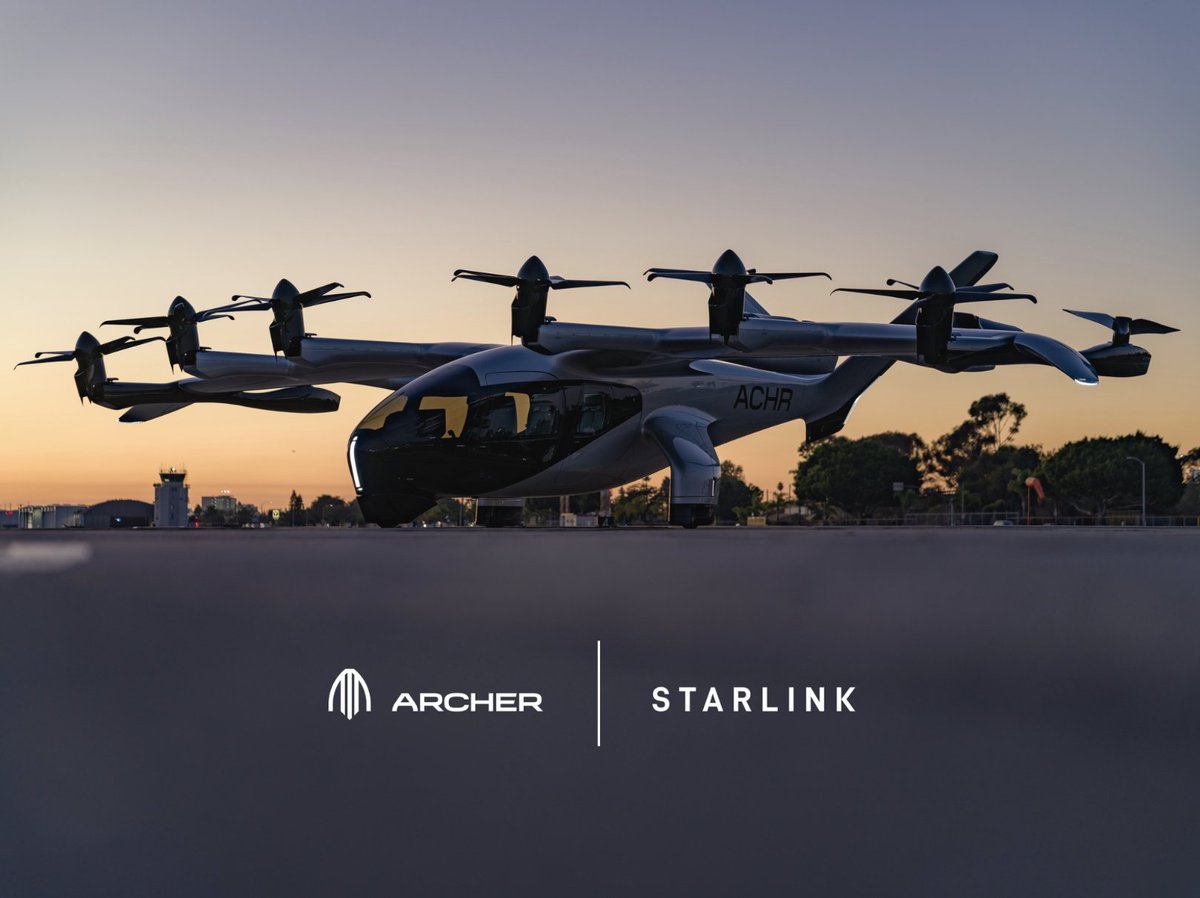
The News: Archer Aviation has announced an industry-first partnership with Starlink to install satellite internet hardware aboard its Midnight electric air taxi, marking Starlink's official entry into the urban air mobility market.
Why It Matters: Starlink's proven low-Earth-orbit network is now expanding beyond cars and ships into the skies — with serious implications for how autonomous and piloted air taxis will communicate, navigate, and serve passengers.
Source: @SawyerMerritt on X
Starlink Enters the Air Taxi Market — Archer Aviation's Midnight Is First in Line
Starlink has officially landed in a new frontier. Archer Aviation announced today that it is partnering with Starlink to deliver high-speed, low-latency satellite connectivity aboard its Midnight electric vertical takeoff and landing (eVTOL) aircraft — an industry first that signals Starlink's serious ambitions in the emerging urban air mobility space.

📊 Key Figures
| Metric | Value | Context |
|---|---|---|
| Midnight Capacity | 1 pilot + 4 passengers | Starlink serves all 5 seats |
| Optimized Mission Range | ~20 miles (32 km) | Back-to-back urban hops |
| Max Range | 100 miles (161 km) | Full Starlink coverage throughout |
| Top Speed | 150 mph (241 km/h) | LEO latency unaffected at speed |
| Operating Altitude | ~1,500 ft urban | Where cellular coverage is weakest |
| Turnaround Charge Time | 10–12 minutes | High-frequency ops demand reliable uplink |
What the Deal Actually Covers
This is not a vague MOU. According to the official announcement from Archer (NYSE: ACHR), the agreement has three concrete pillars:
- Hardware installation and testing — Starlink terminals will be physically integrated into the Midnight airframe and put through operational trials.
- Passenger connectivity — Starlink will deliver in-flight internet access to passengers during commercial air taxi operations.
- Operational communications — The link will also connect pilots and the aircraft to Archer's ground-based engineering teams, creating a real-time data pipeline during flights.
A fourth, longer-horizon element is also built into the partnership: joint development of a connectivity solution designed to support Archer's future autonomous aircraft program. That last point is arguably the most significant — it positions Starlink not just as an inflight Wi-Fi provider, but as critical infrastructure for the next generation of pilotless air taxis.
Why Starlink — and Why Now?
Urban air taxis operate in a connectivity no-man's-land. At roughly 1,500 feet above city streets, Midnight flies too low for the high-altitude aviation bands used by commercial jets, yet too high for reliable 4G/5G cellular coverage — which is engineered to point downward toward street level, not upward into the sky.
Starlink's low-Earth-orbit constellation is uniquely suited to fill that gap. Its satellites orbit at approximately 550 km altitude, delivering consistent, high-bandwidth coverage with latencies that rival terrestrial broadband — regardless of what's happening on the ground below. For a vehicle making dozens of 20-mile hops per day across a dense urban grid, that reliability is not a luxury. It's an operational requirement.
Starlink already serves commercial aviation, maritime vessels, and ground vehicles — including Tesla cars with the Premium Connectivity option. Expanding into eVTOL aircraft is a natural progression, and Archer gives Starlink a high-profile, commercially focused launch partner in the segment. For context, you can follow our SpaceX coverage for more on Starlink's broader expansion strategy.
🔭 The BASENOR Take
| Timeline | Hardware integration + testing underway; commercial ops TBD |
| Impact Level | 🟠 High — first Starlink eVTOL deployment; sets industry standard |
| Confidence | 🟢 High — official press release from Archer (NYSE: ACHR) confirmed |
The headline here is Starlink's market expansion, but the subtext is about autonomous flight. The explicit mention of developing connectivity for Archer's future autonomous aircraft tells you where both companies see this going. A pilotless air taxi is not commercially viable without an ultra-reliable, low-latency data link to ground operations — and that is exactly what Starlink is being positioned to provide.
For Tesla owners watching the broader Elon Musk ecosystem: this is Starlink executing on the same playbook that made it indispensable for maritime and automotive markets — get the hardware in early, build the integration deep, and become the default standard before competitors can respond. Joby Aviation, Lilium's successors, and Wisk are all watching this announcement closely.
The Midnight aircraft's operational profile — frequent short hops, rapid turnarounds, dense urban environments — is also the hardest possible connectivity test case. If Starlink performs well here, the certification pathway for every other eVTOL operator becomes significantly clearer. This deal is less about Archer's air taxis and more about Starlink writing the rulebook for an entire new aviation category.
📰 Deep Dive
Archer's choice of Starlink over a cellular or traditional aviation-band solution is a telling signal about where the eVTOL industry's technical consensus is heading. The Midnight's 10-to-12-minute turnaround charging window means it is designed for relentless operational tempo — potentially dozens of flights per day per aircraft. Every communication system on that vehicle needs to be as reliable as the rotors. Cellular handoffs in dense urban cores are notoriously inconsistent; Starlink's satellite-based approach sidesteps that problem entirely.
The ground operations angle is also underappreciated. By linking pilots and the Midnight aircraft to Archer's engineering teams in real time, Starlink becomes part of the aircraft's health-monitoring and safety infrastructure — not just a passenger perk. That framing makes FAA certification conversations considerably different than if this were simply branded as inflight Wi-Fi.
Long term, the autonomous aircraft development clause in this partnership is the one to watch. As regulators in the U.S. and internationally begin to define what connectivity requirements autonomous air taxis must meet, Archer and Starlink will have a head start in shaping those standards — because they will have real flight data before anyone else does.
Sources & reporting notes
The links below identify the material source records used for this report.
- @SawyerMerritt on X (2026-02-27T13:30:00.000Z) — Direct source
Source links are preserved as published or accessed. See our editorial standards and corrections policy.
The BASENOR Editorial Desk covers Tesla, SpaceX, and related technology, curating reporting from primary sources — official accounts, regulatory filings, and software release data. Every article passes source-record and fact-checking review before publication. About the newsroom.
This report was curated by the BASENOR Editorial Desk from the sources listed above. Read our editorial standards or email editorial@basenor.com to report an error.