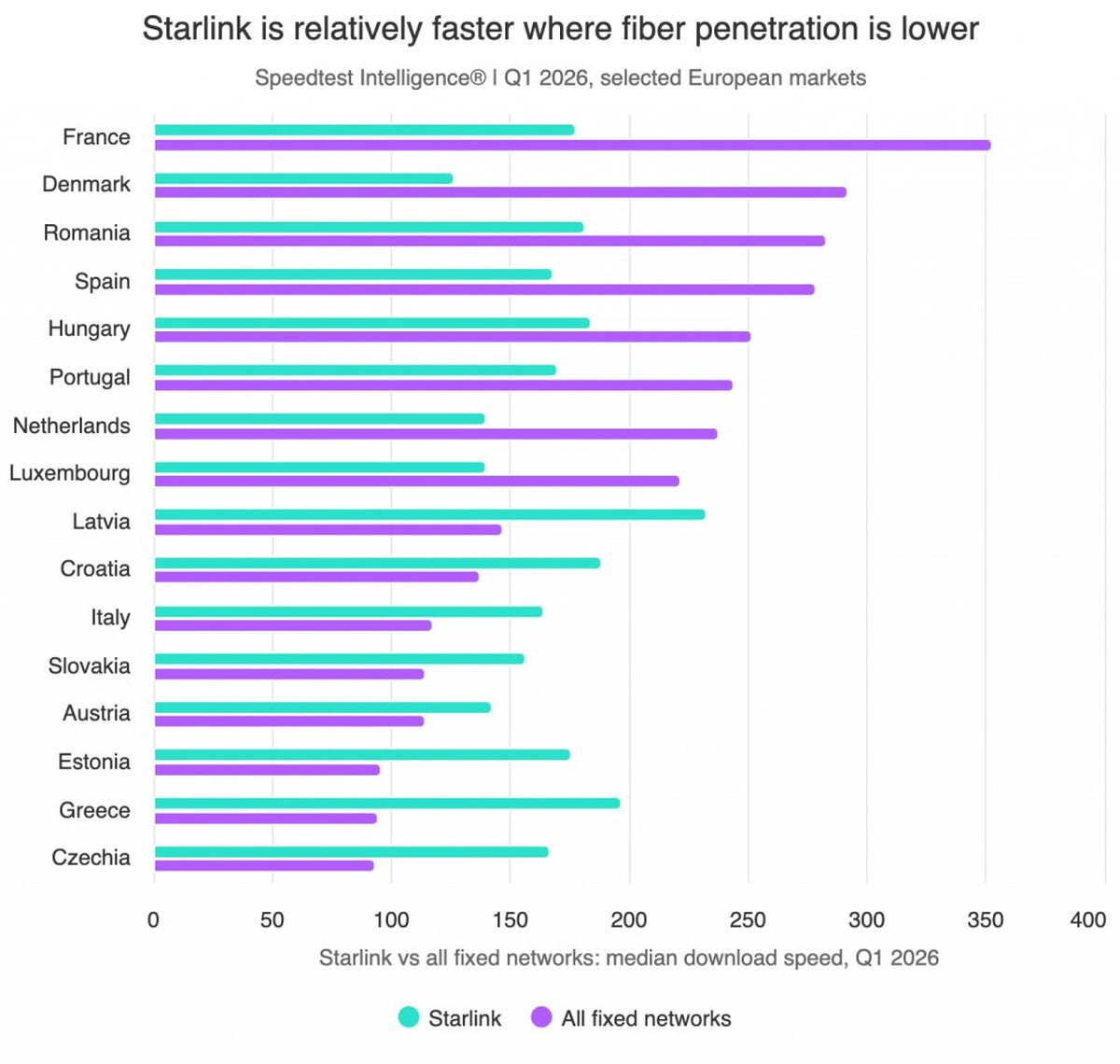
Starlink just posted a significant performance milestone in Europe. According to Ookla Speedtest data published May 25, 2026, the service's median download speed across all 27 tracked European countries climbed from 114.05 Mbps in Q1 2025 to 165.71 Mbps in Q1 2026 — a 45% gain in a single year. Speeds improved in 26 of those 27 markets.

The gains are most pronounced in areas where traditional fixed-line infrastructure has historically underserved residents — islands, mountain communities, and rural farmland. As the Ookla report notes, Starlink's footprint in Europe is most visible precisely where fiber and cable networks are delayed, weaker, or simply difficult to deploy. That's the same connectivity gap the service was designed to close, and the speed data suggests it's closing it faster than before.
The improvement tracks with SpaceX's ongoing satellite deployment cadence. A larger, denser constellation means more capacity per region and shorter signal paths to ground stations, both of which translate directly into higher throughput for end users. For European subscribers who signed on during the earlier, slower phase of the network, the difference between 114 Mbps and 165 Mbps is genuinely meaningful — enough to move Starlink from a capable rural backup into a credible primary broadband option for most households.
Whether the trajectory holds through Q2 and Q3 2026 will depend on how quickly SpaceX continues expanding European coverage and whether subscriber density in any given market starts to pressure available capacity. For now, the numbers point in one direction only.
Sources & reporting notes
The links below identify the material source records used for this report.
- @SawyerMerritt on X (2026-05-26T12:59:16.000Z) — Direct source
Source links are preserved as published or accessed. See our editorial standards and corrections policy.
The BASENOR Editorial Desk covers Tesla, SpaceX, and related technology, curating reporting from primary sources — official accounts, regulatory filings, and software release data. Every article passes source-record and fact-checking review before publication. About the newsroom.
This report was curated by the BASENOR Editorial Desk from the sources listed above. Read our editorial standards or email editorial@basenor.com to report an error.