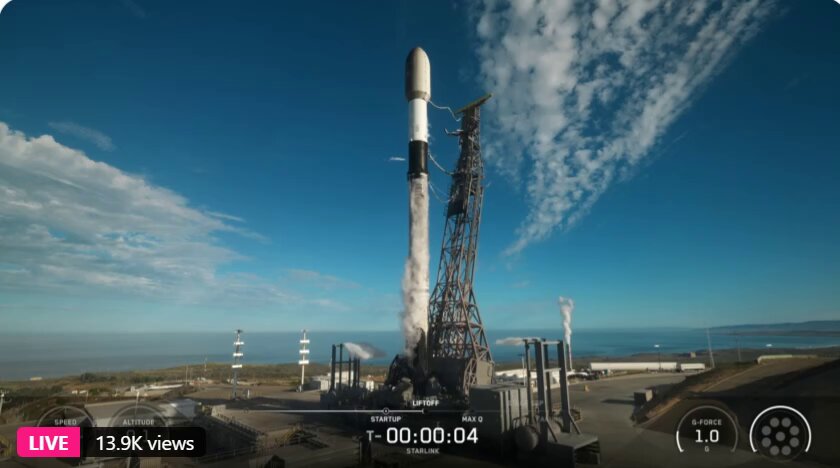
SpaceX completed the Starlink Group 17-39 mission on July 21, 2026, lifting off from Space Launch Complex 4E at Vandenberg Space Force Base and sticking the booster landing — one day after an automated abort scrubbed the first attempt. Here are the four details that matter.

1. The July 20 abort made this launch a comeback story
The original attempt on July 20 ended in an automated T-0 abort at ignition — the kind of split-second engine-health check that Falcon 9 is designed to catch. SpaceX confirmed the vehicle and payload were safe and rescheduled for July 21. The turnaround was under 24 hours, which is now routine for SpaceX but still worth noting: a scrub that would have grounded a rocket for weeks a decade ago barely registers as a delay anymore.
2. Booster B1082 just logged its 23rd flight
The first stage flying this mission was B1082, making its 23rd trip to space and back. That flight count puts it among the most-flown boosters in the Falcon 9 fleet. SpaceX has been steadily pushing the reuse envelope — early Block 5 boosters were originally certified for ten flights, and the program has long since moved past that benchmark without drama. Each successful landing adds another data point to the case that rocket reusability is an engineering solved problem, not an aspiration.
3. Twenty-four Starlink V2 Mini satellites headed to LEO
The payload was a standard batch of 24 Starlink V2 Mini satellites, destined for Low Earth Orbit as part of the Group 17 shell. V2 Mini satellites are larger and carry more bandwidth capacity than the original V1 design, allowing SpaceX to deliver more throughput per launch. The Group 17 designation refers to the orbital shell being filled — SpaceX operates multiple shells at different altitudes and inclinations to build out global coverage, and missions like this one are the incremental work that keeps the constellation growing.
4. The booster touched down on OCISLY in the Pacific
After stage separation, B1082 executed its return burn and landed on the Of Course I Still Love You droneship stationed in the Pacific Ocean. Vandenberg launches targeting westward or polar orbits typically recover on OCISLY rather than the East Coast ship, given the flight trajectory. The landing was confirmed by NASASpaceflight moments after touchdown.

With Group 17-39 in the books, SpaceX continues filling out the Starlink constellation at a pace that makes individual missions feel almost unremarkable — which, given where rocket reusability stood just a few years ago, might be the most remarkable thing of all. For more on SpaceX's launch cadence and constellation progress, see our SpaceX coverage.
Sources & reporting notes
The links below identify the material source records used for this report.
- @NASASpaceflight on X (2026-07-21T14:50:46.000Z) — Direct source
- @NASASpaceflight on X (2026-07-21T14:59:16.000Z) — Direct source
Source links are preserved as published or accessed. See our editorial standards and corrections policy.
The BASENOR Editorial Desk covers Tesla, SpaceX, and related technology, curating reporting from primary sources — official accounts, regulatory filings, and software release data. Every article passes source-record and fact-checking review before publication. About the newsroom.
This report was curated by the BASENOR Editorial Desk from the sources listed above. Read our editorial standards or email editorial@basenor.com to report an error.