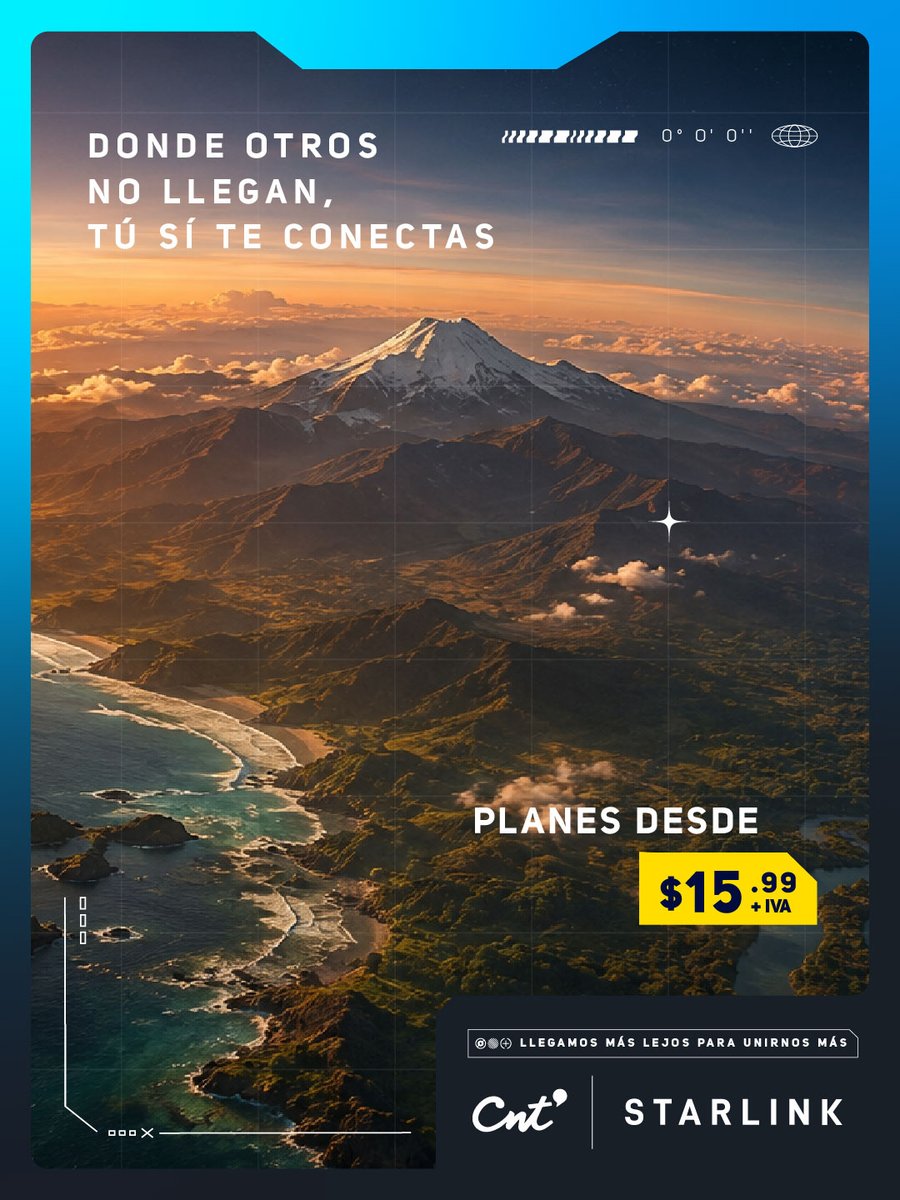
Starlink has officially switched on its Mobile direct-to-cell service in Ecuador, partnering with state-owned carrier CNT (Corporación Nacional de Telecomunicaciones) to extend coverage into the country's most geographically challenging terrain. The announcement, confirmed directly by Starlink on September 29, 2026, marks another step in the service's Latin American expansion — and it has real implications for anyone in Ecuador who's ever lost signal in the mountains or along a remote coastline.

1. The Partnership Is With Ecuador's National Carrier
CNT EP — Corporación Nacional de Telecomunicaciones — is Ecuador's state-owned telecom provider and the company behind this rollout. CNT already had an existing relationship with Starlink for fixed broadband services, including a deployment of Starlink's Bonded Gateway solution in the Galápagos Islands. Expanding that relationship into direct-to-cell territory is a significant step up: instead of selling hardware kits, CNT is now distributing satellite mobile connectivity to ordinary LTE phone users.
2. No New Hardware Required for Compatible Phones
Starlink Mobile works with most modern LTE devices — no satellite phone, no external antenna, no special kit. According to Starlink's published compatibility data, supported devices include iPhone 13 and later, select Samsung Galaxy models (A-series, S-series, Z-series, XCover Pro), 2024–2025 Motorola models, and the Google Pixel 9 series. When a compatible phone loses terrestrial coverage, it automatically connects to the Starlink satellite network without any manual intervention from the user.
3. Ecuador's Geography Makes This Particularly Meaningful
Ecuador is a compact country with extreme topographic variety — Pacific coastline, Andean highlands, Amazon basin, and the remote Galápagos Islands. Traditional cellular infrastructure simply cannot cover all of it economically. Starlink's announcement specifically calls out coastlines, mountains, and forests as target environments, which maps almost perfectly onto the country's most persistent dead zones. For fishing communities, highland farmers, and ecotourism operators, this is the kind of connectivity gap that has gone unfilled for years.
4. Ecuador Follows Chile as the Second Latin American Direct-to-Cell Market
Starlink's Direct to Cell service began its Latin American expansion in Chile in November 2025 through a partnership with Entel, initially supporting text messaging. Ecuador now becomes the second country in the region to go live with the service, and notably the announcement references both apps and messaging — suggesting the Ecuador launch may include data capabilities beyond SMS. Globally, the service has been live in the United States (with T-Mobile) and New Zealand (with One NZ) since mid-2025.
5. The Satellites Function as Cell Towers in Space
The underlying technology is worth understanding. Starlink's Direct to Cell satellites operate as orbiting LTE base stations, communicating with phones over standard cellular frequencies rather than requiring proprietary protocols. The satellites connect to each other via laser links and route traffic back to ground stations. From a phone's perspective, the handoff from a terrestrial tower to a Starlink satellite is seamless — the device doesn't know the difference. This architecture is what allows existing phones to participate without firmware changes or hardware upgrades.
For Ecuador, the practical question now is how quickly CNT rolls out access to its subscriber base and what pricing looks like at the consumer level. Starlink's pattern in other markets has been to position direct-to-cell as an add-on to existing mobile plans rather than a standalone product — but the specifics of the CNT commercial structure haven't been publicly detailed yet. That's the next piece of the story to watch. For more on SpaceX's satellite network expansion, see our SpaceX coverage.
Sources & reporting notes
The links below identify the material source records used for this report.
- @Starlink on X (2026-09-29T23:35:20.000Z) — Direct source
Source links are preserved as published or accessed. See our editorial standards and corrections policy.
The BASENOR Editorial Desk covers Tesla, SpaceX, and related technology, curating reporting from primary sources — official accounts, regulatory filings, and software release data. Every article passes source-record and fact-checking review before publication. About the newsroom.
This report was curated by the BASENOR Editorial Desk from the sources listed above. Read our editorial standards or email editorial@basenor.com to report an error.