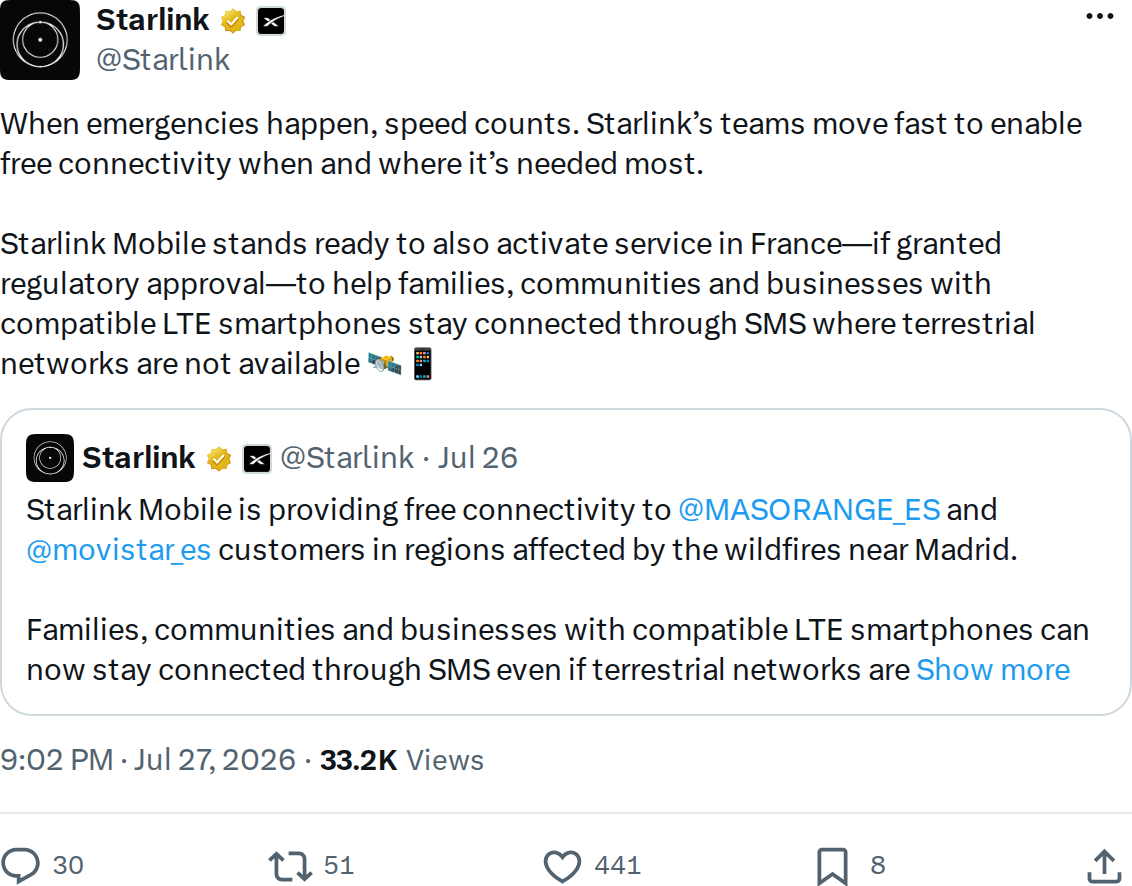
Starlink is positioning its Direct-to-Cell mobile service as a first-responder tool — and it wants France to be next in line. On July 27, 2026, the official Starlink account confirmed that Starlink Mobile is ready to activate free emergency connectivity in France, pending regulatory approval from French authorities. The announcement comes as the service is already running in real crisis conditions elsewhere in Europe.

What exactly is Starlink Mobile, and how is it different from standard Starlink?
Standard Starlink requires a dish and router — hardware that most people don't carry during an evacuation. Starlink Mobile (also called Direct-to-Cell, or D2C) works differently: it lets compatible LTE smartphones connect directly to Starlink's satellites without any additional equipment. That means ordinary phones can send and receive SMS messages even when every cell tower in the area is down or destroyed. According to Starlink, its V2 satellites support speeds up to 150 Mb/s and are built to handle government-grade emergency alert systems including WEA, CMAS, and ETWS — the same standards used by national emergency broadcast networks.
Is Starlink Mobile actually being used in emergencies right now?
Yes. As of July 27, 2026, Starlink Mobile is providing free satellite texting to Movistar and MasOrange customers in wildfire-affected regions near Madrid, Spain, where fires have knocked out terrestrial networks. That's a live deployment, not a pilot. Beyond Spain, SpaceX and the U.S. State Department signed a two-year Memorandum of Understanding on June 12, 2026, specifically to use Starlink's low-Earth-orbit constellation for restoring communications globally after natural disasters. The infrastructure is operational — the limiting factor in most markets is regulatory approval, not technical readiness.
Why does Starlink need separate approval for France if it already operates there?
This is the key distinction. Starlink already holds authorization from ARCEP — France's Authority for Electronic Communications and Postal Services — for satellite broadband, and has offered commercial internet service in France since 2022. But Direct-to-Cell is a different technical service operating on different spectrum. Mobile satellite connectivity for standard smartphones requires authorization to use the 2 GHz band, which is currently licensed to other operators. Those licenses expire in May 2027. On May 27, 2026, the European Commission confirmed that non-European satellite operators, including Starlink, are eligible to bid for that spectrum — but the proposal still needs approval from EU member states and the European Parliament before it becomes law. France, as an EU member, sits inside that regulatory process.
Where is Starlink Mobile already approved in Europe?
The UK — operating outside EU jurisdiction — is the furthest along. Starlink Mobile's Direct-to-Cell service went live in the UK with Virgin Media O2 in early 2026. On the continent, Deutsche Telekom has announced a partnership to roll out satellite-to-mobile connectivity across Germany and several other European markets, with a target of early 2028. According to reporting as of July 23, 2026, D2C messaging and limited data services are launching market by market as national regulators grant approvals and operators sign carrier agreements. Full voice and higher-bandwidth data services remain in testing, with broader European availability expected through 2026 and 2027.
What does Starlink's constellation actually look like at this scale?
According to Starlink, the constellation now consists of nearly 8,000 low-Earth orbit satellites, with over 650 D2C-capable satellites specifically in orbit. The company reported more than 10 million active customers as of February 2026. Testing for wireless emergency alerts in Europe using S-band satellite spectrum — conducted in partnership with MediaTek — began the week of March 4, 2026. The scale matters for emergency use: low-Earth orbit means lower latency than traditional geostationary satellites, and a denser constellation means more coverage redundancy when ground infrastructure fails.
What happens in France until approval comes through?
Standard Starlink dish-based service continues normally for existing French subscribers. For mobile emergency connectivity specifically, French users remain dependent on terrestrial networks. If a major disaster disrupts those networks before D2C approval lands, Starlink could potentially deploy portable dish hardware to affected areas — as it has done in past crises — but the seamless phone-based texting that D2C enables won't be available until regulators act. The EU spectrum decision timeline, with current licenses running to May 2027, suggests the regulatory window for France could open within the next 12 months, though nothing is guaranteed until the European Parliament and member states finalize the framework.
Sources & reporting notes
The links below identify the material source records used for this report.
- @Starlink on X (2026-07-27T21:02:20.000Z) — Direct source
Source links are preserved as published or accessed. See our editorial standards and corrections policy.
The BASENOR Editorial Desk covers Tesla, SpaceX, and related technology, curating reporting from primary sources — official accounts, regulatory filings, and software release data. Every article passes source-record and fact-checking review before publication. About the newsroom.
This report was curated by the BASENOR Editorial Desk from the sources listed above. Read our editorial standards or email editorial@basenor.com to report an error.