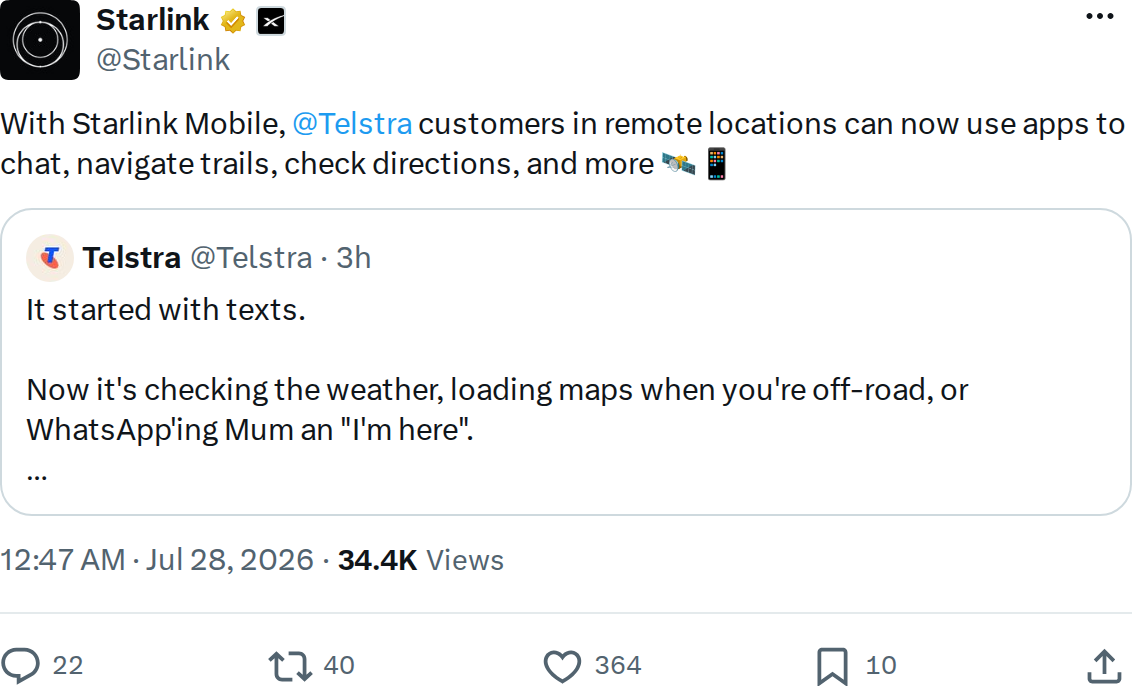
Starlink Mobile and Telstra have taken their Australian partnership a significant step further. As of July 2026, eligible Telstra customers can now use a curated selection of satellite-optimised apps — navigation, messaging, weather — from virtually anywhere across mainland Australia and Tasmania, no cell tower required. Here's what the expansion actually means, by the numbers and by the details that matter.

1. This Is an Australian First — Apps via Satellite, Not Just Texts
When Telstra first launched satellite-to-mobile messaging with Starlink in June 2025, it was text-only — a safety net for basic communication in coverage black spots. The July 2026 expansion is a genuine milestone: according to Telstra, this is the first time in Australia that satellite-to-mobile services have extended beyond text messaging to include full app functionality. Navigation, messaging platforms, weather, and fitness apps are now all accessible via satellite on compatible devices.
2. The App List Is More Comprehensive Than You'd Expect
Telstra's "Select Satellite Apps" roster covers the tools most people actually need in remote areas. Navigation: Apple Maps, Google Maps, and AllTrails. Messaging: iMessage, WhatsApp, Facebook Messenger, Signal, and Google Messages. Weather: Apple Weather, AccuWeather, and Google Weather. Google Fitness and the My Telstra app round out the list. These apps are optimised for lighter data activity — streaming and high-bandwidth use aren't supported — but for trail navigation and staying in contact, the lineup is practical and well-chosen.
3. Adoption Numbers Are Substantial
The service isn't a niche experiment. According to Telstra, more than 2.7 million Telstra customers have connected to Starlink Mobile at least once since launch, out of over 2.9 million total satellite connections recorded across compatible devices in the past 13 months. Daily connections now average over 200,000 — more than double the roughly 80,000 daily connections recorded at launch. Over 26 million text messages have been sent or received via Telstra Satellite Messaging since the service began.
4. Your Phone May Already Be Compatible
No new hardware is required for most recent flagship owners. The service works on an iPhone 13 or newer (with up-to-date software) and devices in the Samsung Galaxy S26 family, among other compatible handsets. The catch: you need to be on an eligible Consumer or Small Business Telstra Upfront Mobile Plan — pre-paid plans are excluded. You also need to be outdoors with a clear line of sight to the sky. It won't work indoors or under heavy tree cover.
5. Coverage Is Near-National, With One Notable Gap
The service spans mainland Australia and Tasmania, which makes it genuinely useful for the vast majority of remote travel scenarios — outback drives, coastal trails, rural properties. The one exception is the Australian Radio Quiet Zone in Western Australia, where satellite transmissions are restricted to protect radio telescope operations. Worth knowing before you plan a trip to that region expecting satellite connectivity.
6. Voice Is Coming — But Isn't Here Yet
The current service is data-focused: apps and messaging, not calls. Telstra has confirmed that voice and low-speed data services are on the roadmap as the underlying technology matures. Critically, the existing satellite service is also not a substitute for emergency services — users cannot call or text Triple Zero through it. That limitation is worth understanding clearly before treating satellite connectivity as a full safety backup in genuinely remote or dangerous situations.
The Telstra–Starlink partnership has moved faster than most satellite-to-mobile rollouts globally, and the adoption data suggests real demand in a country where coverage gaps are a practical daily reality for millions. The next milestone to watch is voice — when that arrives, the service shifts from a useful supplement to a genuine alternative for remote connectivity.
Sources & reporting notes
The links below identify the material source records used for this report.
- @Starlink on X (2026-07-28T00:47:42.000Z) — Direct source
Source links are preserved as published or accessed. See our editorial standards and corrections policy.
The BASENOR Editorial Desk covers Tesla, SpaceX, and related technology, curating reporting from primary sources — official accounts, regulatory filings, and software release data. Every article passes source-record and fact-checking review before publication. About the newsroom.
This report was curated by the BASENOR Editorial Desk from the sources listed above. Read our editorial standards or email editorial@basenor.com to report an error.