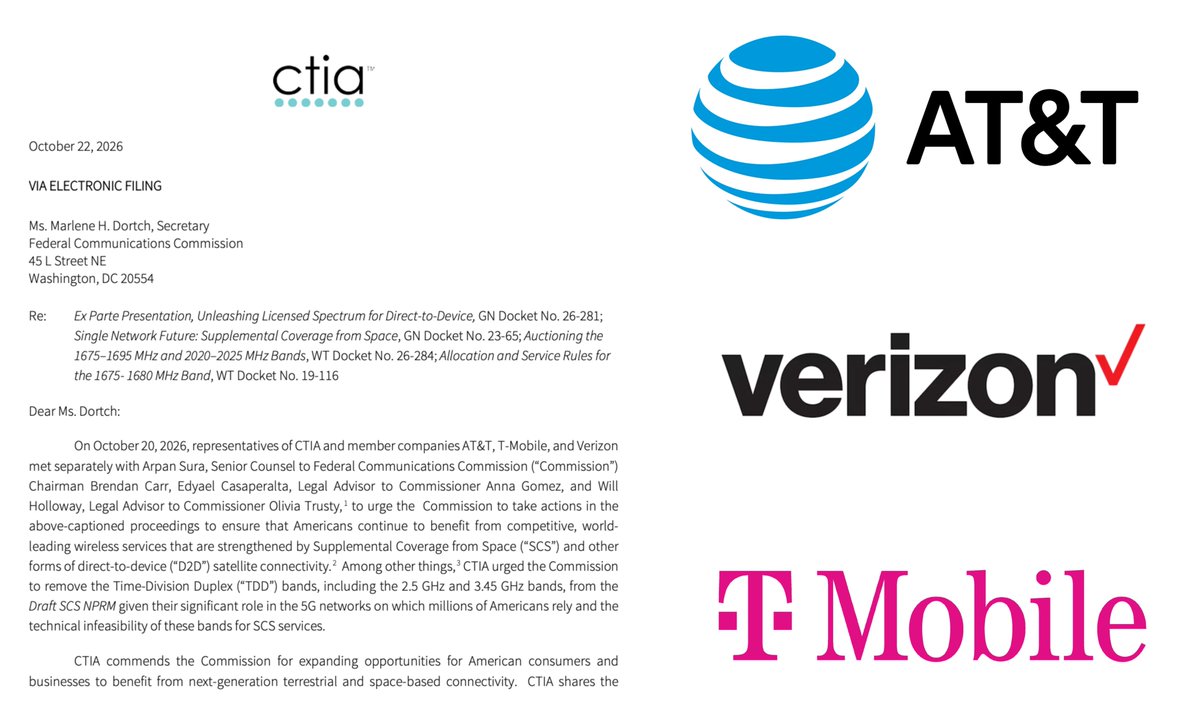
A few months ago, legacy cell carriers were publicly brushing off Starlink Mobile as a non-threat — too weak to penetrate walls, too limited to matter. That narrative has collapsed. Now those same carriers are reportedly turning to lobbyists to slow SpaceX down, a tell-tale sign that the technology is performing better than they let on. Here's what's driving the shift, and what the next phase of Starlink Mobile actually looks like.

Why did legacy carriers suddenly change their tune on Starlink Mobile?
Earlier in 2026, major carriers publicly downplayed Starlink's direct-to-device service, specifically citing the inability of satellite signals to penetrate walls as a fundamental limitation. That talking point has aged poorly. SpaceX has been acquiring spectrum licenses — including an agreement to purchase a nationwide low-band 800 MHz portfolio from investment firm Grain Management, reportedly valued at approximately $8 billion — that is specifically designed to travel through walls. Low-band spectrum is the same frequency range that gives legacy carriers their indoor coverage advantage. Once SpaceX closes that acquisition (pending FCC approval), the wall-penetration argument evaporates entirely.
What exactly is Starlink Mobile, and how does it work?
Starlink's Direct-to-Cell satellites function as orbiting cell towers, connecting directly to standard smartphones without any special hardware. The current generation supports text messaging, location sharing, and a selection of apps. Full voice and data capabilities are in development, with initial data speeds targeted at 2–4 Mbps per user. As of mid-2025, over 650 Direct-to-Cell satellites were already deployed, and commercial service launched through mobile-network partners — including T-Mobile's T-Satellite service, which went live on July 23, 2025, according to public records.
What is SpaceX planning to launch next, and when?
The FCC has approved SpaceX's application to deploy 15,000 next-generation Starlink Mobile (V2 Mobile) satellites, specifically engineered for direct-to-device services with significantly greater capacity than the current constellation. SpaceX plans to begin launching these V2 Mobile satellites aboard Starship starting in 2027. For context on the pace of expansion: independent satellite-tracking estimates put roughly 11,140 operational Starlink spacecraft in orbit as of late October 2026, out of approximately 13,015 launched historically. SpaceX launched another 27 Starlink satellites on October 22, 2026 alone.
Why are carriers lobbying instead of just competing?
Lobbying typically accelerates when a competitor's product threatens a market position that is difficult to defend on technical or pricing grounds alone. Legacy carriers have spent decades and hundreds of billions of dollars building terrestrial infrastructure — a moat that becomes less relevant when a satellite network can reach any phone, anywhere, without a cell tower. SpaceX is also reportedly seeking access to at least 80,000 cell sites across the United States, including discussions with Crown Castle, which would give Starlink Mobile a hybrid satellite-plus-terrestrial footprint that mirrors what carriers already operate. At that point, the competitive overlap becomes direct and unavoidable.
Does this affect existing Starlink or T-Mobile users right now?
For current T-Mobile subscribers using T-Satellite, the service is already live and functional for messaging and basic connectivity. The more significant changes — expanded data speeds, voice capabilities, and the V2 Mobile constellation — are still on the roadmap rather than available today. The spectrum acquisitions SpaceX is pursuing still require FCC sign-off before they can be deployed. So the short answer is: what exists today is useful but limited; what's coming in 2027 and beyond is what has carriers genuinely worried.
The lobbying shift is arguably the most honest signal the industry has produced about where this technology is headed. When incumbents stop dismissing a competitor and start trying to regulate it, the competitive threat has moved from theoretical to real. SpaceX's next launch cadence and the outcome of its spectrum applications will determine how quickly that threat materializes into something subscribers actually feel in their monthly bills.
Sources & reporting notes
The links below identify the material source records used for this report.
- @SawyerMerritt on X (2026-10-23T17:26:54.000Z) — Direct source
Source links are preserved as published or accessed. See our editorial standards and corrections policy.
The BASENOR Editorial Desk covers Tesla, SpaceX, and related technology, curating reporting from primary sources — official accounts, regulatory filings, and software release data. Every article passes source-record and fact-checking review before publication. About the newsroom.
This report was curated by the BASENOR Editorial Desk from the sources listed above. Read our editorial standards or email editorial@basenor.com to report an error.