SpaceX's Starlink is getting measurably faster across the U.S. — and it's pulling customers away from legacy DSL, cable, and fixed wireless providers in the process. A new report from Ookla, the firm behind Speedtest, puts concrete numbers on both trends and adds a surprising twist: urban Starlink adoption is now growing faster than rural.

1. Upload speeds jumped 42% in a single year
This is the headline figure from Ookla's data. U.S. median upload speeds on Starlink climbed from 14.63 Mbps in the first half of 2025 to 20.73 Mbps in the first half of 2026 — a 42% year-over-year gain, according to the report. Upload performance improved in all 50 states and Washington, D.C., with individual state gains ranging from 25% to 70%. For users on video calls, cloud backups, or remote work, that's a meaningful real-world difference.
2. Download speeds rose 12% nationally — but not everywhere
Median download speeds reached 119.71 Mbps nationally in the first half of 2026, up 12% year-over-year. That's a solid headline number, but the state-level picture is more complicated: download speeds actually declined in 16 states and Washington, D.C. The divergence suggests network capacity is being absorbed unevenly as subscriber counts grow, and that SpaceX's ongoing satellite launches are still catching up in some regions.
3. Four in ten users now clear the FCC's broadband benchmark
The FCC defines minimum broadband as 100 Mbps down / 20 Mbps up. In the first half of 2026, 40% of U.S. Starlink Speedtest users hit that threshold, according to Ookla. That's a notable shift for a service that was once written off as a niche rural option — it means Starlink is increasingly competitive with wired alternatives on the metric regulators use to define adequate internet access.
4. Starlink is pulling customers from DSL, cable, and fixed wireless
The Ookla report documents Starlink gaining market share at the expense of traditional internet service providers — specifically DSL, cable, and fixed wireless operators. The data doesn't break out exact switching volumes, but the directional trend is clear: as speeds improve and pricing becomes more competitive, Starlink is no longer just filling gaps where no other option exists. It's winning head-to-head comparisons in served markets too.
5. Urban growth is now outpacing rural growth
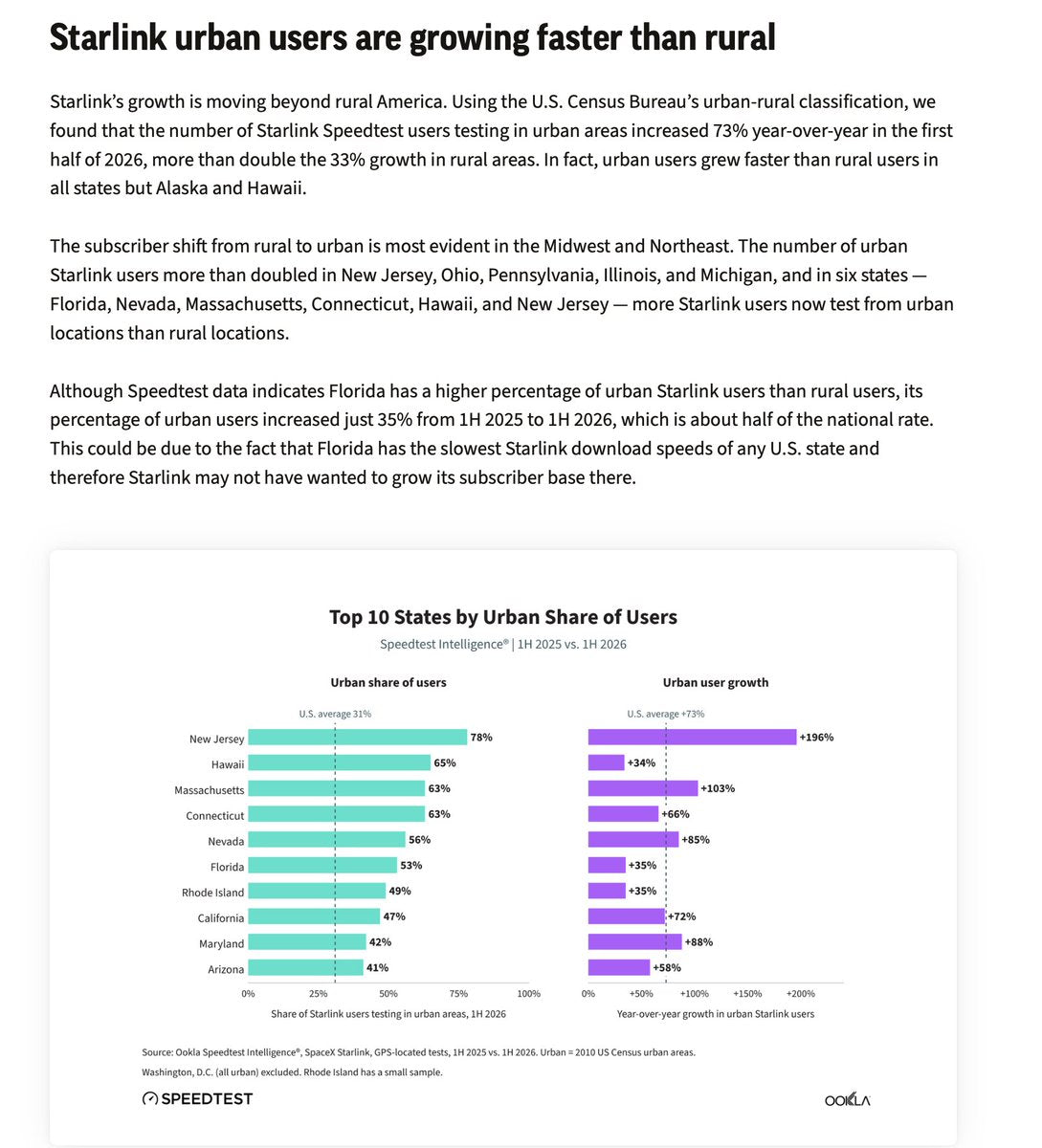
This may be the most strategically significant data point in the report. Starlink built its early subscriber base almost entirely on rural and underserved markets — areas where the satellite service faced little or no competition. The fact that urban user growth is now accelerating faster than rural growth signals that Starlink has crossed a threshold: it's becoming a genuine mainstream alternative, not just a last-resort option. For SpaceX, urban density means higher revenue per satellite pass and a much larger total addressable market.
The Ookla data lands at a moment when SpaceX is continuing to expand its constellation and push into new service tiers. Whether the download speed declines in 16 states are a temporary growing pain or a sign of capacity constraints in high-demand corridors will be worth watching in the second-half 2026 figures. For now, the upload story alone gives Starlink a credible answer to one of its longest-standing criticisms. For more on SpaceX's broader trajectory, see our SpaceX coverage.
Sources & reporting notes
The links below identify the material source records used for this report.
- @SawyerMerritt on X (2026-11-11T13:05:15.000Z) — Direct source
- @SawyerMerritt on X (2026-11-11T13:20:29.000Z) — Direct source
Source links are preserved as published or accessed. See our editorial standards and corrections policy.
The BASENOR Editorial Desk covers Tesla, SpaceX, and related technology, curating reporting from primary sources — official accounts, regulatory filings, and software release data. Every article passes source-record and fact-checking review before publication. About the newsroom.
This report was curated by the BASENOR Editorial Desk from the sources listed above. Read our editorial standards or email editorial@basenor.com to report an error.