Elon Musk dropped a specific cost target for Starship on July 29, 2026, telling an X user that the vehicle could reach orbit for well below $100 per kilogram — but only if two demanding conditions are met simultaneously. The math is compelling. The engineering challenge is enormous.

What exactly did Musk say?
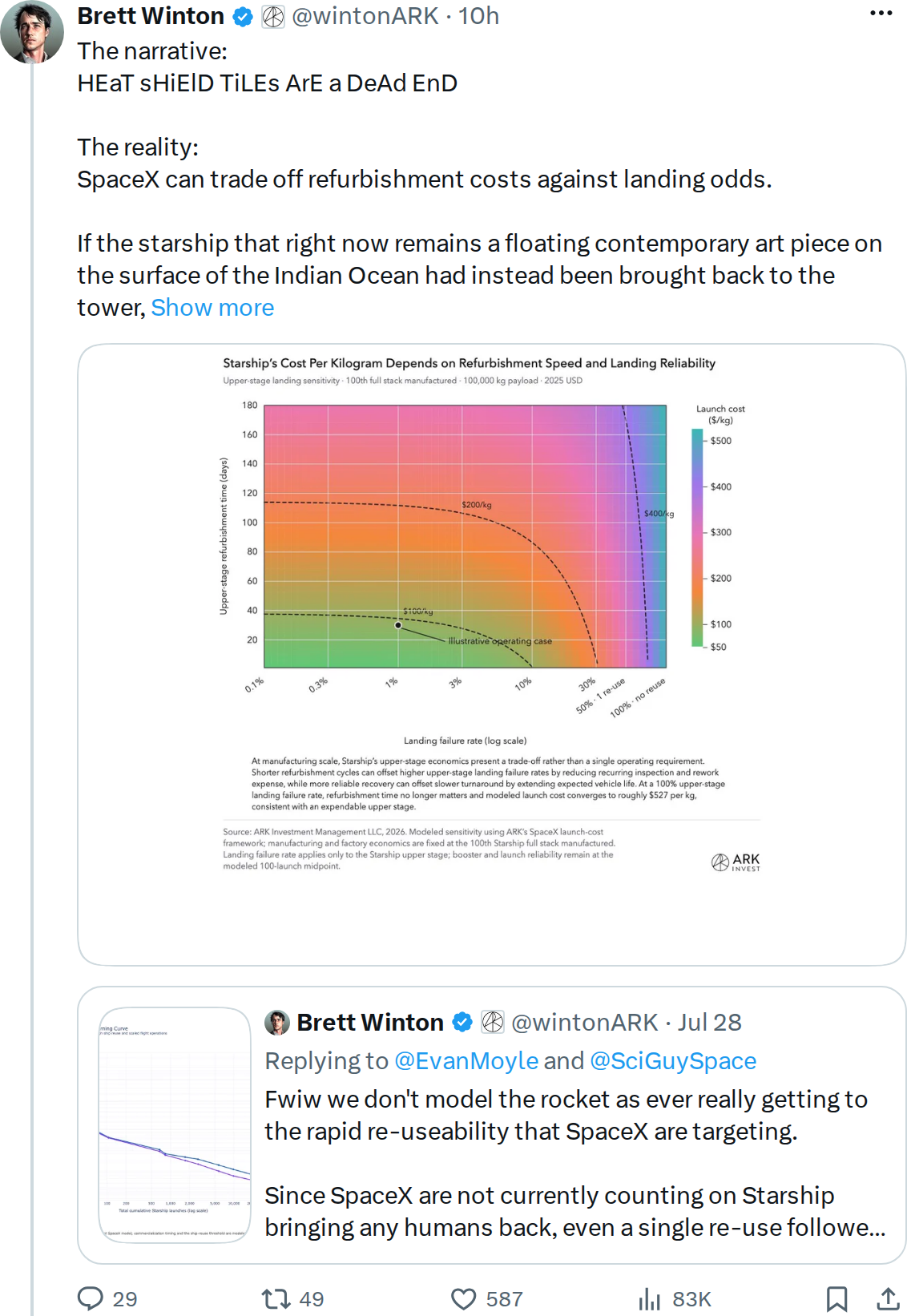
Responding to @wintonARK, Musk stated that Starship's cost to orbit would drop "well below $100/kg" if it achieves "immediate and complete reusability" alongside local production of liquid methane (CH4) and liquid oxygen (O2) propellants. That's not a vague aspiration — it's a conditional statement with two hard prerequisites attached.
Where does Starship stand on cost right now?
According to analyst estimates, Starship currently operates in an experimental phase with launch costs in the range of $82–98 million per flight. Assuming a 100-tonne payload, that translates to roughly $820–980 per kilogram — an order of magnitude above Musk's stated target. The path to sub-$100/kg runs entirely through reusability and propellant economics, not incremental hardware tweaks.
What does 'immediate and complete reusability' actually mean?
This is the harder of the two conditions. SpaceX has demonstrated Super Heavy booster recovery — catching it back at the launch tower — but the Starship upper stage has not yet been successfully reused in a full operational cycle. Work on the upper stage's heat shield is ongoing to enable that capability. Starship Version 3, which SpaceX plans to fly in 2026, is described as a "massive upgrade" designed for full reusability, carrying over 100 metric tonnes to orbit in a reusable configuration and up to 200 tonnes in an expendable one. The vehicle is built for rapid turnaround without refurbishment between flights — but demonstrating that at scale is a different matter from designing for it.
How does propellant production factor into the cost equation?
Propellant is a surprisingly large cost driver. Starship and Super Heavy together require approximately 4,800 tonnes of propellant per launch — roughly 78% liquid oxygen and 22% liquid methane. Musk has previously estimated that at volume, propellant costs could fall to around $100 per tonne, putting total propellant spend at roughly $500,000 per flight. That figure assumes local production at or near the launch site, eliminating transport costs and supply chain markups. The propellant farm at Starbase Launch Pad 2 has already been upgraded with expanded storage capacity and faster-fill pumps, which is a step in that direction.
What's the math behind the $100/kg figure?
Working backward from Musk's target: if Starship achieves a $10 million per-flight launch cost with a 150-tonne payload to Low Earth Orbit, the resulting cost is approximately $67/kg — comfortably below the $100 threshold. That $10 million figure requires reusability to drive down amortized vehicle costs, and cheap on-site propellant to hold down per-flight consumables. Neither condition is trivially achievable, but both have defined engineering pathways that SpaceX is actively pursuing.
When could this realistically happen?
Analyst projections suggest launch costs could fall to $169–200/kg by around 2029 with approximately 10 reuses per vehicle, and into the $89–105/kg range by 2031 with higher flight rates. Those estimates predate any V3 performance data, so they carry real uncertainty in both directions. SpaceX's own internal timeline targets full reusability demonstrations in 2026, which — if successful — would pull the cost curve forward considerably. The honest answer is that the sub-$100/kg figure is achievable on paper today; the question is how many flight-proven reuses it takes to get there operationally.
The gap between today's experimental cost structure and Musk's stated target is large but not arbitrary — every variable in the equation has a known engineering lever. Whether SpaceX can pull all of them in sequence, and on what timeline, is what the next several Starship flights will start to answer. For the broader launch market, even reaching $200/kg on a reliable schedule would reshape the economics of everything from satellite constellations to deep-space missions.
🚀 Following the Starship program? See every test flight, official outcome and the next launch window in our SpaceX Starship Tracker.
Sources & reporting notes
The links below identify the material source records used for this report.
- @elonmusk on X (2026-07-29T23:40:54.000Z) — Direct source
Source links are preserved as published or accessed. See our editorial standards and corrections policy.
The BASENOR Editorial Desk covers Tesla, SpaceX, and related technology, curating reporting from primary sources — official accounts, regulatory filings, and software release data. Every article passes source-record and fact-checking review before publication. About the newsroom.
This report was curated by the BASENOR Editorial Desk from the sources listed above. Read our editorial standards or email editorial@basenor.com to report an error.