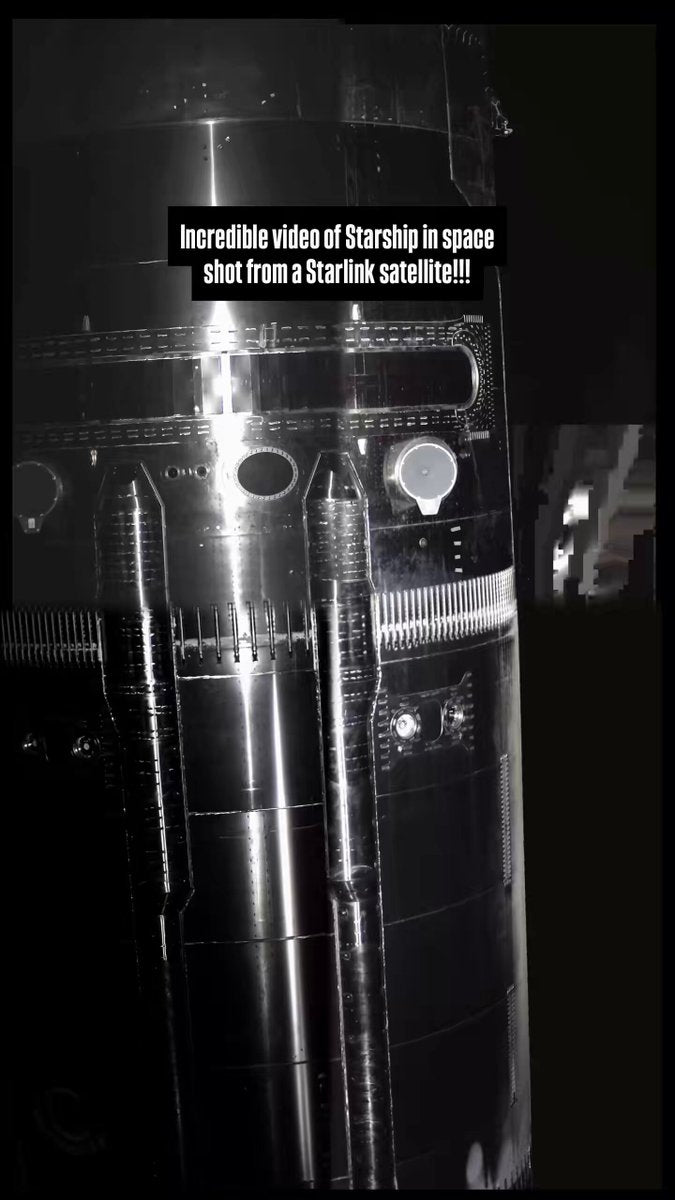
SpaceX just released something genuinely new: a 65-second video of Starship's upper stage cruising through space, shot not from the ground or from Starship itself, but from one of the 20 Starlink V3 satellites deployed during the vehicle's 13th test flight on July 24, 2026. Everyday Astronaut called it 'incredible' — and the technical story behind how it was captured is just as interesting as the footage itself.

1. This Was Starship's 13th Test Flight — and Its First Functional Payload
Flight 13 launched from Starbase, Texas on July 24, 2026, and marked a significant program milestone: it was the first time Starship deployed a batch of operational, revenue-generating Starlink V3 satellites rather than test hardware. Twenty satellites rode to space aboard Ship, making this the program's first real payload delivery mission. The footage is a direct product of that deployment — the satellites that were just released turned around and filmed the rocket that released them.
2. Six of the 20 Satellites Were Equipped With Cameras
Not every Starlink V3 on this flight was a passive observer. SpaceX outfitted six of the 20 deployed spacecraft with cameras specifically to obtain detailed views of Starship's heat shield. The 65-second video released by SpaceX is a composite of imagery taken by four different cameras mounted on a single Starlink V3 satellite — meaning one satellite alone had enough optical coverage to stitch together a multi-angle sequence of the 171-foot (52-meter) Ship.
3. Starship Actively Maneuvered to Face the Camera
The footage isn't a lucky snapshot. According to Space.com, Starship used its attitude control system (ACS) thrusters to rotate the vehicle so its heat shield faced the observing satellite. You can see the evidence in the video itself: small puffs of white vapor from the reaction control thrusters, and three of Ship's six Raptor engines firing as it cruised away. A functional test of the flaps was also captured during the sequence. This was a coordinated imaging operation, not an accidental sighting.
4. The Heat Shield Is the Real Subject of the Footage
The visual spectacle is striking, but the engineering purpose is specific. SpaceX used the satellite cameras primarily to inspect Starship's heat shield — the critical thermal protection system that must survive reentry temperatures during future return-to-launch-site missions. Getting a direct orbital view of the shield's condition, without relying on ground-based tracking or onboard cameras alone, gives engineers a new diagnostic tool for assessing readiness before each attempted recovery.
5. The Satellites Themselves Only Stayed in Space for About 20 Minutes
Flight 13 was a suborbital mission, which means the 20 Starlink V3 satellites deployed on it were never intended to reach a stable orbit. According to Space.com, the entire batch re-entered Earth's atmosphere approximately 20 minutes after deployment. That's an extremely narrow window — the imaging had to happen fast, and the satellites had to be in exactly the right position relative to Ship to capture anything useful. The fact that four cameras on one satellite produced a coherent 65-second composite under those constraints is a notable operational achievement.
6. Starlink V3 Is a Significant Hardware Leap — and SpaceX Plans 100,000 of Them
The cameras are just one capability of the new generation. Starlink V3 satellites are designed to support 1 Tbps of downlink and 160 Gbps of uplink capacity — a substantial step up from V2. Each satellite features upgraded phased array antennas with 2,048 beams in each direction and six high-capacity 400 Gbps space lasers for inter-satellite links. SpaceX's long-term plan calls for a megaconstellation of 100,000 V3 satellites. If even a fraction of those carry cameras, SpaceX will have built a persistent orbital observation network that can monitor Starship operations from space on every future flight.
Everyday Astronaut noted he'd love to see daylight imagery from future missions — and given that SpaceX deliberately designed this imaging capability into the V3 hardware, that's almost certainly coming. The more interesting question is whether this satellite-to-spacecraft observation model eventually becomes a standard part of Starship's flight data package, giving engineers an external orbital perspective on every test from here on out. For a program that has moved this fast, that would be a meaningful operational upgrade. For our SpaceX coverage, follow along as Flight 14 planning gets underway.
🚀 Following the Starship program? See every test flight, official outcome and the next launch window in our SpaceX Starship Tracker.
Sources & reporting notes
The links below identify the material source records used for this report.
- @Erdayastronaut on X (2026-07-31T21:34:15.000Z) — Direct source
Source links are preserved as published or accessed. See our editorial standards and corrections policy.
The BASENOR Editorial Desk covers Tesla, SpaceX, and related technology, curating reporting from primary sources — official accounts, regulatory filings, and software release data. Every article passes source-record and fact-checking review before publication. About the newsroom.
This report was curated by the BASENOR Editorial Desk from the sources listed above. Read our editorial standards or email editorial@basenor.com to report an error.