After more than a dozen test flights and years of engineering work, SpaceX's Starship finally did what it was built to do: reach orbit with a real payload. Flight 14, which lifted off from Starbase, Texas on September 28, 2026, deployed 26 Starlink Version 3 satellites — making it the rocket's first revenue-generating mission. Here's what actually happened, and why it matters beyond the headline.

1. This Was Starship's 14th Flight — and Its First With a Real Payload
Every prior Starship flight was a test. Flight 14 changed that. For the first time, the rocket carried an operational payload — 26 Starlink V3 satellites — and successfully delivered them to orbit. SpaceX describes this as the mission that all the prior development was building toward, and the company confirmed all 26 satellites were deployed successfully. It also marks Starship's transition from experimental vehicle to operational launch system.
2. The Starlink V3 Satellites Are a Generational Leap
These aren't incremental upgrades. Each Starlink V3 satellite delivers approximately 1 terabit per second (Tbps) of downlink capacity — a tenfold increase over the V2 generation. Uplink capacity is 22 times greater than V2. Each satellite also weighs close to 2 tons, which is part of why Starship's massive payload capacity is essential to deploying them at scale. According to verified sources, the successful deployment clears the path for V3 satellites to begin serving customers within weeks.
3. Engines Shut Down Early — and the Mission Succeeded Anyway
This is the detail that most coverage glossed over. During ascent, one Raptor engine on the Super Heavy booster shut down early. Then, during the upper stage burn, a single Raptor vacuum engine also cut out ahead of schedule. Despite both anomalies, Starship still completed its orbit insertion burn and reached its planned trajectory. The mission was shortened from a planned 10-hour, six-orbit flight to roughly three hours, but all primary objectives — orbit and payload deployment — were achieved.
4. Starship Completed Its First-Ever Deorbit Burn and Reentry
Flight 14 logged several firsts beyond just reaching orbit. The Starship upper stage performed its first-ever deorbit burn, survived atmospheric reentry, and descended to its intended splashdown point in the Pacific Ocean. The Super Heavy booster, meanwhile, executed a boostback burn and splashed down in the Gulf of Mexico. SpaceX did not attempt to recover either vehicle from the water on this mission — the focus was proving the full flight profile end-to-end.
5. The Numbers Behind the Rocket Are Still Staggering
For context on what just flew: Starship stands approximately 124 meters (407 feet) tall when fully stacked and measures 9 meters (29.5 feet) in diameter. The Super Heavy booster ignited all 33 of its Raptor 3 engines at liftoff. In fully reusable configuration, Starship's target payload capacity to low Earth orbit is 100–150 tonnes — far beyond any other operational rocket. Flight 14 carried 26 satellites; SpaceX's stated goal is to routinely fly 40–60 V3 satellites per mission going forward.
6. Flight 15 Will Attempt Something Even More Ambitious
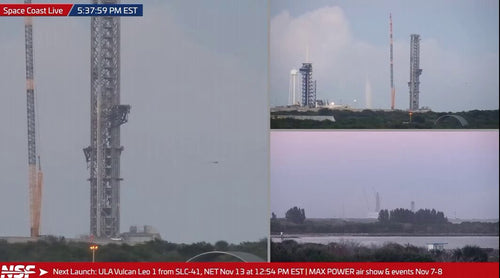
SpaceX isn't pausing to celebrate. Flight 15 is currently targeted for November 13, 2026, and the ambition is significant: it will attempt the first-ever catch of the Starship upper stage using the launch tower's mechanical arms — the same "chopstick" system that has already caught the Super Heavy booster on previous flights. If successful, it would be the final piece needed to make Starship fully and rapidly reusable, which is the core economic argument for the entire program.
Flight 14 answered the foundational question — can Starship reach orbit and deploy a working payload? The answer is yes, even with mid-flight engine anomalies. The next question is whether SpaceX can make the full system catch-and-refly routine. Flight 15 will tell us a lot. For more on SpaceX's progress, follow our SpaceX coverage.
🚀 Following the Starship program? See every test flight, official outcome and the next launch window in our SpaceX Starship Tracker.
Sources & reporting notes
The links below identify the material source records used for this report.
- @SpaceX on X (2026-11-06T14:56:55.000Z) — Direct source
Source links are preserved as published or accessed. See our editorial standards and corrections policy.
The BASENOR Editorial Desk covers Tesla, SpaceX, and related technology, curating reporting from primary sources — official accounts, regulatory filings, and software release data. Every article passes source-record and fact-checking review before publication. About the newsroom.
This report was curated by the BASENOR Editorial Desk from the sources listed above. Read our editorial standards or email editorial@basenor.com to report an error.