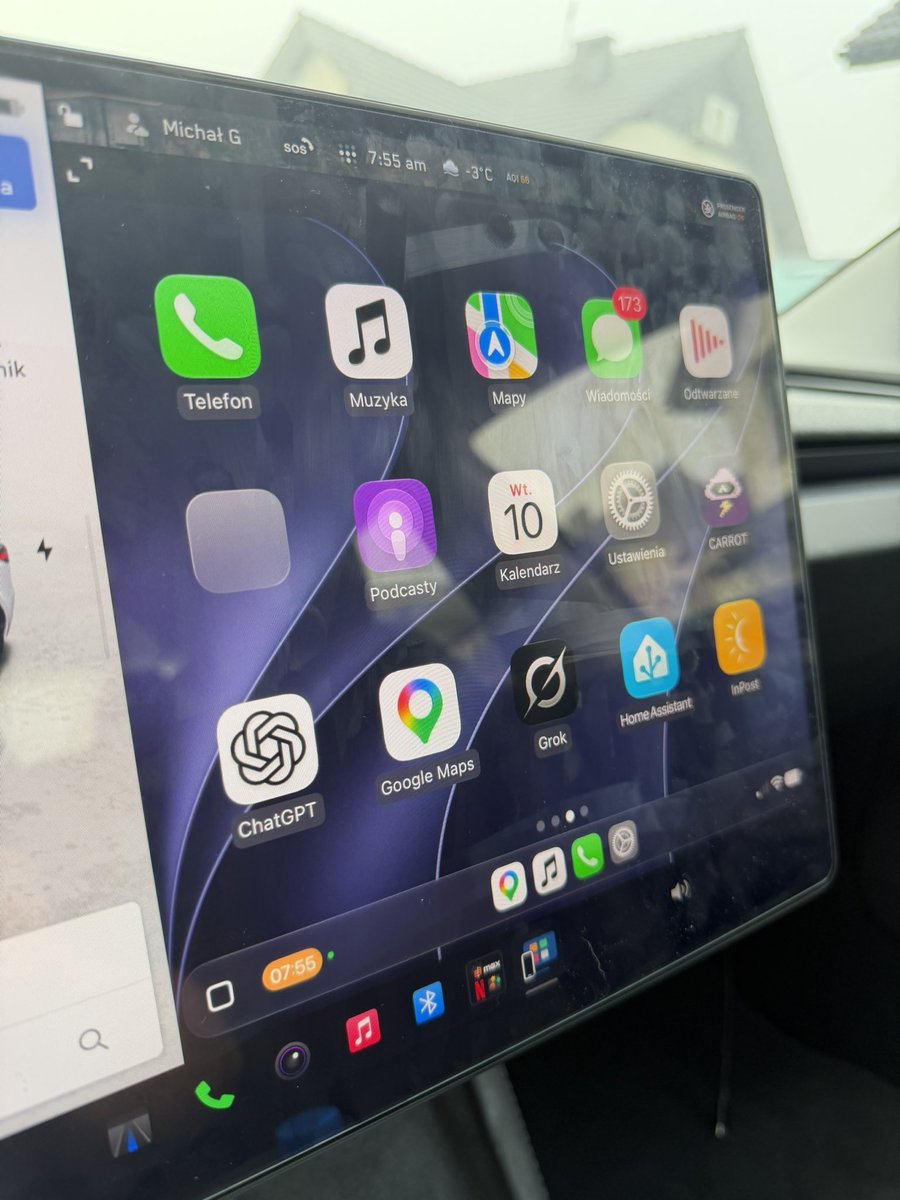
A native Apple CarPlay port for Tesla is no longer a distant dream. Developers Michał Gapiński — the creator of the Tesla Android project — and Maciej Wilczyński demonstrated significant advances in October 2026, and the progress is more substantial than previous browser-based or external hardware workarounds. Here are the four developments worth paying attention to.

1. It Now Works Wirelessly
Earlier CarPlay experiments on Tesla required a wired connection or external hardware. This implementation connects wirelessly and appears as a native window directly on the Tesla's touchscreen — no dongle, no cable dangling from the glovebox. According to reporting on the demonstration, the system runs as a dedicated app within a modified Tesla software environment, enabled by an exploit on AMD Ryzen-powered infotainment hardware. Wireless CarPlay is table stakes on any modern head unit; hitting that bar matters.
2. Multiple Layout Options Are Available
The port isn't locked into one display mode. CarPlay can run in a window on the right side of the screen while Tesla's native vehicle controls remain visible on the left — meaning you don't lose access to climate, drive modes, or the energy display. A full-screen expansion option is also available for when you want CarPlay to take over entirely. That split-screen approach is a smart concession to Tesla's UI philosophy, where vehicle controls aren't buried in a separate menu.

3. Siri Has Full Microphone Access
Voice assistant integration is often the first thing to break in third-party CarPlay hacks. Here, Siri works through Tesla's built-in microphones — you can invoke it and issue commands without reaching for your phone. That's a non-trivial integration; it means the port has access to the car's audio hardware at a level that goes beyond screen mirroring. For iPhone users who rely on Siri for navigation, messaging, or music control while driving, this is the detail that separates a demo from something genuinely usable.

4. Apple Music Plays Back in Lossless Audio
Lossless playback through Apple Music is confirmed working — meaning the audio pipeline isn't being compressed or resampled through an intermediary layer in a way that degrades quality. Wilczyński also demonstrated AirPlay screen mirroring from a MacBook, though that feature currently shows black borders; a planned update is expected to fill the full display. The lossless audio result is the more immediately relevant win for daily use.

Where Things Stand
To be clear about what this is and isn't: as of November 10, 2026, this remains a developer demonstration running on a modified Tesla with an AMD Ryzen infotainment system, using an exploit developed by @CoilShift. It is not a finished product, there is no public download, and neither Gapiński nor Wilczyński has confirmed whether or when it will be released to other owners. The hardware requirement also means compatibility is not universal across the Tesla fleet.
That said, the gap between "proof of concept" and "something worth watching" has closed considerably. Wireless connectivity, split-screen layout, working Siri, and lossless audio in a single demo represents more functional depth than most third-party CarPlay projects reach. Whether it ever ships publicly — and what Tesla's response would be to a widely distributed exploit — remains the open question.
Related Gear
Gear up your Tesla with tested, custom-fit BASENOR accessories — shop Tesla accessories →
Sources & reporting notes
The links below identify the material source records used for this report.
- @TeslaNewswire on X (2026-11-10T12:57:00.000Z) — Direct source
Source links are preserved as published or accessed. See our editorial standards and corrections policy.
The BASENOR Editorial Desk covers Tesla, SpaceX, and related technology, curating reporting from primary sources — official accounts, regulatory filings, and software release data. Every article passes source-record and fact-checking review before publication. About the newsroom.
This report was curated by the BASENOR Editorial Desk from the sources listed above. Read our editorial standards or email editorial@basenor.com to report an error.