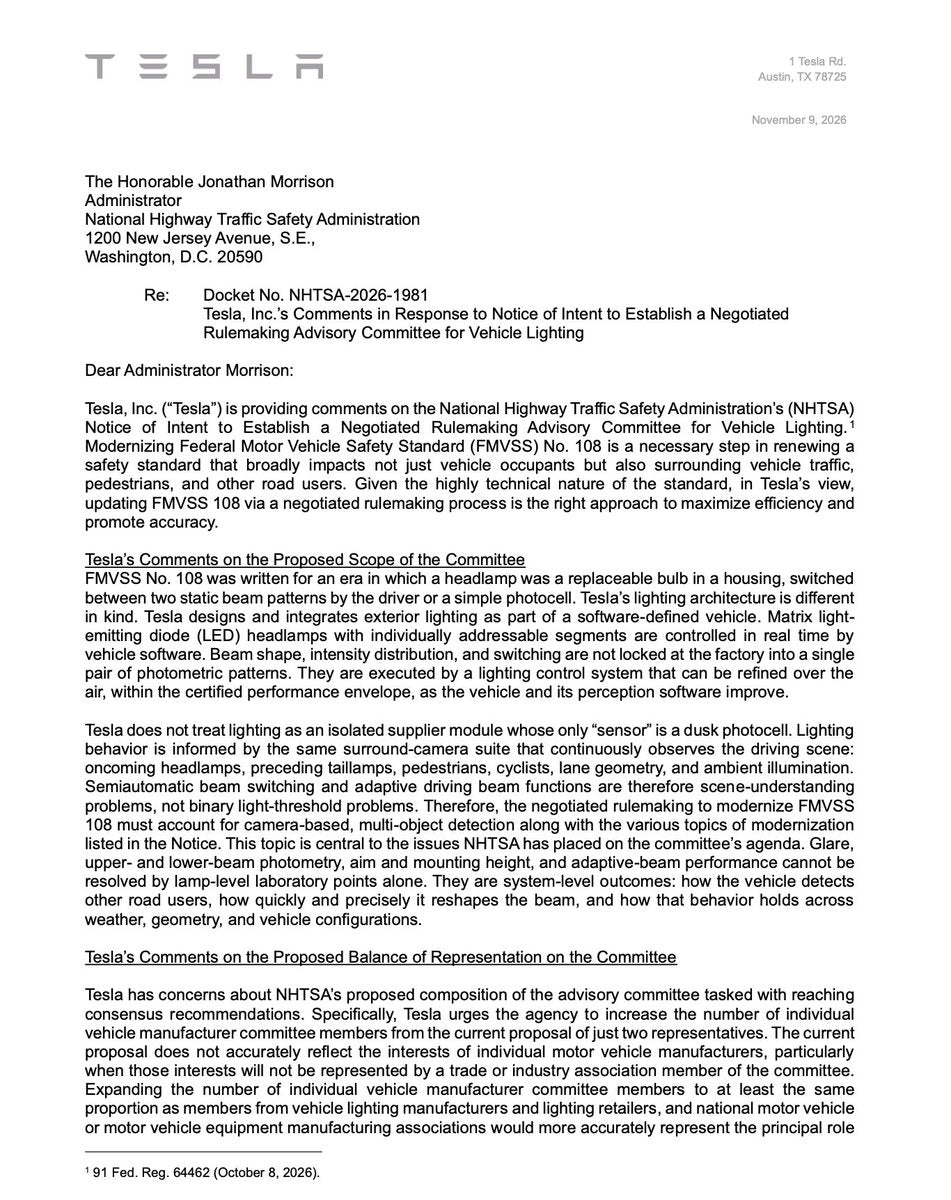
Tesla has formally petitioned the National Highway Traffic Safety Administration to overhaul U.S. vehicle lighting regulations, arguing that the current rulebook was written for an era of fixed halogen bulbs — not the camera-driven, pixel-level matrix LED systems that modern vehicles are capable of deploying. The filing lands just as NHTSA itself has opened a broader review of Federal Motor Vehicle Safety Standard No. 108, the foundational rule that governs how headlights must behave on American roads.

The Core Argument
Tesla's letter to NHTSA centers on a straightforward but consequential mismatch: existing FMVSS No. 108 requirements were designed around static headlight systems. Matrix LED technology — sometimes called Adaptive Driving Beam, or ADB — works fundamentally differently. These systems use onboard cameras to detect other vehicles in real time and then selectively dim individual LEDs within the headlight array to avoid blinding oncoming drivers, while keeping the rest of the road brightly illuminated.
The result, in theory, is a headlight that provides near-high-beam visibility at all times without the glare penalty that forces drivers to manually switch to low beams. The problem is that the U.S. regulatory framework hasn't kept pace. While NHTSA authorized compliant ADB systems back in February 2022, the specific performance requirements that followed have constrained how effectively these systems can operate in practice — limiting the safety benefit that the underlying technology is capable of delivering.
NHTSA's Parallel Review
Tesla's petition arrives at a moment of genuine regulatory movement. On October 6, 2026, NHTSA announced a formal modernization effort for FMVSS No. 108 — the most significant review of U.S. vehicle lighting standards in years. According to federal records, the scope covers headlight glare and aim, newer lighting technologies including LEDs and automatic high beams, dusk sensors, replaceable light sources, and alignment with international standards. Adaptive driving beam systems are explicitly part of the review.
NHTSA is pursuing a negotiated rulemaking process, engaging up to 18 stakeholders to develop recommendations. The comment period for committee scope and membership applications closed on November 9, 2026 — one day before Tesla's letter was reported — under docket number NHTSA-2026-1981. No completion date for the rulemaking has been announced.
Regulatory Filing
Agency: National Highway Traffic Safety Administration (NHTSA)
Standard Under Review: FMVSS No. 108 — Vehicle Lighting
NHTSA Review Announced: October 6, 2026
Comment Deadline: November 9, 2026
Docket: NHTSA-2026-1981
Process: Negotiated rulemaking, up to 18 stakeholders
Completion Date: Not announced
Why This Matters Beyond Tesla
The regulatory gap Tesla is highlighting isn't a Tesla-specific problem — it affects any automaker trying to bring advanced lighting technology to U.S. consumers. European and Asian markets have operated under more permissive international standards for years, meaning vehicles sold abroad can take fuller advantage of matrix LED capabilities than their American counterparts. Aligning FMVSS No. 108 with international standards is one of the stated goals of NHTSA's current review, which suggests Tesla's petition is pushing on a door that's already ajar.
For Tesla owners specifically, the stakes are concrete. Tesla's vehicles are equipped with camera arrays that could, in principle, support more sophisticated ADB functionality than current U.S. rules allow. A regulatory update wouldn't necessarily require new hardware — it could unlock capability through software, the same way many Tesla features have evolved over time.
The Separate Headlight Recall Context
It's worth noting that Tesla's advocacy for updated lighting rules runs alongside a less favorable recent history with NHTSA on the same standard. In July 2026, NHTSA denied a separate Tesla petition related to headlight brightness non-compliance affecting approximately 20,349 Model 3 and Model Y vehicles from model years 2017 through 2023. Tesla had argued the non-compliance was inconsequential to safety; NHTSA disagreed and mandated a recall requiring physical headlamp replacement. The two matters are legally distinct — one is a compliance dispute over existing rules, the other is a forward-looking argument to change those rules — but together they illustrate how much FMVSS No. 108 has become a recurring friction point between Tesla and federal regulators.
Whether NHTSA's ongoing rulemaking process moves quickly enough to matter for vehicles currently on the road remains the open question. Negotiated rulemakings are thorough by design, but they are rarely fast. Tesla's letter is a public signal that the company intends to stay engaged in that process — and that it sees modernized lighting standards not just as a regulatory checkbox, but as a meaningful safety and capability unlock for its fleet.
Related Gear
Gear up your Tesla with tested, custom-fit BASENOR accessories — shop Tesla accessories →
Sources & reporting notes
The links below identify the material source records used for this report.
- @SawyerMerritt on X (2026-11-10T14:43:30.000Z) — Direct source
- @SawyerMerritt on X (2026-11-10T14:43:30.000Z) — Direct source
Source links are preserved as published or accessed. See our editorial standards and corrections policy.
The BASENOR Editorial Desk covers Tesla, SpaceX, and related technology, curating reporting from primary sources — official accounts, regulatory filings, and software release data. Every article passes source-record and fact-checking review before publication. About the newsroom.
This report was curated by the BASENOR Editorial Desk from the sources listed above. Read our editorial standards or email editorial@basenor.com to report an error.