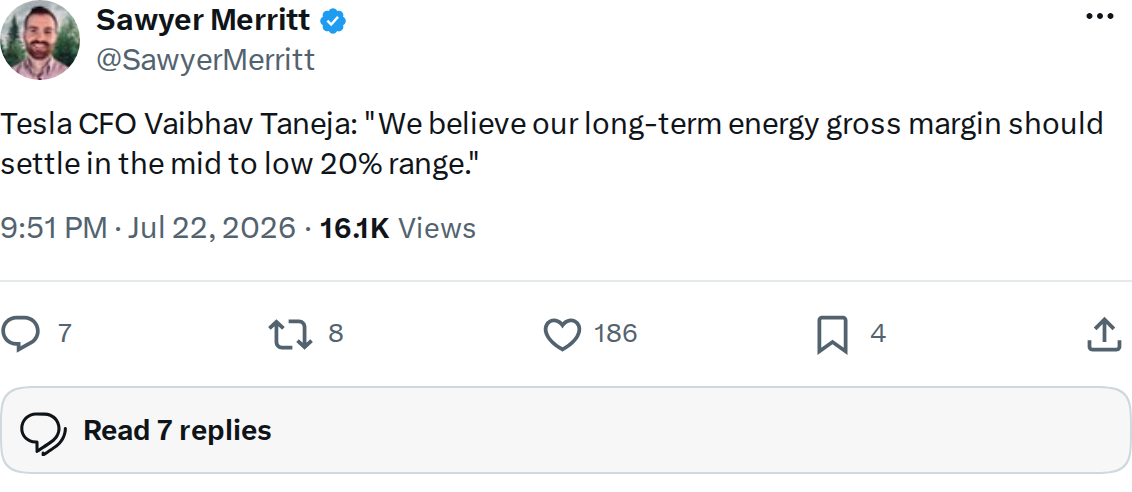
During Tesla's Q2 2026 earnings call on July 22, CFO Vaibhav Taneja put a number on where the company expects its energy business to land over the long run: a gross margin in the mid to low 20% range. That's a notable reset from recent performance — and it signals how Tesla is thinking about a segment that has become one of its fastest-growing revenue lines.

Why the Number Matters
Tesla's energy storage segment — anchored by Megapack deployments for utilities and grid operators — posted a gross margin exceeding 39.5% in Q1 2026. That figure looked exceptional on paper, but it included approximately $250 million in one-time tariff benefits that inflated the result. Strip those out and the underlying margin picture was already softer.
Taneja flagged margin compression ahead during the Q1 call in April, pointing to three pressures: intensifying competition from low-cost manufacturers, policy uncertainty affecting project economics, and the direct cost impact of tariffs on components. The mid-to-low 20% long-term target, stated explicitly on the Q2 call, is management telling investors not to anchor to the elevated recent prints.
Analysts had been estimating the segment's full-year 2026 gross margin near 29% — roughly flat with recent quarters — but with acknowledged downside risk. Taneja's guidance lands below that consensus range, suggesting Tesla's own internal modeling anticipates the competitive and tariff pressures to bite harder than the sell-side has priced in.
The Competitive Context
The energy storage market is no longer a space where Tesla operates without serious pricing pressure. Chinese manufacturers have been aggressively expanding into international utility-scale markets, and their cost structures allow them to bid projects at margins that squeeze incumbents. Tesla's Megapack retains advantages in software integration, grid services capability, and supply chain reliability — but those advantages translate into a premium that utilities are increasingly willing to scrutinize.
A settled long-term margin in the mid-to-low 20s is still a healthy business. For context, Tesla's automotive gross margin has hovered in a similar or lower range in recent quarters as the company navigated price cuts and mix shifts. The energy segment at 20-24% would be generating real profit at scale — but it represents a significant step down from the 30-40% range that briefly made the segment look like a high-margin software-adjacent business.
What It Means for Tesla's Overall Story
Tesla has been positioning energy as a second major profit engine alongside automotive. The Q1 tariff windfall and prior strong margins had fueled optimism that energy could eventually carry margins above the auto business. Taneja's explicit long-term target recalibrates that narrative: energy will be a meaningful, profitable contributor, but not a margin outlier.
The more important variable now is volume. If Tesla can deploy Megapacks at scale — and the backlog has remained robust — then a 20-23% margin on a rapidly growing revenue base still compounds into a significant earnings contributor. The CFO's statement is less a warning and more a floor: this is where the business normalizes, and Tesla is comfortable building around it.
Whether that floor holds will depend on how quickly Tesla can reduce its own cost structure relative to the competition — and how much of the current tariff environment proves durable versus transient. The Q3 earnings call in October will be the next real data point on whether the compression is tracking as management expects.
Related Gear
Gear up your Tesla with tested, custom-fit BASENOR accessories — shop Tesla accessories →
Sources & reporting notes
The links below identify the material source records used for this report.
- @SawyerMerritt on X (2026-07-22T21:51:39.000Z) — Direct source
Source links are preserved as published or accessed. See our editorial standards and corrections policy.
The BASENOR Editorial Desk covers Tesla, SpaceX, and related technology, curating reporting from primary sources — official accounts, regulatory filings, and software release data. Every article passes source-record and fact-checking review before publication. About the newsroom.
This report was curated by the BASENOR Editorial Desk from the sources listed above. Read our editorial standards or email editorial@basenor.com to report an error.