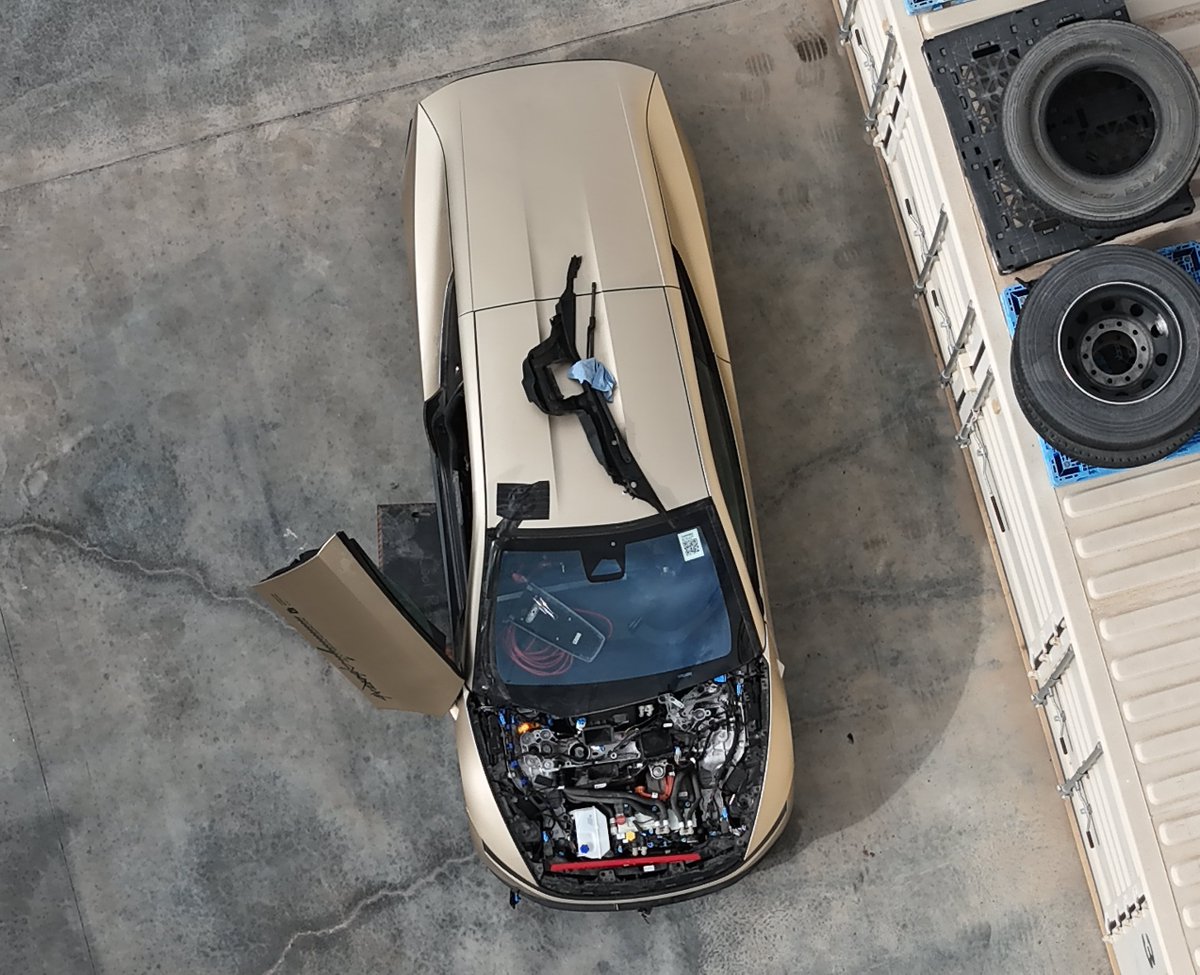
The News: Aerial footage of the Tesla Cybercab provides the clearest look yet at what lives under the front hood and how much clearance the butterfly doors need to swing open.
Why It Matters: With volume production slated for April 2026, these design details reveal real-world practicalities — frunk utility, door clearance requirements, and accessibility features — that will affect every future Cybercab rider.
Source: @TeslaNewswire on X
Tesla Cybercab Aerial Shot Reveals What's Under the Frunk and How the Butterfly Doors Actually Work
A new aerial shot of the Tesla Cybercab is giving enthusiasts and future riders the most detailed look yet at two of the vehicle's most talked-about design elements: the front hood compartment and the unique butterfly door mechanism. With volume production reportedly beginning in April 2026, these aren't just aesthetic curiosities — they're practical engineering decisions that define how the world's first mass-market robotaxi will actually function.

📊 Key Figures
| Detail | What We Know |
|---|---|
| First mass-produced unit | Rolled off Gigafactory Texas line, February 2026 |
| Volume production start | April 2026 (confirmed) |
| Passenger capacity | 2 passengers, no steering wheel or pedals |
| Door type | Power-operated butterfly doors, no exterior handles |
| Door release system | Two-pull: gentle pull = electronic open; firm pull = mechanical emergency release |
What's Actually Under That Front Hood?
The Cybercab's front hood compartment is compact and densely packed — don't expect a Model Y-sized frunk for your grocery run. According to footage and observations from earlier this year, the space is occupied almost entirely by the vehicle's core operating systems: the HVAC system, the FSD computer, a low-voltage battery, a lithium-ion battery, and steering motors for autonomous operation.
One standout detail: the washer fluid reservoir is reportedly larger than what you'd find in a Model Y. That's not an oversight — it's intentional engineering. The Cybercab relies on a dense array of cameras and sensors to operate autonomously, and keeping those optics clean in rain, snow, or road grime is critical to safe FSD operation. A larger reservoir means longer intervals between refills, which matters enormously for a vehicle designed to run continuously as a robotaxi with minimal human intervention.
In short, the frunk isn't a storage space. It's the brain of the vehicle.
The Butterfly Doors: More Engineered Than They Look
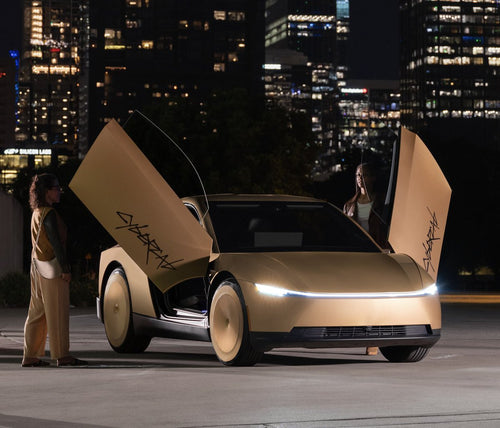
The aerial perspective makes one thing immediately clear: the Cybercab's butterfly doors require meaningful overhead and lateral clearance to open fully. This isn't a minor consideration for urban deployment — fleet operators and parking infrastructure will need to account for it.
But the door system is more sophisticated than early prototypes suggested. As of late March 2026, Tesla has incorporated an entirely new door mechanism featuring a two-pull system. A gentle pull triggers electronic opening; a firmer pull engages a purely mechanical emergency release — a critical safety redundancy for a vehicle with no driver present.
The doors are power-operated and close automatically once a passenger is seated, similar in behavior to the powered doors on the Model X. But unlike the Model X's falcon-wing doors — which require complex sensors and actuators to avoid obstacles — the Cybercab's butterfly design is described as mechanically simpler while still offering wide, unobstructed entry.
There's also a notable accessibility dimension. A lead Tesla engineer confirmed in March that the butterfly door configuration is specifically designed to facilitate parallel wheelchair parking. Because the doors swing up and outward rather than out to the side, the door itself never becomes an obstacle during a wheelchair transfer — a thoughtful design choice for a vehicle intended to serve all riders autonomously. The door handles also include raised braille lettering for visually impaired passengers.
No exterior door handles exist on the Cybercab. Entry is managed entirely through the electronic system or, in an emergency, the mechanical two-pull release.
🔭 The BASENOR Take
Timeline: First unit produced February 2026 → Volume production April 2026 → Aerial design details emerging March 30, 2026
Impact Level: High — These details shape real-world robotaxi deployment logistics
Confidence: High — Multiple footage sources and engineer statements corroborate the findings
What this aerial shot really tells us is that Tesla has been solving problems most people haven't thought about yet. A frunk packed with HVAC, FSD compute, and an oversized washer reservoir isn't glamorous — but it's the kind of engineering that keeps a driverless vehicle running reliably at scale. The large washer reservoir in particular is a small detail with enormous operational implications: a robotaxi that can't see clearly is a robotaxi that can't work.
The butterfly door story is equally telling. The two-pull emergency release, the braille lettering, the wheelchair-optimized opening arc — these aren't features you add for a concept car. They're features you add when you're preparing for real-world regulatory scrutiny and genuine public deployment. Tesla is clearly thinking about the Cybercab not just as a product, but as public transit infrastructure.
The clearance requirement for the doors is the one detail that will demand attention from fleet operators. Urban environments — tight parking garages, curbside drop zones, narrow lanes — will need to be evaluated against the door's sweep. Tesla will almost certainly address this in its robotaxi deployment guidelines, but it's a practical constraint that distinguishes the Cybercab from a conventional vehicle in ways that go beyond the missing steering wheel.
With volume production weeks away, every new detail like this one matters. The Cybercab is no longer a concept — it's a vehicle being engineered for the real world, and the real world is complicated. So far, the engineering answers look solid.
🚕 Following the Robotaxi rollout? See every operating city, launch date and announced market in our Tesla Robotaxi Tracker.
Related Gear
Gear up your Tesla with tested, custom-fit BASENOR accessories — shop Tesla accessories →
Sources & reporting notes
The links below identify the material source records used for this report.
- @TeslaNewswire on X (2026-03-30T18:56:55.000Z) — Direct source
Source links are preserved as published or accessed. See our editorial standards and corrections policy.
The BASENOR Editorial Desk covers Tesla, SpaceX, and related technology, curating reporting from primary sources — official accounts, regulatory filings, and software release data. Every article passes source-record and fact-checking review before publication. About the newsroom.
This report was curated by the BASENOR Editorial Desk from the sources listed above. Read our editorial standards or email editorial@basenor.com to report an error.