📌 UPDATE — July 1, 2026
Tesla's Cybercab Robotaxi service appears to be nearing launch in the Miami area, with real-world first responder training now underway. This week, Coral Gables, Florida Fire Department personnel completed a specialized training session with Tesla covering the Robotaxi platform's safety systems and emergency response protocols — a strong signal that commercial deployment in the region is imminent. The training aligns directly with the emergency procedures outlined in the First Responders Guide covered in this article, now being put into practice at the local level. No official launch date has been announced by Tesla.
@SawyerMerritt · July 1, 2026
"Looks like @Tesla is getting closer to launching its Robotaxi service in the Miami area. This week, Coral Gables, Florida Fire personnel participated in a specialized training session with Tesla, focusing on the safety systems & emergency response for Tesla's Robotaxi platform."
View on X →
📌 UPDATE — June 29, 2026
The Texas Department of Public Safety has officially added the Tesla Cybercab to its Connected Autonomous Vehicles First Responder Interaction Plans page — a meaningful regulatory milestone signaling that real-world deployment of Tesla's autonomous ride-hailing service in Texas is drawing closer. This marks the first time a state-level public safety agency has formally incorporated the Cybercab into its emergency responder framework, going beyond Tesla's own internal guide. The listing means Texas first responders will have state-sanctioned protocols for interacting with Cybercabs on public roads, a prerequisite for large-scale commercial AV operations in the state.

📣 @SawyerMerritt via X — June 29, 2026
📌 UPDATE — June 28, 2026
New official Tesla documentation has clarified a key distinction for identifying production Cybercabs: vehicles equipped with a steering wheel, brake pedal, and acceleration pedal are engineering or test units operating at SAE Level 2, while production Cybercabs will not typically carry these controls. The documentation also confirms that an official Cybercab decal identifies vehicles operating within Tesla's Robotaxi service — separate from test vehicles or customer-owned units. Additionally, new documentation hints the Cybercab may be Tesla's first front-wheel-drive vehicle 🔍, a detail flagged by @wholemars. Prominent Tesla observer @SawyerMerritt noted the documentation drop feels like a signal that first public Cybercab rides are imminent.

Source: @SawyerMerritt · @wholemars · June 27, 2026
📌 UPDATE — June 27, 2026
Tesla's published Cybercab First Responders Guide has surfaced additional granular details beyond the initial report. All Cybercabs in active service will display a "Cybercab" wordmark prominently on the sides and trunk — a key visual identifier for first responders on scene. The guide also documents the vehicle's airbag system layout specific to the Cybercab's two-seat, no-steering-wheel configuration, which differs significantly from conventional Tesla models. Additionally, the document outlines precise autonomous behavior protocols for when the vehicle detects emergency lights and sirens, providing responders with clearer expectations of how the robotaxi will react during an active incident.

Source: @TeslaNewswire · June 27, 2026
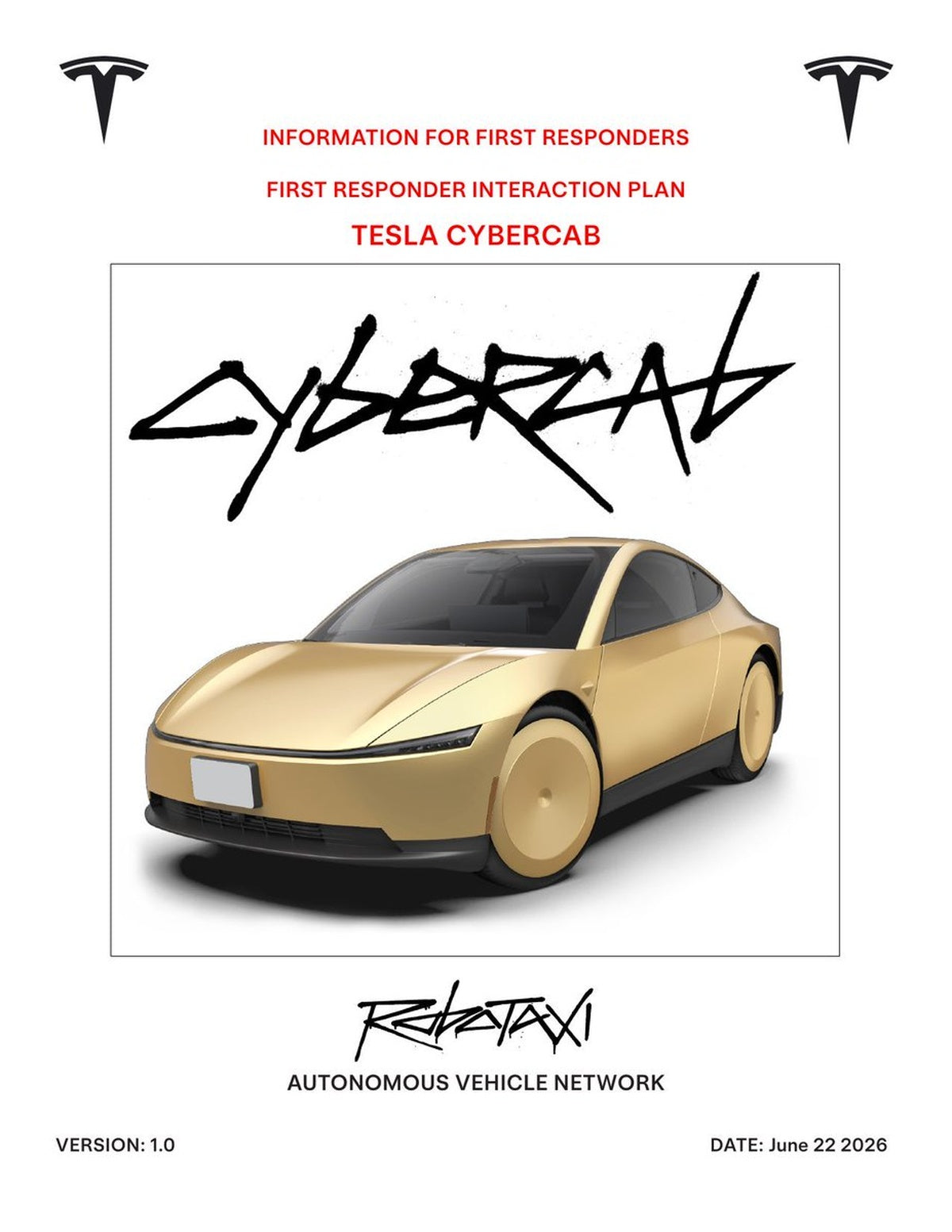
Tesla has quietly published a First Responders Guide for the Cybercab — and buried inside are some of the most concrete technical confirmations we've seen yet on the autonomous robotaxi. From its official SAE autonomy classification to how it behaves around emergency vehicles, the guide fills in details that Tesla hadn't formally stated in a single document before now.

Here are the five most important things the guide reveals for anyone following the Cybercab rollout.
1. Unsupervised FSD Is Officially SAE Level 4
This is the headline confirmation. Tesla's First Responders Guide formally classifies the Cybercab's autonomous driving system as SAE Level 4 — meaning the vehicle can perform the entire dynamic driving task without any human input within its defined operational design domain. This isn't marketing language; SAE Level 4 is a specific technical standard, and Tesla has now put it in writing in an official safety document. For context, Texas updated its law on May 28, 2026 to allow companies to self-certify their autonomous systems as SAE Level 4 or higher for commercial driverless transportation — and Tesla has done exactly that.
2. The Cybercab Wordmark Appears on the Sides and Trunk
The guide confirms that vehicles in service will carry the "Cybercab" wordmark on both the sides and the trunk. This matters practically for first responders who need to quickly identify the vehicle type at an incident scene, but it also tells us something about how Tesla plans to brand the fleet in public. Expect the Cybercab name to be prominently visible rather than tucked away — a deliberate choice for a vehicle designed to operate autonomously in urban environments.
3. The Vehicle Responds Specifically to Emergency Lights and Sirens
The source tweet cuts off mid-sentence on this point, but it confirms the Cybercab has defined behavior protocols when it detects emergency lights and sirens. This is a standard requirement for any Level 4 autonomous vehicle operating on public roads — the system must be able to yield appropriately to emergency vehicles without human override. The fact that it's documented in a First Responders Guide suggests Tesla has worked directly with emergency services to define these scenarios.
4. Production Is Already Underway at Gigafactory Texas
The guide's publication isn't happening in a vacuum. According to verified production records, Cybercab manufacturing began at Gigafactory Texas in February 2026, with the EPA issuing a Certificate of Conformity for the 2026 model year on May 26, 2026. Volume production is targeted for the end of 2026. The First Responders Guide being live now aligns with a vehicle that is actively entering commercial service — this isn't pre-launch documentation.
5. The Specs Underneath the Autonomy Are Genuinely Impressive
While the guide focuses on emergency response protocols, the Cybercab's underlying hardware is worth noting as context. EPA filings show a roughly 47.6 kWh battery pack, a 163 kW (219 hp) front-mounted motor, and an unadjusted combined range of 418.2 miles — with an estimated EPA-adjusted figure near 293 miles. At 6 miles per kWh, it ranks among the most efficient EVs ever produced. The vehicle weighs 3,113 pounds and has no steering wheel or pedals, having been designed from the ground up for fully autonomous operation.
What This Means for the Autonomous Vehicle Landscape
A First Responders Guide is a mundane document by design — it exists to help firefighters and paramedics safely handle a vehicle at an accident scene. But the fact that Tesla has published one for the Cybercab signals something important: this vehicle is close enough to widespread deployment that emergency services need to be briefed. The SAE Level 4 confirmation in that document is the most authoritative statement Tesla has made about the Cybercab's autonomy level to date, and it carries more weight than a product page claim. Watch for fleet expansion announcements as volume production ramps toward the end of the year.
🚕 Following the Robotaxi rollout? See every operating city, launch date and announced market in our Tesla Robotaxi Tracker.
Related Gear
Gear up your Tesla with tested, custom-fit BASENOR accessories — shop Tesla accessories →
Sources & reporting notes
The links below identify the material source records used for this report.
- @TeslaNewswire on X (2026-06-27T21:45:32.000Z) — Direct source
- @TeslaNewswire on X (2026-06-27T21:57:14.000Z) — Direct source
- @SawyerMerritt on X (2026-06-27T23:01:02.000Z) — Direct source
- @SawyerMerritt on X (2026-06-27T23:04:09.000Z) — Direct source
- @wholemars on X (2026-06-27T23:24:51.000Z) — Direct source
- @wholemars on X (2026-06-27T23:06:52.000Z) — Direct source
- @SawyerMerritt on X (2026-06-29T18:32:35.000Z) — Direct source
- @SawyerMerritt on X (2026-07-01T05:39:06.000Z) — Direct source
Source links are preserved as published or accessed. See our editorial standards and corrections policy.
The BASENOR Editorial Desk covers Tesla, SpaceX, and related technology, curating reporting from primary sources — official accounts, regulatory filings, and software release data. Every article passes source-record and fact-checking review before publication. About the newsroom.
This report was curated by the BASENOR Editorial Desk from the sources listed above. Read our editorial standards or email editorial@basenor.com to report an error.