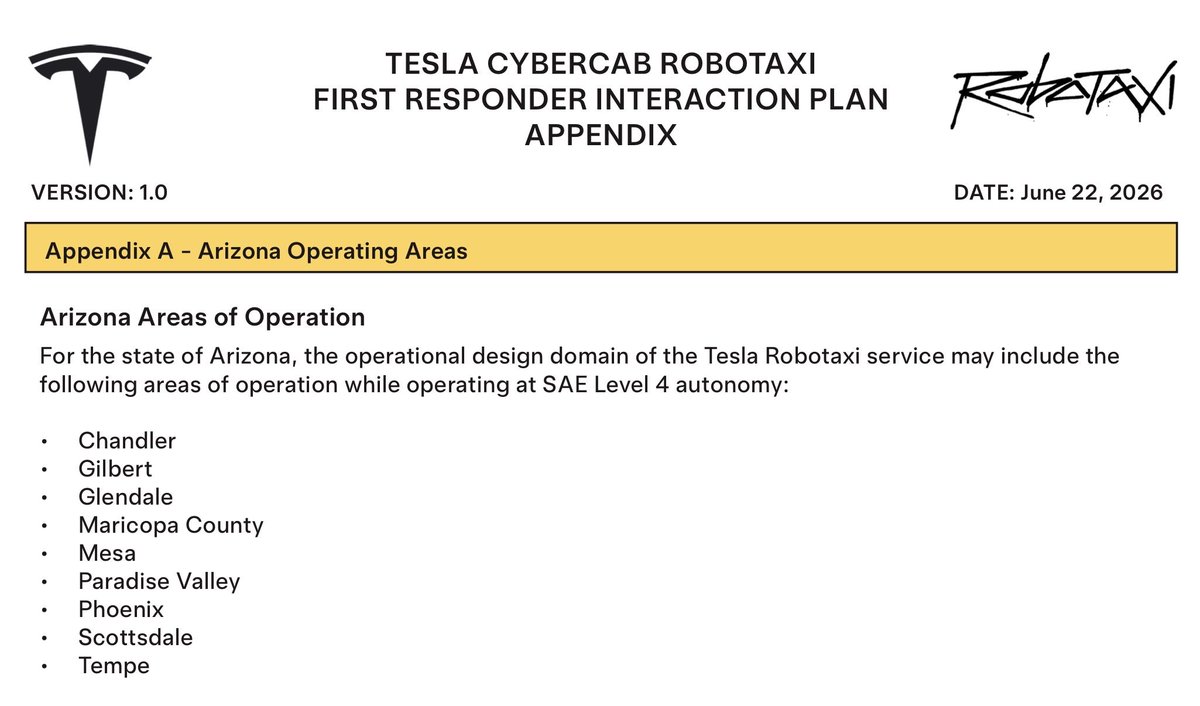
Tesla has officially disclosed the initial operating areas for its Cybercab Robotaxi service in Arizona, naming nine cities and regions across the greater Phoenix metro. The list — submitted as part of a Robotaxi First Responder Interaction Plan — gives the clearest picture yet of where driverless rides will first become available to the public in the state.

The Nine Operating Areas
The confirmed deployment zones span a broad swath of Maricopa County, covering both dense urban cores and affluent suburban corridors:
| City / Region | Notes |
|---|---|
| Phoenix | State capital; expected among first markets live |
| Scottsdale | Active Cybercab testing sightings as recently as June 2026 |
| Tempe | Dense urban corridor adjacent to Phoenix |
| Mesa | Site of a planned 56-stall private V4 Supercharger depot |
| Chandler | Second planned private V4 Supercharger depot; active test area |
| Gilbert | Fast-growing East Valley suburb |
| Glendale | Western metro anchor |
| Paradise Valley | Upscale enclave between Phoenix and Scottsdale |
| Maricopa County | Overarching county jurisdiction covering all above cities |
How Arizona Got Here
The groundwork for this rollout has been building for over a year. Arizona's Department of Transportation granted Tesla approval to operate as a transportation network company (TNC) in November 2025 — initially permitting commercial ride-hailing with a human driver present. That regulatory foothold was always intended as a stepping stone to fully driverless operation.
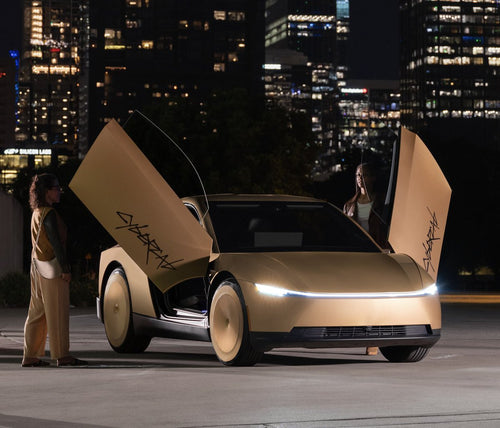
On the hardware side, approximately 60 Robotaxi-ready Model Y vehicles were spotted staged in a Phoenix parking lot back in April 2026, signaling the transition from closed testing to active pre-launch preparation. Those Model Ys carry a Robotaxi-specific rear camera washer not found on consumer vehicles. Meanwhile, the purpose-built Cybercab entered production at Gigafactory Texas in April 2026, with the EPA recording May 29, 2026 as its official introduction into commerce date — meaning purpose-built units are now available to deploy alongside the Model Y fleet.
Tesla has also been quietly building the charging backbone to support the Arizona fleet. Plans filed for Chandler and Mesa each detail dedicated private V4 Supercharger stations with 56 next-generation stalls — exclusively for Robotaxi use, not open to the public.
Context: Texas Is Already Running
Arizona is not Tesla's first Robotaxi market. The service is currently operating in Austin, Dallas, and Houston using Model Y vehicles. The Texas experience — including its operational data and edge-case handling — is almost certainly informing how Tesla structures the Arizona launch zones. The Phoenix metro's wide, grid-based road network and favorable weather make it a logical second major market before Tesla pushes into more complex urban environments.
One regulatory tailwind worth noting: on June 25, 2026, NHTSA proposed removing the federal requirement for manual brake pedals in fully autonomous vehicles. The Cybercab — which has no steering wheel or pedals by design — would directly benefit if that rule change is finalized after its 30-day public comment period.
With nine operating zones confirmed, dedicated charging infrastructure under development, and Cybercab units already spotted testing on public roads across the metro, the Arizona launch is moving from planning documents to physical reality. The remaining question is less whether the service goes live and more when Tesla flips the switch from staged testing to public availability.
🚕 Following the Robotaxi rollout? See every operating city, launch date and announced market in our Tesla Robotaxi Tracker.
Related Gear
Gear up your Tesla with tested, custom-fit BASENOR accessories — shop Tesla accessories →
Sources & reporting notes
The links below identify the material source records used for this report.
- @TeslaNewswire on X (2026-06-27T22:07:08.000Z) — Direct source
Source links are preserved as published or accessed. See our editorial standards and corrections policy.
The BASENOR Editorial Desk covers Tesla, SpaceX, and related technology, curating reporting from primary sources — official accounts, regulatory filings, and software release data. Every article passes source-record and fact-checking review before publication. About the newsroom.
This report was curated by the BASENOR Editorial Desk from the sources listed above. Read our editorial standards or email editorial@basenor.com to report an error.