30-Second Brief
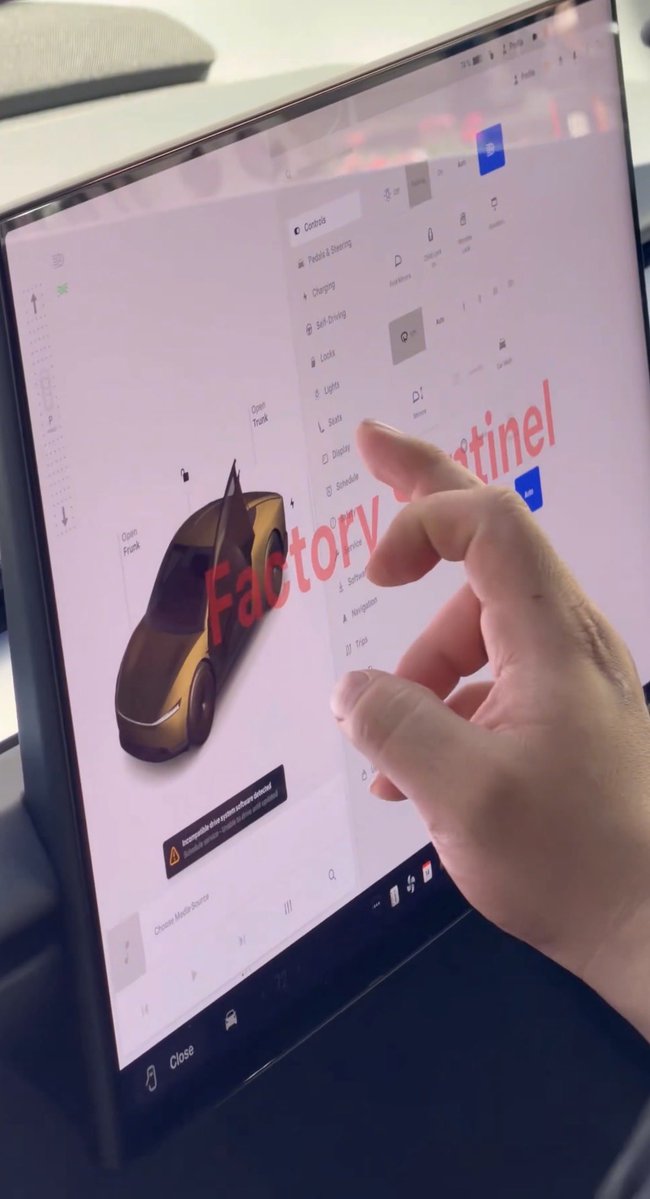
The News: Factory software screenshots of the Tesla Cybercab reveal a UI nearly identical to existing Tesla vehicles — including a surprising 'Pedals & Steering' menu and 'Fold Mirrors' button on a car that has neither pedals, a steering wheel, nor physical mirrors.
Why It Matters: This is the first real look at how Tesla plans to manage its fully autonomous robotaxi through software — and the familiar interface suggests the Cybercab shares far more DNA with current Tesla vehicles than previously understood.
Source: @TeslaNewswire on X
Tesla Cybercab UI Spotted Running Factory Software — And It Has a 'Pedals' Menu
The first real glimpse of the Tesla Cybercab's operating software is here, and it raises as many questions as it answers. Screenshots and video captured from a Cybercab running factory software show a user interface that will look immediately familiar to any current Tesla owner — but with a handful of details that reveal just how unusual this vehicle truly is.

📊 Key Figures
| Metric | Detail |
|---|---|
| Central Display Size | 21 inches — largest in any Tesla to date |
| FSD Version | Unsupervised FSD 12.5 |
| First Unit Off Line | March 9, 2026 — Gigafactory Texas |
| Mass Production Target | April 2026 |
| Expected Starting Price | Under $30,000 |
What the UI Actually Shows
The screenshots reveal five notable elements in the Cybercab's factory software build:
- A familiar Tesla UI layout — The overall design language mirrors what you'd find in a Model 3 or Model Y today. Tesla hasn't reinvented the interface for its robotaxi; it's adapted the existing one.
- 'Pedals & Steering' menu — The most eyebrow-raising discovery. The Cybercab has no steering wheel and no pedals by design. This menu almost certainly serves diagnostic, configuration, or autonomous system parameter functions rather than manual control settings.
- 'Mirrors Settings' and 'Fold Mirrors' button — The Cybercab replaces traditional side mirrors with cameras. Yet the UI retains mirror-related controls, likely managing the camera-based vision system in the same menu structure Tesla uses for mirror adjustments on conventional models.
- 'Self-Driving' menu — Expected, but confirmed. A dedicated section for managing the vehicle's autonomous functions, consistent with the Cybercab being built entirely around unsupervised FSD 12.5.
- 'Factory Sentinel' watermark — A watermark present on the factory software build, indicating this is pre-production software not intended for public release. Its presence confirms these screenshots come from an early production unit.
The tweet from @TeslaNewswire also references a warning message that appears to be cut off — suggesting there may be additional software flags or compatibility notices present in the factory build that haven't been fully captured yet.
The 21-Inch Screen: Why It Matters More Here Than Anywhere Else
In a conventional Tesla, the touchscreen is a convenience layer — you still have a steering wheel and pedals as primary controls. In the Cybercab, the 21-inch display is the control interface. Full stop. There's no fallback.
That context makes the 'Pedals & Steering' menu discovery particularly interesting. Tesla appears to have built the Cybercab's software on the same codebase as its existing vehicle lineup, repurposing existing menu structures for new functions rather than building a ground-up autonomous vehicle OS. It's a pragmatic engineering choice — and one that likely accelerates the development timeline significantly.
Production-ready Cybercabs spotted recently also feature relocated window controls, USB-C charging ports beneath the touchscreen, and physical door-release and emergency stop buttons with Braille lettering — all pointing to a vehicle designed around the passenger experience rather than a driver's.
🔭 The BASENOR Take
Timeline: First unit off the line March 9, 2026 → Mass production targeted for April 2026 → Regulatory approval still pending from NHTSA
Impact Level: 🟡 Medium-term — Cybercab won't affect most Tesla owners immediately, but the software architecture revealed here has implications for the entire fleet.
Confidence: High on UI observations (direct screenshots); Medium on menu function interpretations (no official Tesla commentary yet).
The most significant takeaway from this UI leak isn't any single menu — it's the confirmation that Tesla is treating the Cybercab as an extension of its existing software platform rather than a separate product. That's a double-edged sword: it means faster development and easier iteration, but it also means the Cybercab's software will carry the same quirks and legacy structures as vehicles designed with human drivers in mind. Whether a 'Pedals & Steering' menu on a pedalless car creates passenger confusion — or simply lives invisibly in the background — remains to be seen. The bigger obstacle isn't the software. It's NHTSA. Regulatory approval for a vehicle with no manual override controls is uncharted territory in the U.S., and no amount of familiar UI design changes that calculus.
📰 Deep Dive
Tesla's decision to build the Cybercab's UI on its existing vehicle software stack is consistent with how the company has approached hardware evolution across its lineup. Rather than developing parallel codebases, Tesla typically extends a single software architecture — which is why features from a Model S update often appear weeks later on a Model 3. The Cybercab appears to follow the same pattern, inheriting menu structures wholesale and adapting their function for an autonomous context.
The 'Factory Sentinel' watermark is worth noting separately. Sentinel Mode is Tesla's existing vehicle security system that activates cameras when the car is parked. A 'Factory Sentinel' variant likely indicates a heightened monitoring mode used during production and quality control — essentially the vehicle watching itself for anomalies during factory testing. Its presence in these screenshots confirms this is a very early software build, not consumer-ready firmware.
With mass production targeted for April 2026 and the first unit already confirmed off the Gigafactory Texas line as of March 9, the Cybercab's development is moving fast. But the regulatory path remains the critical unknown. NHTSA has never approved a vehicle for public road use that lacks a steering wheel, pedals, or any manual override capability. Tesla will need either a federal exemption or new rulemaking — a process that has historically moved far slower than Tesla's production timelines. The software can be ready. The question is whether the legal framework will be.
📋 Tracking Tesla software? See every firmware, FSD and app version in one place in our Tesla Software Update Tracker.
🚕 Following the Robotaxi rollout? See every operating city, launch date and announced market in our Tesla Robotaxi Tracker.
Related Gear
Gear up your Tesla with tested, custom-fit BASENOR accessories — shop Tesla accessories →
Sources & reporting notes
The links below identify the material source records used for this report.
- @TeslaNewswire on X (2026-03-14T19:48:11.000Z) — Direct source
Source links are preserved as published or accessed. See our editorial standards and corrections policy.
The BASENOR Editorial Desk covers Tesla, SpaceX, and related technology, curating reporting from primary sources — official accounts, regulatory filings, and software release data. Every article passes source-record and fact-checking review before publication. About the newsroom.
This report was curated by the BASENOR Editorial Desk from the sources listed above. Read our editorial standards or email editorial@basenor.com to report an error.