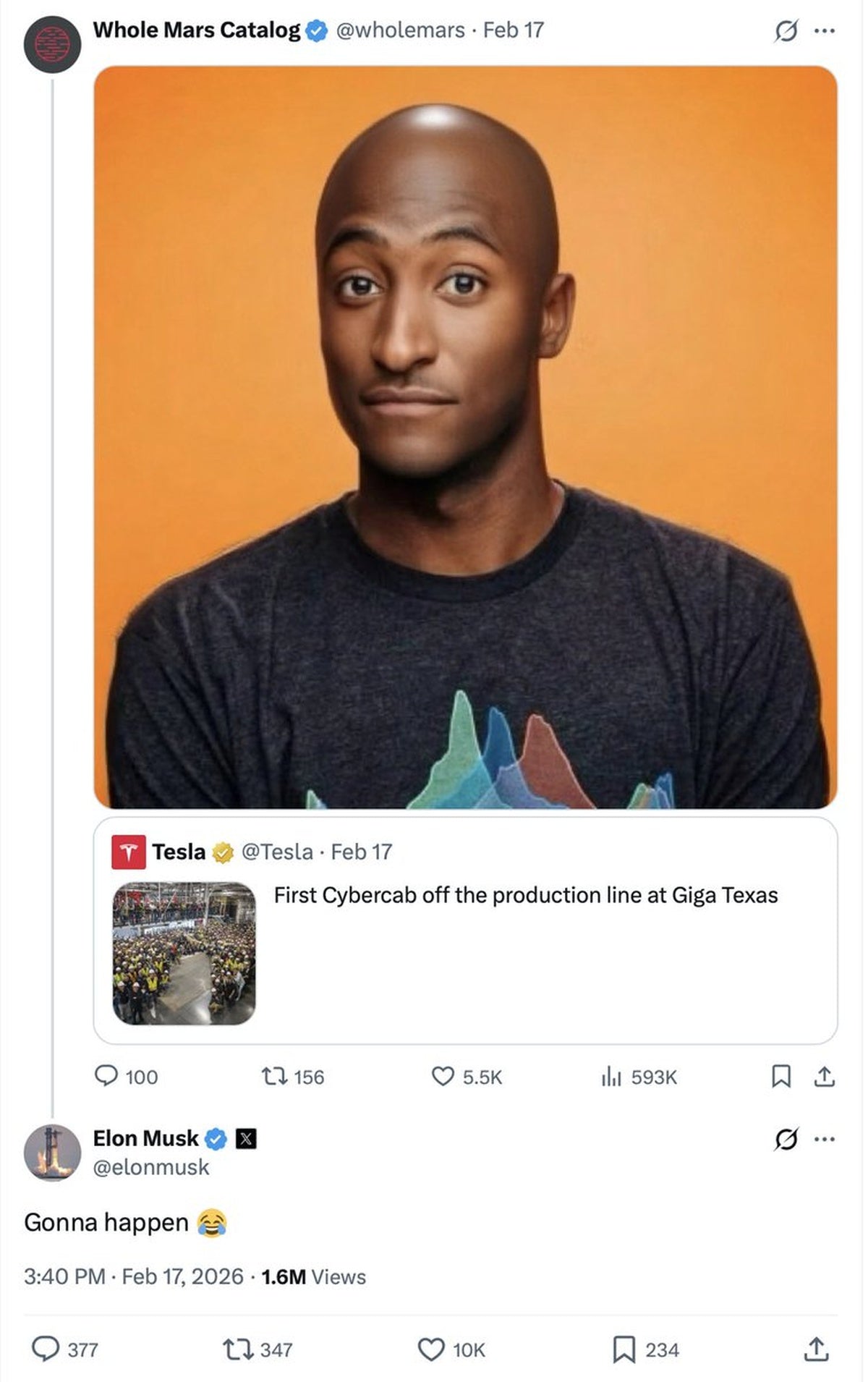
Tesla executive Lars made two significant statements at an event today that are already circulating widely among investors and owners: the Cybercab will be sold to a customer for under $30,000 within the next six months, and Tesla is preparing for massive scale across its entire real-world AI product lineup — Cybercab, Robotaxi, Optimus, factory automation, service automation, and products he declined to name. His core message, according to reporter Whole Mars Catalog who was present, is that the market is fundamentally underestimating not just Tesla's AI capabilities, but its ability to execute at scale.

The Cybercab Price Claim
The under-$30,000 figure is the headline number here. Tesla has previously indicated the Cybercab would be priced below $30,000 at launch — Elon Musk floated a sub-$30K target as far back as the vehicle's October 2024 concept reveal — but attaching a six-month window to an actual customer sale is a meaningfully more concrete commitment than anything the company has officially published. The Cybercab is a two-passenger, fully autonomous vehicle with no steering wheel or pedals, designed from the ground up for robotaxi deployment and personal ownership.

If that timeline holds, a customer Cybercab delivery would land before the end of 2026. Tesla has allocated $20 billion in capital expenditure for 2026 toward AI infrastructure, according to prior company disclosures, and in January 2026 invested approximately $2 billion in xAI to deepen its ability to deploy AI products into the physical world at scale. The financial scaffolding for rapid Cybercab production is clearly being built — the question has always been whether the manufacturing ramp can match the ambition.
What 'Massive Scale' Actually Means
Lars's broader point is harder to quantify but arguably more important. Tesla's updated mission — "to build a world of amazing abundance," formalized in January 2026 — signals that the company no longer views itself primarily as an automaker. The product list he cited covers autonomous vehicles (Cybercab and Robotaxi), humanoid robotics (Optimus), factory automation, and service automation. That's a portfolio spanning personal transportation, industrial labor, and AI-driven services simultaneously.
The unnamed future products he referenced are the wildcard. Tesla has historically used these moments to hint at things that materialize 12-24 months later. Whether that means a next-generation Roadster variant, an autonomous semi application, or something entirely outside the vehicle category is genuinely unknown — but the framing of "real-world AI products" suggests the emphasis is on physical deployment, not software licensing.
Why the Underestimation Argument Has Weight
The claim that Tesla's AI capabilities are being underestimated isn't new, but it's gaining more traction as FSD mileage accumulates and Optimus moves from prototype demos toward factory deployment. Tesla's advantage in this framing isn't just the AI models themselves — it's the closed loop between real-world data collection, in-house training compute (Dojo), and direct integration into physical products that Tesla both manufactures and sells. No other company in the current landscape has all three at comparable scale.
For Tesla owners watching the roadmap, the six-month Cybercab window is the most actionable signal here. It suggests production at Gigafactory Texas is further along than public commentary has implied. Whether the first customer sale is a single symbolic delivery or the start of a genuine volume ramp will tell us a great deal about where Tesla's autonomous vehicle business actually stands heading into 2027.
🚕 Following the Robotaxi rollout? See every operating city, launch date and announced market in our Tesla Robotaxi Tracker.
🤖 Tracking Tesla's humanoid robot? See every Optimus production milestone and appearance in our Tesla Optimus Tracker.
Related Gear
Gear up your Tesla with tested, custom-fit BASENOR accessories — shop Tesla accessories →
Sources & reporting notes
The links below identify the material source records used for this report.
- @wholemars on X (2026-06-30T20:01:54.000Z) — Direct source
- @wholemars on X (2026-06-30T20:42:16.000Z) — Direct source
Source links are preserved as published or accessed. See our editorial standards and corrections policy.
The BASENOR Editorial Desk covers Tesla, SpaceX, and related technology, curating reporting from primary sources — official accounts, regulatory filings, and software release data. Every article passes source-record and fact-checking review before publication. About the newsroom.
This report was curated by the BASENOR Editorial Desk from the sources listed above. Read our editorial standards or email editorial@basenor.com to report an error.