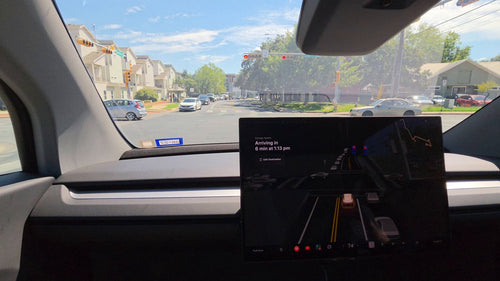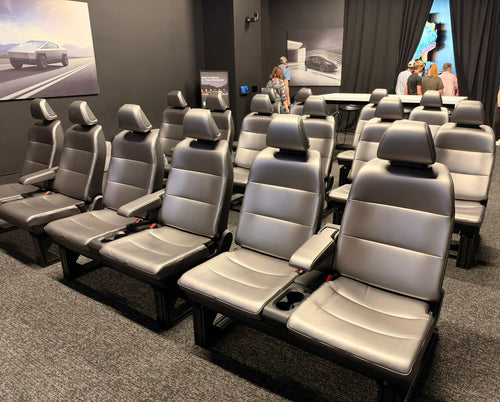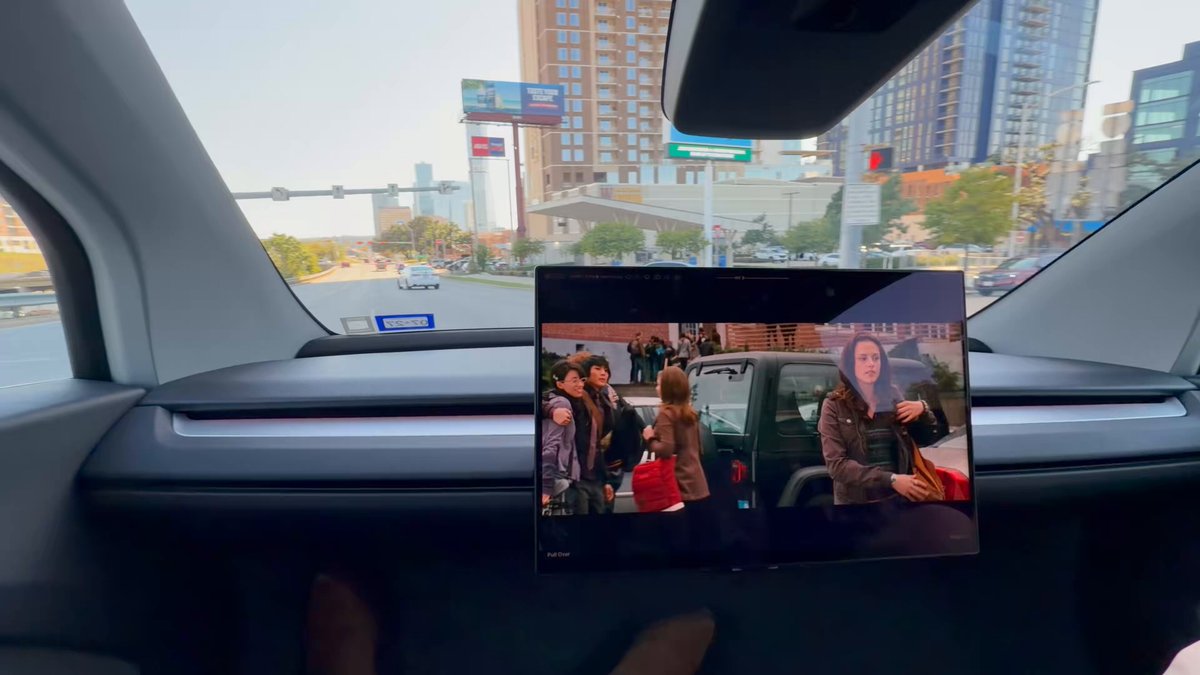
Remove the steering wheel, and you gain something: space. Tesla's Cybercab turns that freed-up real estate into the most entertainment-forward cabin the company has ever built, anchored by a 21-inch central display that doubles as the vehicle's sole control surface. For passengers who've grown accustomed to staring at headrests, it's a fundamental rethink of what a car ride can look like.

One Screen to Run Everything
At 21 inches, the Cybercab's display is the largest Tesla has ever integrated into a production vehicle — and it carries more responsibility than any screen before it. With no instrument cluster, no steering column, and no stalks, this single panel manages navigation, climate, trip settings, safety status, and entertainment. According to verified specifications, the UI is built on Unreal Engine, giving Tesla a rendering foundation capable of handling both real-time autonomous driving visuals and full-screen media playback simultaneously.
That's a meaningful engineering choice. Unreal Engine isn't just a gaming engine — it's the same platform used for cinematic-quality visual effects, which suggests Tesla is positioning the Cybercab's interface as something closer to an immersive display than a traditional car touchscreen.
What Passengers Actually Get
The entertainment pitch is straightforward: passengers can stream Netflix and YouTube, play games, make video calls, or browse their music library — all through the 21-inch display, with audio routed through the car's surround sound system. For a typical robotaxi ride across a city, that's enough time to finish an episode, clear a few levels of a game, or take a work call without pulling out a phone.
Beneath the main display, passengers have access to window controls and USB-C charging ports. Physical door-release and emergency stop buttons — both with Braille lettering for accessibility — are also present in the cabin. Tesla has clearly thought about the scenario where a passenger needs to act independently of the software interface.
The Design Logic Behind It
The absence of a steering wheel and pedals doesn't just free up dashboard space — it restructures the entire floor plan. Without a steering column eating into the footwell, the Cybercab can maximize legroom in a way that conventional vehicles can't. The screen placement follows naturally: where a driver's instrument cluster and center console once lived, there's now a single unified surface facing the passenger space.
This is the clearest hardware signal yet that Tesla designed the Cybercab from the ground up as a passenger product, not a driver product with autonomy bolted on. Every interior decision — the screen size, the Unreal Engine UI, the surround sound, the Braille emergency controls — reflects a cabin built around people who are riding, not driving.
Whether that translates into a genuinely compelling experience at scale depends on content licensing deals, network reliability, and how the UI performs in real-world autonomous operation. But as a design statement, the 21-inch Cybercab screen is the most direct answer Tesla has given yet to the question of what people are supposed to do when the car drives itself.
🚕 Following the Robotaxi rollout? See every operating city, launch date and announced market in our Tesla Robotaxi Tracker.
Related Gear
Gear up your Tesla with tested, custom-fit BASENOR accessories — shop Tesla accessories →
Sources & reporting notes
The links below identify the material source records used for this report.
- @wholemars on X (2026-10-09T21:10:01.000Z) — Direct source
Source links are preserved as published or accessed. See our editorial standards and corrections policy.
The BASENOR Editorial Desk covers Tesla, SpaceX, and related technology, curating reporting from primary sources — official accounts, regulatory filings, and software release data. Every article passes source-record and fact-checking review before publication. About the newsroom.
This report was curated by the BASENOR Editorial Desk from the sources listed above. Read our editorial standards or email editorial@basenor.com to report an error.