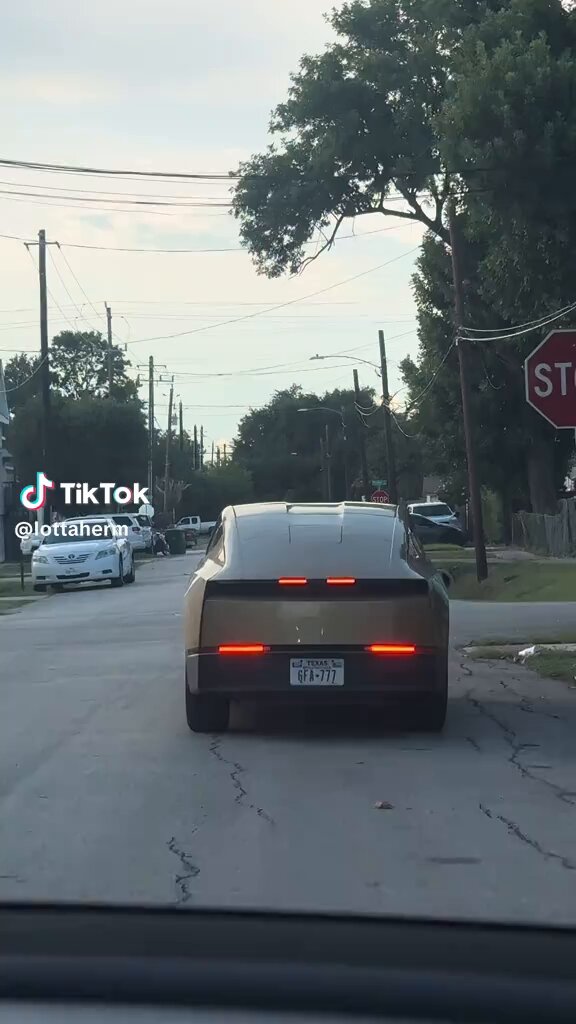
New images of Tesla's Cybercab circulating this week show something most people didn't expect to see on a robotaxi: a sleek, flush-mounted Starlink satellite dish with a distinctive gold cover, apparently integrated directly into the vehicle's body. Shared by Sawyer Merritt on August 16, the photos offer the clearest look yet at production-intent hardware — and they raise a lot of questions. Here are the ones that matter most.

What exactly is this dish, and where is it mounted on the Cybercab?
According to images of a Cybercab spotted in Dallas, Texas on August 8, the Starlink dish appears to be integrated flush into the rear of the vehicle — likely beneath the trunk lid or within the rear roof panel. The gold cover is the most visually striking detail, and it's believed to represent production-intent hardware rather than a testing rig. Earlier Cybercab prototypes used external dishes bolted on for connectivity trials; this design is clearly a step toward final production form.
Which version of Starlink is it?
The Cybercab features the Starlink V5 terminal — the latest generation of SpaceX's hardware. According to background research, the V5 is 35% smaller and 62% lighter than the previous V4 model, weighing approximately 1.1 kg. It draws roughly 35–50 watts of power (about half of what the V4 consumed) and is rated for wind resistance up to 265 km/h. For a vehicle traveling at highway speeds, that wind rating matters considerably.
What will passengers actually get out of it?
The Starlink V5 terminal delivers download speeds exceeding 375 Mbps, according to available specifications. In practical terms, that means passengers in a Cybercab should be able to stream 4K video, run video calls, or handle productivity tasks during a ride — even in areas with weak or absent cellular coverage. For a robotaxi service where the ride itself is the product, that connectivity becomes part of the experience Tesla is selling.
Does the Cybercab need Starlink to drive itself?
No. Tesla's VP of AI Software, Ashok Elluswamy, has explicitly stated that Starlink connectivity is not required for the Cybercab's autonomous driving system to function safely. All perception, decision-making, and vehicle control happen onboard via Tesla's own computers. Starlink serves the passenger experience and fleet management layer — not the autonomy stack. The car will drive itself whether or not it has a satellite signal.
What does Tesla use Starlink for on the fleet management side?
Beyond passenger Wi-Fi, Starlink connectivity is intended to support navigation updates, remote customer service, and overall fleet coordination — particularly in locations where cellular infrastructure is sparse or unreliable. For a robotaxi network operating at scale across large geographic areas, having a fallback connectivity layer that doesn't depend on local cell towers is a meaningful operational advantage.
Is this just for the Cybercab, or is it coming to other Teslas?
Elon Musk stated in July 2026 that Starlink integration is planned for the entire Tesla vehicle lineup going forward, applying to future production vehicles in markets where Starlink is active. The Cybercab appears to be the first production vehicle where this integration is being built in from the ground up rather than retrofitted. Whether the gold cover aesthetic carries over to other models remains to be seen.
Where does the Cybercab program stand right now?
Pilot production of the Cybercab began at Gigafactory Texas in February 2026, with steering-wheel-free builds confirmed by April 2026. Tesla is targeting large-scale robotaxi deployment by late 2026. The Dallas sighting — showing what looks like production-ready hardware including the Starlink dish — suggests that timeline is being actively worked toward. The shift from external test antennas to a flush, gold-covered integrated unit is a meaningful signal that the design is converging on its final form.
🚕 Following the Robotaxi rollout? See every operating city, launch date and announced market in our Tesla Robotaxi Tracker.
Related Gear
Gear up your Tesla with tested, custom-fit BASENOR accessories — shop Tesla accessories →
Sources & reporting notes
The links below identify the material source records used for this report.
- @SawyerMerritt on X (2026-08-16T04:53:11.000Z) — Direct source
- @SawyerMerritt on X (2026-08-16T04:53:11.000Z) — Direct source
Source links are preserved as published or accessed. See our editorial standards and corrections policy.
The BASENOR Editorial Desk covers Tesla, SpaceX, and related technology, curating reporting from primary sources — official accounts, regulatory filings, and software release data. Every article passes source-record and fact-checking review before publication. About the newsroom.
This report was curated by the BASENOR Editorial Desk from the sources listed above. Read our editorial standards or email editorial@basenor.com to report an error.