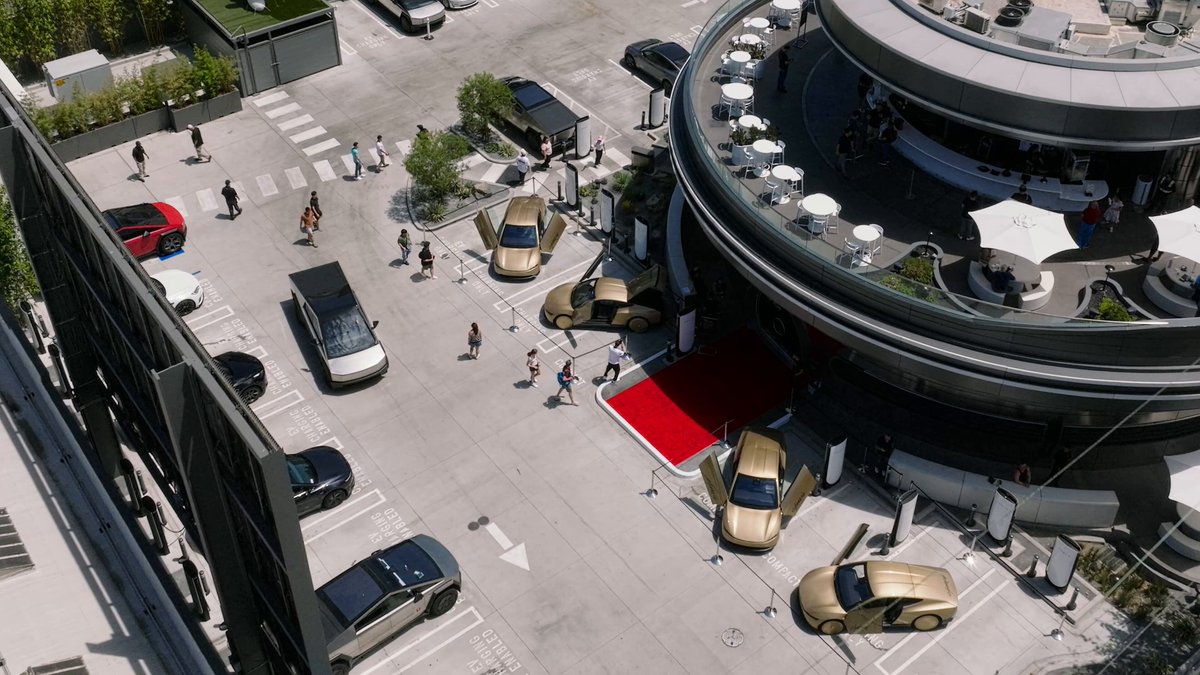
Tesla marked the first anniversary of its West Hollywood Diner by releasing a video that quietly says a great deal: Cybercabs parked out front with no steering wheels and no pedals. It's the clearest public visual yet that Tesla is building its robotaxi fleet to be fully driverless from the factory floor up — not retrofitted, not optionally autonomous, but structurally incapable of human operation.

What the Video Actually Confirms
The absence of a steering wheel and pedals isn't a prototype quirk — it's a regulatory and engineering statement. Under U.S. federal motor vehicle safety standards, vehicles without manual controls require a specific NHTSA exemption to operate on public roads. Tesla has been pursuing that pathway, and deploying Cybercabs at a public-facing venue like the Diner — even in a parked, showcase capacity — signals the company is confident enough in its regulatory standing to put the hardware in front of cameras and crowds.
The Tesla Diner in West Hollywood opened in July 2025, combining a classic American diner aesthetic with a Supercharger station and a drive-in theater screen. Its first anniversary gave Tesla a natural, brand-appropriate stage to show the Cybercab in context: a place people already associate with the Tesla lifestyle, not a closed test track or a controlled press event.
Why the Hardware Detail Matters
There's a meaningful difference between a vehicle that can drive itself and one that cannot be driven any other way. Every Cybercab built without a steering column is a vehicle that only works if the autonomy stack works. That's a design philosophy — and a business bet — that sets Tesla's approach apart from incremental autonomy programs that retain manual override as a fallback.
It also has supply chain implications. A Cybercab production line doesn't need to source steering columns, pedal assemblies, or the associated safety systems that connect them. That simplification, at scale, reduces unit cost and assembly complexity — a factor that matters enormously if Tesla's robotaxi economics depend on high vehicle utilization and low per-mile operating costs.
The Diner as a Strategic Backdrop
Tesla didn't choose a highway or a test facility for this footage. The Diner is a consumer touchpoint — a place designed to make Tesla feel approachable and culturally relevant. Parking fully driverless Cybercabs there on the anniversary sends a deliberate message to the public: this technology is ready to be seen, not hidden. Whether it's ready to be ridden at scale is a separate question, but the visual confidence is notable.
The broader Cybercab rollout timeline remains in motion. Tesla has been expanding its supervised autonomous driving operations, and the Diner appearance fits a pattern of gradually normalizing the hardware in public settings before wider commercial deployment. The next question isn't whether the steering wheel is gone — the video answers that. It's how quickly the regulatory, insurance, and operational frameworks catch up to the hardware Tesla is already building.
🚕 Following the Robotaxi rollout? See every operating city, launch date and announced market in our Tesla Robotaxi Tracker.
Related Gear
Gear up your Tesla with tested, custom-fit BASENOR accessories — shop Tesla accessories →
Sources & reporting notes
The links below identify the material source records used for this report.
- @TeslaNewswire on X (2026-07-22T04:39:11.000Z) — Direct source
Source links are preserved as published or accessed. See our editorial standards and corrections policy.
The BASENOR Editorial Desk covers Tesla, SpaceX, and related technology, curating reporting from primary sources — official accounts, regulatory filings, and software release data. Every article passes source-record and fact-checking review before publication. About the newsroom.
This report was curated by the BASENOR Editorial Desk from the sources listed above. Read our editorial standards or email editorial@basenor.com to report an error.