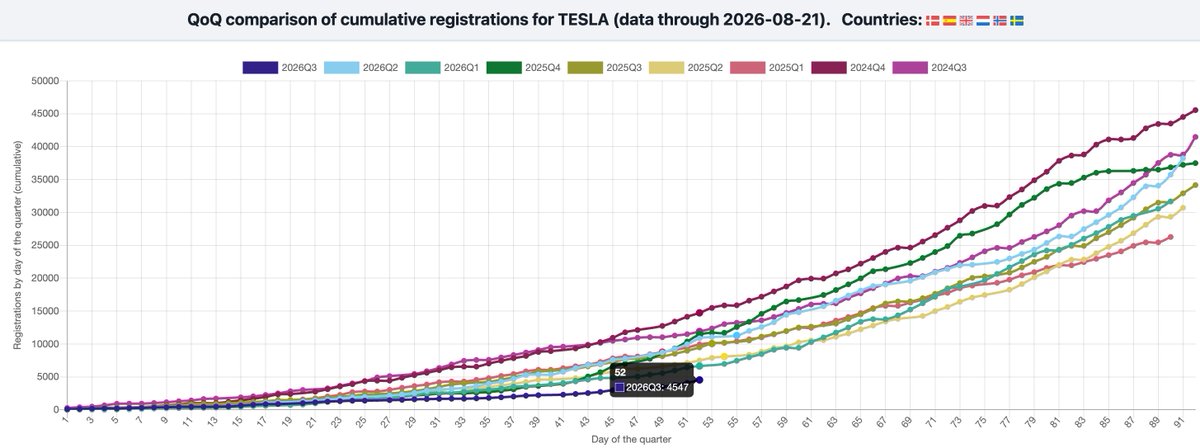
Tesla's European sales numbers are flashing a warning sign. With roughly one month left in Q3 2026, quarter-to-date registrations across Europe are tracking at their lowest point since reliable monitoring began — worse than any comparable period on record, according to Electrek editor Fred Lambert. The end-of-quarter surge that Tesla typically engineers is still possible, but the hole to climb out of is unusually deep.

The Pattern Behind the Numbers
Tesla's European delivery cadence has long followed a predictable rhythm: registrations crater in the first two months of each quarter as inventory is repositioned, then spike sharply in the final weeks as the company pushes to hit targets. That wave pattern is well-documented and largely explains why individual monthly figures can look alarming in isolation.
But Lambert's observation goes beyond the usual seasonal noise. He notes that even accounting for the expected end-of-quarter recovery, the quarter-to-date deficit is historically severe. The implication: even a strong September push may not fully offset the shortfall accumulated in July and August.
The market-level data from July 2026 illustrates the unevenness of the current quarter. Norway — historically one of Tesla's most reliable European strongholds — recorded just 24 registrations in July, a 97.1% year-over-year decline and the deepest monthly trough the brand has seen in that market, according to registration data. Spain told a similar story, with 131 registrations in July representing an 81.3% drop year-over-year. Both figures reflect the trough phase of Tesla's delivery wave, but the magnitude is striking even by that standard.
Not every market moved in the same direction. France posted an 86% increase in July registrations, and Denmark rose 52% in the same month — a reminder that Europe is not a monolith and that Tesla's position varies considerably by country.
The Giga Shanghai Export Factor
Lambert flagged one key variable that could reshape the quarter's final tally: Tesla reportedly exported a significant volume of vehicles from Giga Shanghai to Europe last month. Those cars are likely still in transit or clearing customs, and their registration would typically land in September — the final month of the quarter and the one that historically carries the heaviest delivery weight.
This is a structural feature of how Tesla manages its European supply chain. Vehicles built in Shanghai for European markets face multi-week shipping times, meaning production decisions made in July and August directly determine what's available to register in September. If that export volume is as large as Lambert suggests, the September registration spike could be substantial.
The question is whether it will be large enough. Q2 2026 set a high baseline to defend: Tesla registered 28,610 vehicles across Europe in May 2026 alone — a 107.9% year-over-year increase — and June 2026 came in 50.6% above the prior year, according to registration data. The Model Y led European EV sales during that stretch, and the Model 3 reached the eighth position overall in June. That momentum makes the current Q3 trough more conspicuous, not less.
What the Quarter-to-Date Deficit Actually Means
It is worth being precise about what Lambert's claim does and does not say. Quarter-to-date figures through late August capture roughly two months of a three-month quarter. For Tesla, those first two months are structurally weak — the company intentionally concentrates deliveries in the final weeks. So a record-low quarter-to-date reading does not automatically translate into a record-low quarterly total.
What it does mean is that the September recovery would need to be unusually large to produce a respectable Q3 result. Tesla has pulled off dramatic end-of-quarter surges before, but the arithmetic here is demanding. If July and August registrations are running at record lows, the September volume required to match or exceed Q2's performance is correspondingly higher.
For context, Norway's year-to-date Tesla registrations through July 2026 still stood at 14,413 — up 3.9% year-over-year — and Tesla remained the country's best-selling brand for the year. That figure shows how a weak month can sit inside a healthy cumulative trend when prior quarters were strong. The same dynamic applies at the European level: Q2's outperformance provides a buffer, but it also raises the bar for what Q3 needs to deliver.
The Broader Picture
Europe remains a strategically critical market for Tesla, and the competitive landscape has shifted meaningfully over the past 18 months. European legacy automakers and Chinese EV brands have both accelerated their electric offerings, and Tesla's brand perception in several markets has faced headwinds unrelated to product quality. Whether the current quarter-to-date weakness reflects supply timing, demand softness, or some combination of both will become clearer when September registration data is published in early October.
Lambert's note that he expects sales to 'take off next month' suggests the Shanghai export pipeline is real and substantial. If September delivers, Q3 may look more defensible in the final tally than the mid-quarter snapshot implies. If it doesn't, Tesla will be facing pointed questions about European demand heading into Q4 — a quarter that typically carries its own end-of-year delivery push but also coincides with intensifying competition across the continent.
Related Gear
Gear up your Tesla with tested, custom-fit BASENOR accessories — shop Tesla accessories →
Sources & reporting notes
The links below identify the material source records used for this report.
- @FredLambert on X (2026-08-25T17:48:34.000Z) — Direct source
Source links are preserved as published or accessed. See our editorial standards and corrections policy.
The BASENOR Editorial Desk covers Tesla, SpaceX, and related technology, curating reporting from primary sources — official accounts, regulatory filings, and software release data. Every article passes source-record and fact-checking review before publication. About the newsroom.
This report was curated by the BASENOR Editorial Desk from the sources listed above. Read our editorial standards or email editorial@basenor.com to report an error.