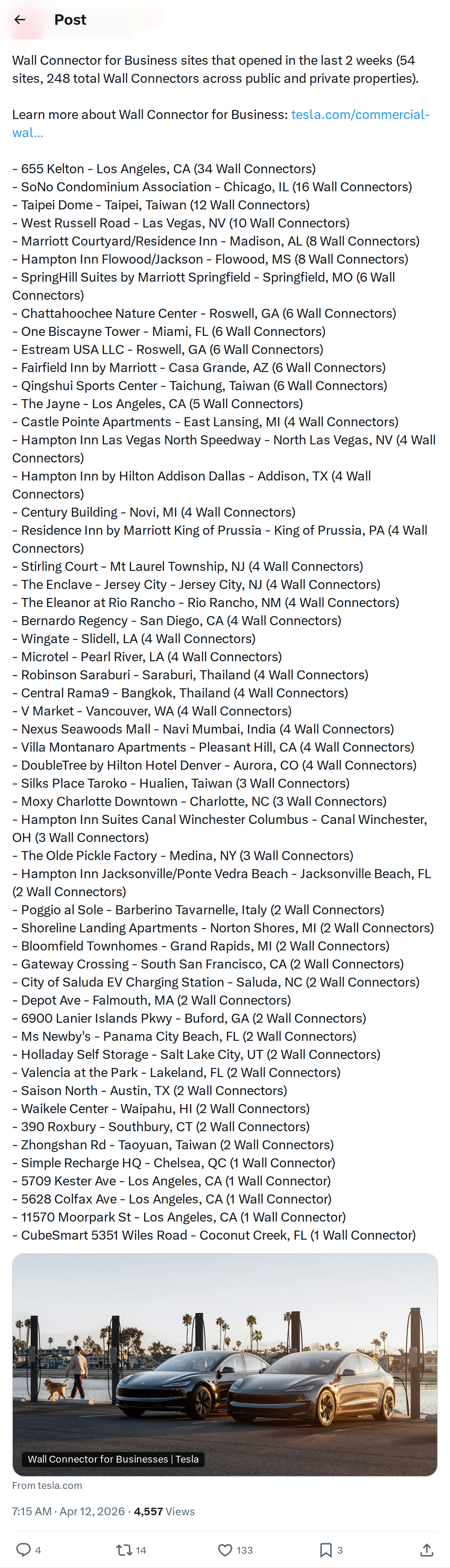
The News: Tesla Charging opened 54 new Wall Connector for Business sites in the last two weeks, deploying 248 Wall Connectors across public and private properties — including a single 34-unit installation in Los Angeles.
Why It Matters: The Wall Connector for Business program is quietly building a dense, EV-agnostic charging layer at apartments, hotels, and workplaces — places where Tesla owners spend hours, not minutes. More sites mean more charge-while-you-live coverage.
Source: @TeslaCharging on X
Tesla's Workplace and Residential Charging Network Keeps Accelerating
Tesla Charging's latest biweekly update confirms 54 new Wall Connector for Business sites went live in the past two weeks, bringing 248 new Wall Connectors online across a mix of public-facing and private properties. The headline installation: 655 Kelton in Los Angeles, CA, which received 34 Wall Connectors in a single deployment — the kind of density that turns a residential building into a genuine EV hub.

This rollout follows a pattern Tesla Charging has maintained throughout early 2026. In late March, Tesla activated 288 Wall Connectors across 56 business sites in a comparable two-week window, with major deployments in New Jersey and Colorado. In mid-March, a single update added 570 Wall Connectors across 90 sites — including 62 units at The Barcelona Tower in Los Angeles. The pace is consistent and accelerating.
📊 Key Figures
| Metric | Value | Context |
|---|---|---|
| New Sites (2 weeks) | 54 | ~56 sites in prior 2-week window |
| Total Wall Connectors Added | 248 | Avg. ~4.6 connectors per site |
| Largest Single Installation | 34 connectors | 655 Kelton, Los Angeles, CA |
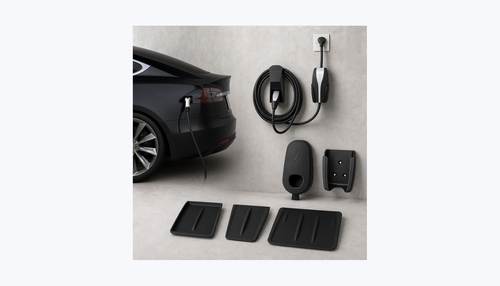
| Power Output per Connector | Up to 11.5 kW | ~44 miles of range per hour |
| Hardware Cost (est.) | $650/unit | Turnkey install est. ~$5,000 |
| Tesla Revenue Fee (paid sites) | $0.03/kWh | Free if charging is offered free |
Why the Wall Connector for Business Program Is Different
The Supercharger network gets the headlines, but Wall Connector for Business is doing something Superchargers can't: it's embedding Tesla charging infrastructure into the places people actually live, work, and sleep. Apartments, hotels, corporate campuses, and parking structures are the environments where EVs sit idle for hours — exactly the charging window that Level 2 hardware is built for.
What makes the current generation particularly notable is universal compatibility. The Universal Wall Connector supports both Tesla's NACS and includes a built-in NACS-to-J1772 adapter, meaning any EV can use these stations. That's a meaningful shift — Tesla is no longer building exclusive infrastructure. It's building infrastructure that happens to benefit Tesla owners most, while remaining open to the broader EV market.
For property owners, the business case is straightforward. Sites that charge for electricity earn revenue, with Tesla taking only $0.03 per kWh for payment processing and support. Sites that offer free charging pay nothing for the software. Either way, the property gets listed on Tesla's 'Find Us' map and Trip Planner — a meaningful amenity signal for EV-driving tenants and guests.
🔭 The BASENOR Take
Timeline: Ongoing biweekly cadence throughout Q1–Q2 2026
Impact Level: Medium-High — cumulative effect on destination charging availability
Confidence: High — sourced directly from @TeslaCharging official account
The 54-site, 248-connector update is not a headline moment in isolation. It becomes significant when you zoom out. Tesla Charging has now reported three consecutive biweekly expansions in 2026, each adding hundreds of connectors. The cumulative math is substantial: just these three windows alone account for over 1,100 new Wall Connectors at business locations.
The Los Angeles concentration is worth watching. The 34-unit installation at 655 Kelton follows the 62-unit Barcelona Tower deployment from March. LA is clearly a priority market — likely a combination of high EV adoption rates, dense multifamily housing stock, and regulatory pressure from California's building codes, which increasingly mandate EV-ready infrastructure in new construction.
For Tesla owners, the practical upside is straightforward: more places where you can plug in overnight or during a workday without competing for a Supercharger stall. For non-Tesla EV owners, the J1772 adapter compatibility means these sites are genuinely accessible — which matters for the program's commercial viability and Tesla's broader infrastructure ambitions.
The pace suggests Tesla Charging has moved past the pilot phase for this program and into systematic, market-by-market rollout. If the biweekly cadence holds, the Wall Connector for Business network could add thousands of connectors per quarter — quietly building one of the most extensive Level 2 business charging networks in North America. Follow our charging news for ongoing coverage as the network expands.
Related Gear
Gear up your Tesla with tested, custom-fit BASENOR accessories — shop Tesla accessories →
Sources & reporting notes
The links below identify the material source records used for this report.
- @TeslaCharging on X (2026-04-11T23:15:07.000Z) — Direct source
Source links are preserved as published or accessed. See our editorial standards and corrections policy.
The BASENOR Editorial Desk covers Tesla, SpaceX, and related technology, curating reporting from primary sources — official accounts, regulatory filings, and software release data. Every article passes source-record and fact-checking review before publication. About the newsroom.
This report was curated by the BASENOR Editorial Desk from the sources listed above. Read our editorial standards or email editorial@basenor.com to report an error.