📌 UPDATE — August 17, 2026
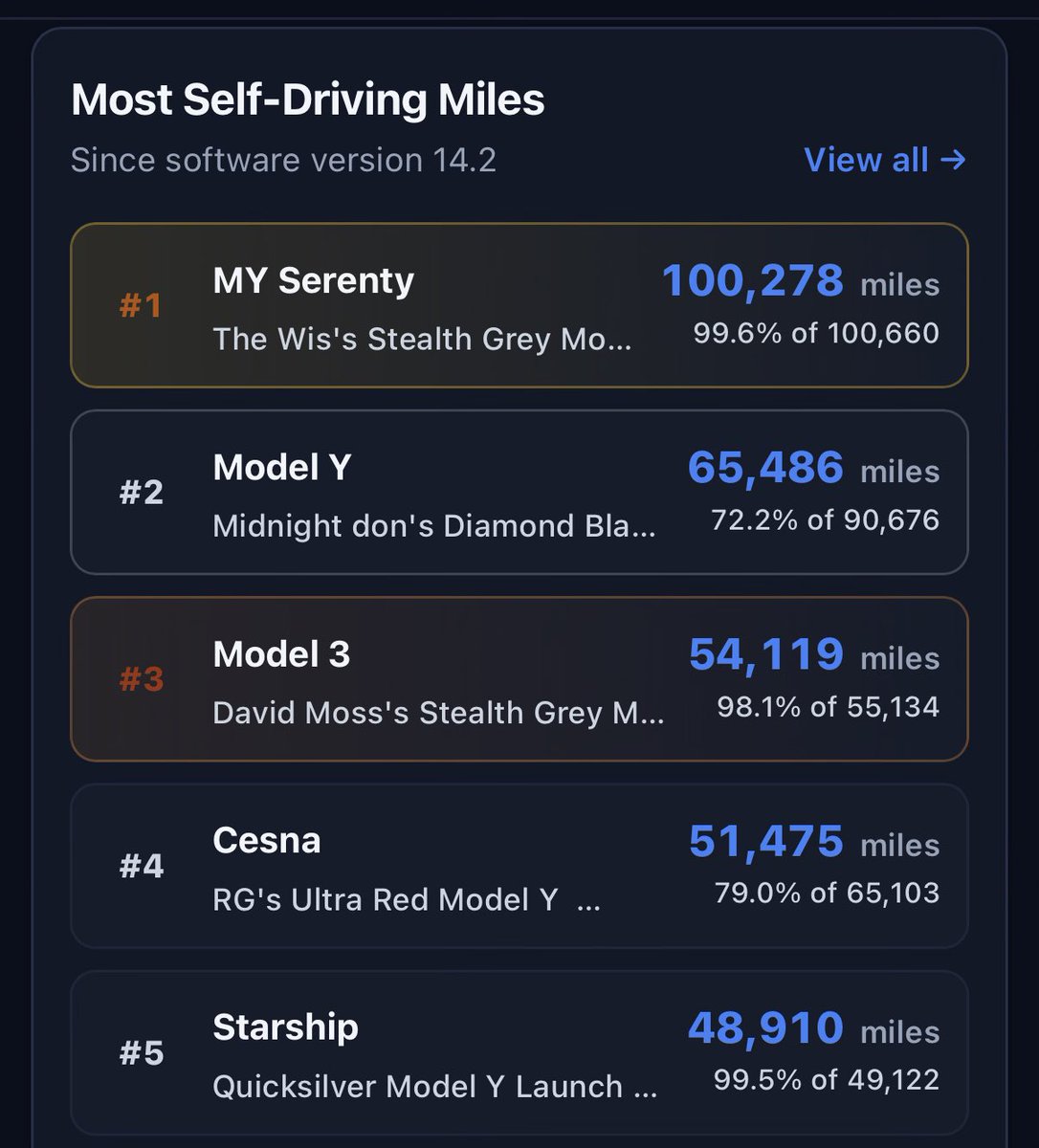
New details have emerged expanding the scope of this milestone: the same owner has now accumulated over 500,000 cumulative FSD miles (~804,000 km) across two vehicles, making the 100,000-mile run on FSD (Supervised) v14 just one chapter in a much larger autonomous driving story. The 99.6% autonomy score is accompanied by an active 76-day hands-free streak, underscoring the consistency — not just the raw mileage — of the achievement. At 382 manual intervention miles out of 100,000+, that works out to roughly one disengagement every ~262 miles on v14 alone. Across the half-million-mile lifetime total, this owner may represent the single most documented real-world FSD dataset held by a private individual.

A Tesla owner known as @TheWis65 has crossed a threshold that would have seemed like science fiction just a few years ago: 100,000 miles logged on Tesla's Full Self-Driving system, with the car driving itself for 99.6% of every single one of them. In the entire stretch, only 382 miles were driven manually. The milestone was flagged by prominent Tesla community account @wholemars on August 13, 2026.

What 382 Manual Miles Actually Means
To put the numbers in perspective: 382 miles across 100,000 total is roughly the distance from Los Angeles to San Francisco — driven by a human hand, once, in a car that otherwise navigated itself through an equivalent of four trips around the Earth's equator. That's not a weekend experiment with a new feature. That's a fundamental shift in how someone relates to their vehicle.
The achievement runs on FSD version 14.2, the release that also introduced the "Continuous Intervention-Free FSD Miles" widget — a real-time counter that lets owners track unbroken autonomous streaks. According to background research, that widget debuted with 14.2 and was later expanded in version 14.3.4 with celebratory animations at milestones like 250, 500, 1,000, and 5,000 consecutive intervention-free miles. @TheWis65's 100,000-mile cumulative figure is a different metric — total FSD miles across the vehicle's lifetime — but it's arguably the more meaningful one. It measures sustained, day-to-day trust in the system, not a single lucky streak.
The Fleet Context Behind One Driver's Numbers
Individual milestones like this don't exist in a vacuum. As of July 18, 2026, Tesla's FSD fleet had collectively accumulated over 12.4 billion miles, according to data cited in recent reporting. That cumulative figure is the backbone of Tesla's neural network training loop — more miles mean more edge cases, more edge cases mean better models, better models mean more miles get handed back to the car. @TheWis65's 100,000 miles are a drop in that ocean, but they represent exactly the kind of high-autonomy, low-intervention driving that generates the most valuable training signal.
For context on where FSD stands commercially: Tesla reported 1.48 million active FSD subscriptions in Q2 2026, and the subscription-only model (priced at $99/month in the U.S. as of February 2026) is now the sole purchase path for new customers. The system is available in 12 markets globally as of this summer.
A Benchmark Shift, Not Just a Personal Record
Earlier this month, another milestone made the rounds: Tesla owner David Moss logged over 25,000 consecutive, zero-intervention miles — a single unbroken autonomous run confirmed by in-car footage. That record speaks to reliability in a specific, controlled sense. @TheWis65's 100,000-mile cumulative figure speaks to something different: what it looks like when a driver genuinely stops treating FSD as a feature to monitor and starts treating it as the default way the car moves.
The gap between those two framings matters for how the broader public evaluates autonomous driving. A long unbroken streak is impressive engineering. A driver who manually touches the wheel for less than 0.4% of their miles over six figures of driving is a behavioral data point — evidence that at least some owners have crossed a psychological threshold where FSD is the baseline, not the experiment.
Whether that threshold becomes common depends on what comes after 14.2. FSD v14.3.7 is the current release for Hardware 4 vehicles, and Hardware 3 owners recently received FSD v14.1 Lite as part of the unified rollout confirmed on August 9. The trajectory is toward more capability on more cars — and milestones like this one are, in a quiet way, the receipts.
Related Gear
Gear up your Tesla with tested, custom-fit BASENOR accessories — shop Tesla accessories →
Sources & reporting notes
The links below identify the material source records used for this report.
- @wholemars on X (2026-08-13T13:19:39.000Z) — Direct source
Source links are preserved as published or accessed. See our editorial standards and corrections policy.
The BASENOR Editorial Desk covers Tesla, SpaceX, and related technology, curating reporting from primary sources — official accounts, regulatory filings, and software release data. Every article passes source-record and fact-checking review before publication. About the newsroom.
This report was curated by the BASENOR Editorial Desk from the sources listed above. Read our editorial standards or email editorial@basenor.com to report an error.