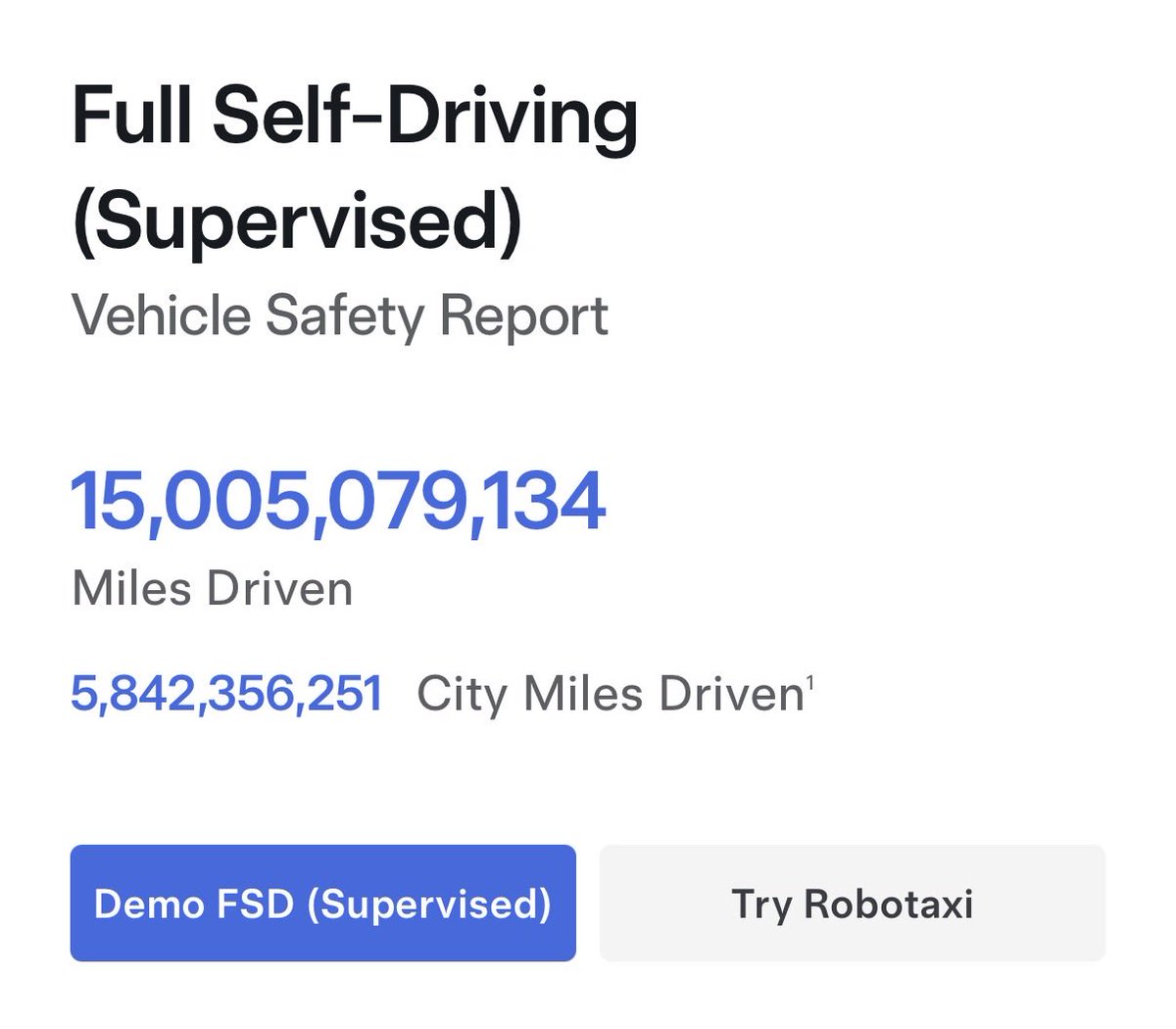
Tesla's Full Self-Driving (Supervised) system has crossed 15 billion cumulative miles driven — a figure that includes 5.8 billion miles on city streets, where the hardest edge cases live. The milestone, reported on September 29, 2026, lands as the fleet's daily accumulation rate has been running at roughly 41.7 million miles per day, meaning this number is already higher by the time you read this.

The Numbers Behind the Milestone
1. 15 Billion Miles — or 24.1 Billion Kilometers
The headline figure translates to 24.1 billion kilometers, which puts it in perspective for a global audience. To frame the scale differently: the distance from Earth to the Sun is roughly 150 million kilometers. Tesla's FSD fleet has collectively traveled the equivalent of about 160 round trips to the Sun. This is real-world supervised driving data — not simulation — collected across every road type, weather condition, and traffic scenario the fleet encounters daily.
2. 5.8 Billion Urban Miles
Nearly 39% of all FSD miles have been driven on city streets. That proportion has been growing. According to background data, as of early September 2026, roughly 5.45 billion of the then-14.05 billion cumulative miles were urban. The jump to 5.8 billion urban miles in the weeks since reflects a meaningful shift in where the fleet is operating — and where the training signal is richest. Urban driving means intersections, cyclists, pedestrians, unprotected left turns, and construction zones: the scenarios that matter most for full autonomy.
3. 41.7 Million Miles Per Day
That was the accumulation rate observed in late August 2026, and it's the number that makes every milestone feel temporary. At that pace, Tesla's fleet adds the equivalent of roughly 167 trips around Earth's circumference every single day. The 14-billion-mile mark was crossed on August 27, 2026, meaning the final billion miles to reach today's milestone took approximately 24 days. The next billion-mile increment will likely arrive before the end of October.
4. From 7 Billion to 14.9 Billion in Nine Months
At the end of 2025, cumulative FSD miles stood at 7 billion. By September 26, 2026, that figure had reached 14.9 billion — meaning the fleet more than doubled its lifetime mileage in under nine months. That acceleration reflects both a growing FSD-enabled fleet and increasing engagement from existing owners. More vehicles, more miles per vehicle, and a higher proportion of those miles in the complex urban environments that stress-test the system hardest.
5. 1.69 Billion City Miles Added Since May 2026
Of the approximately 4.04 billion total miles added between May and early September 2026, about 1.69 billion — roughly 42% — were on city streets. That's a higher urban share than the overall fleet average, suggesting the mix is tilting further toward urban use as FSD matures. For Tesla's training pipeline, this matters: city miles generate denser, more varied data per mile than highway driving, which tends to be repetitive. The shift toward urban accumulation is effectively a quality upgrade to the training dataset, not just a quantity increase.

The 15-billion-mile figure is a snapshot, not a finish line. With the fleet adding miles at this rate, the more meaningful question is what Tesla does with the data — and whether the next major FSD capability jump arrives before the 20-billion-mile mark does. Given the current pace, that milestone is roughly five months away.
Related Gear
Gear up your Tesla with tested, custom-fit BASENOR accessories — shop Tesla accessories →
Sources & reporting notes
The links below identify the material source records used for this report.
- @TeslaNewswire on X (2026-09-29T13:07:30.000Z) — Direct source
Source links are preserved as published or accessed. See our editorial standards and corrections policy.
The BASENOR Editorial Desk covers Tesla, SpaceX, and related technology, curating reporting from primary sources — official accounts, regulatory filings, and software release data. Every article passes source-record and fact-checking review before publication. About the newsroom.
This report was curated by the BASENOR Editorial Desk from the sources listed above. Read our editorial standards or email editorial@basenor.com to report an error.