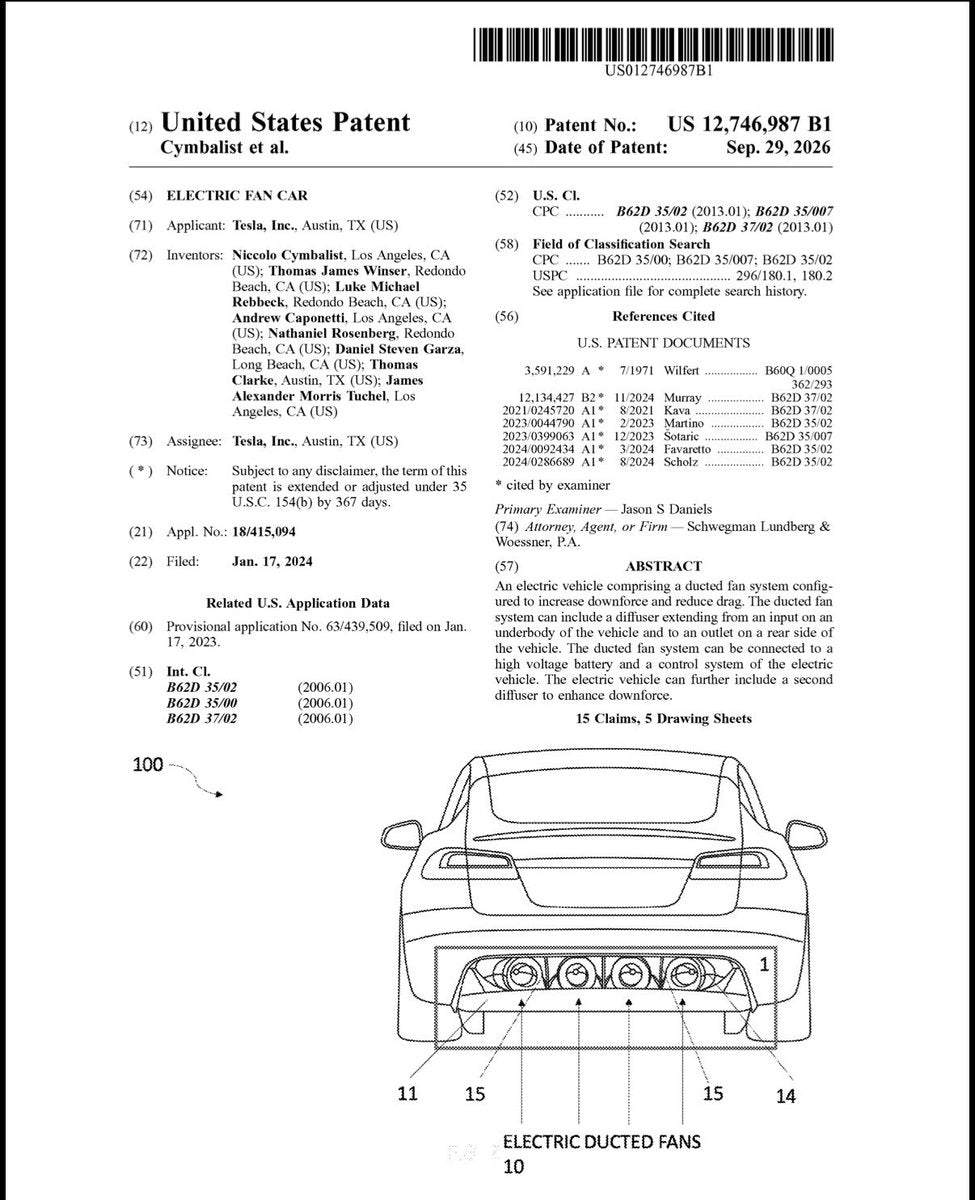
Tesla was granted a new patent today — US 12,746,987 B1 — for what it calls an "Electric Fan Car" system. The technology uses electric ducted fans to actively generate downforce, independent of vehicle speed. While the patent drawings show a Model S, that vehicle line has since ended production, pointing most observers toward one obvious candidate: the long-awaited next-generation Roadster.

What exactly does this patent describe?
The system uses four electric ducted fans mounted in the rear diffuser of the vehicle. Air is drawn in through an inlet on the underbody, routed through internal ducts, and expelled out the rear. That process creates a low-pressure zone — essentially a suction region — beneath the car. The result is downforce generated by the fans themselves, not by the car's shape or speed through the air.
How is this different from a traditional diffuser or rear wing?
Conventional aerodynamic elements — diffusers, spoilers, active wings — only work when air is moving over and under the car at speed. The faster you go, the more downforce they generate. Tesla's fan system flips that dependency: because the fans are powered electrically, they can generate downforce at any speed, including near-zero. That's a meaningful advantage during hard braking from high speeds or tight, slow-speed cornering where aero grip normally disappears. For context, Tesla also filed a separate patent (US 2026/0285418 A1, published September 24, 2026) for an active deployable rear wing capable of generating up to 700 kg of downforce — the two systems could potentially work in tandem.
Why does the patent show a Model S if that car is no longer in production?
Patent drawings routinely use existing vehicle silhouettes as reference geometry — it doesn't mean the technology is intended for that specific model. Tesla ended Model S and Model X production earlier this year, and the Fremont line previously used for those vehicles is being repurposed. The inventors listed on this patent are primarily based at Tesla's Los Angeles design studio, which has historically been closely tied to performance and specialty vehicle work. The next-gen Roadster, still unannounced with a firm launch date, is the most logical application given the performance profile this system targets.

When was this patent filed, and how long has Tesla been working on it?
The original provisional application dates to January 17, 2023 — meaning Tesla has been developing this concept for nearly four years. A full application followed in January 2024, and the patent was officially granted today, September 29, 2026. That timeline suggests this isn't a speculative sketch; it's a mature engineering concept that has cleared the full patent review process.
Does a granted patent mean this will actually appear in a production car?
Not automatically. Patents protect intellectual property and signal where a company's engineering attention is focused — they don't guarantee production. That said, the specificity here is notable: four fans, a defined underbody inlet, a rear outlet, a diffuser routing path, and eight named inventors. This reads less like a defensive filing and more like documented engineering work. Whether it makes it into the Roadster or another future vehicle depends on cost, packaging constraints, and decisions Tesla hasn't announced publicly.
What would this mean for Roadster performance if it does ship?
The original Roadster concept promised 0-60 mph in under 2 seconds and sub-8-second quarter miles, with a claimed "SpaceX package" that was rumored to involve cold-air thrusters. An active downforce system like this would address a real engineering challenge: keeping a lightweight, extremely powerful car planted at both high speed and low speed without relying purely on mechanical grip. Consistent downforce across the entire speed range means more predictable braking, faster corner entry, and better stability under hard acceleration — the kind of performance envelope that separates a track-capable car from one that's merely fast in a straight line.
Related Gear
Gear up your Tesla with tested, custom-fit BASENOR accessories — shop Tesla accessories →
Sources & reporting notes
The links below identify the material source records used for this report.
- @TeslaNewswire on X (2026-09-29T14:19:01.000Z) — Direct source
- @SawyerMerritt on X (2026-09-29T14:47:08.000Z) — Direct source
Source links are preserved as published or accessed. See our editorial standards and corrections policy.
The BASENOR Editorial Desk covers Tesla, SpaceX, and related technology, curating reporting from primary sources — official accounts, regulatory filings, and software release data. Every article passes source-record and fact-checking review before publication. About the newsroom.
This report was curated by the BASENOR Editorial Desk from the sources listed above. Read our editorial standards or email editorial@basenor.com to report an error.