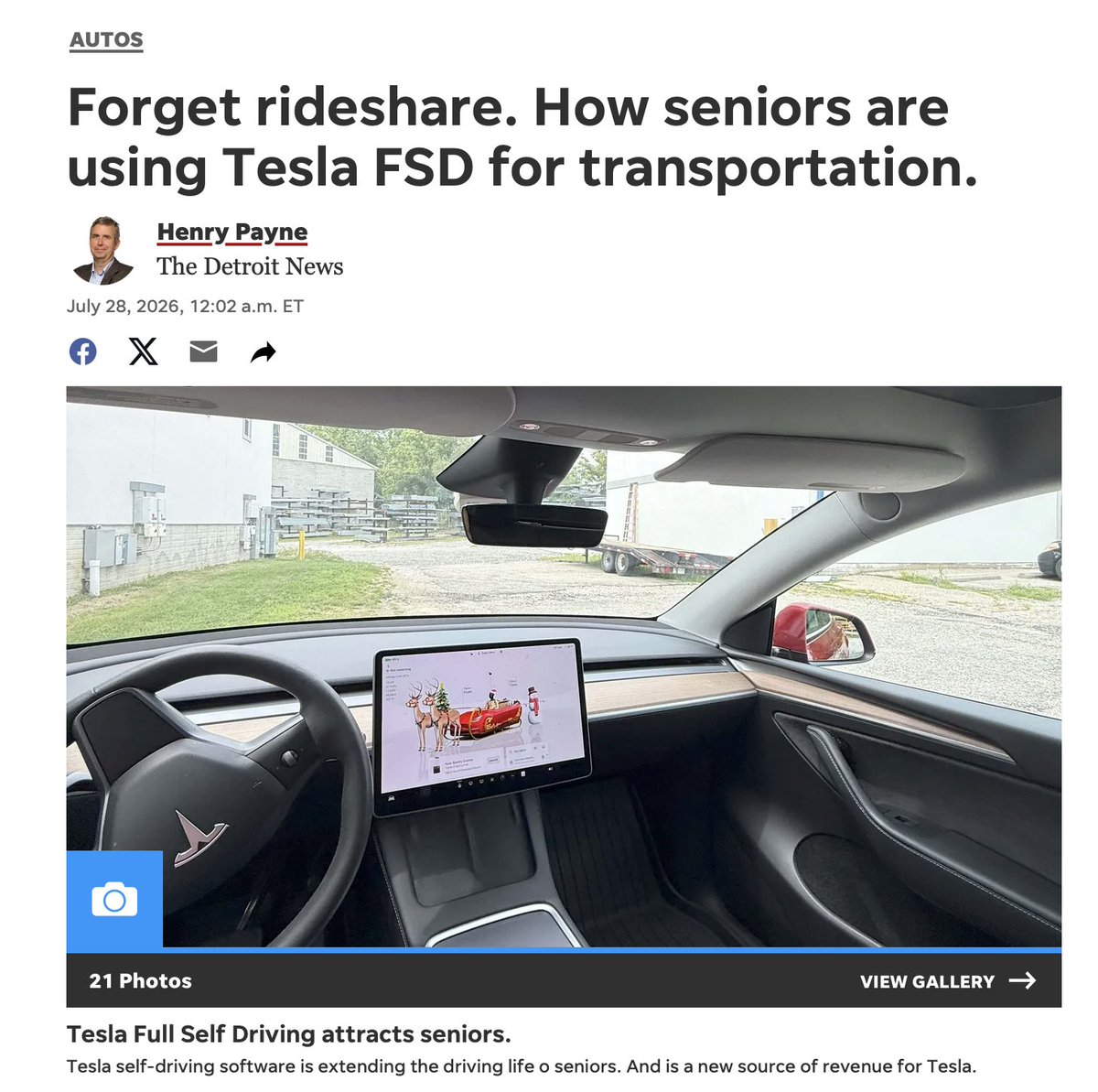
A new feature story from The Detroit News is drawing attention for framing Tesla's Full Self-Driving system not as a futuristic novelty, but as a practical tool that is already restoring transportation independence for older drivers. The piece, flagged by Tesla commentator Sawyer Merritt, positions FSD as a driver-assist technology with real-world consequences for a demographic that has long struggled with mobility loss.

What the Detroit News Coverage Actually Says
The Detroit News excerpt shared by Merritt reads: "Determined to maintain their individual transportation independence, they are using Tesla's hands-free FSD system as a driver assist. Though by no means exclusive to seniors in its ability to add another set of..." — the quote cuts off, but the framing is clear. The article is not a technology review. It is a human story about people using available tools to stay mobile.
That framing matters. Coverage of FSD in mainstream outlets has historically skewed toward edge cases and regulatory friction. A Detroit-based newspaper — in the heart of the American auto industry — running a sympathetic, use-case-driven piece on Tesla's driver-assist system is a meaningful shift in tone. Detroit News readers are not early adopters scrolling Tesla forums. They are general-interest automotive consumers, and the publication carries weight in that community.
The Seniors Angle Is Not New — But It Is Growing
The mobility challenge for aging drivers is well-documented. Giving up the car keys is one of the most psychologically significant transitions older adults face, often tied directly to loss of independence, social isolation, and declining health outcomes. Driver-assist technology has long been theorized as a bridge — a way to extend safe driving years without requiring full autonomy.
That theory is increasingly showing up in practice. According to reporting from AutoSpies in March 2026, Tesla's FSD Supervised technology was already being discussed as a tool that could empower seniors to drive longer safely and reduce reliance on others. One widely circulated account from the same period described a 93-year-old woman who regained her driving independence after purchasing a Model Y with FSD and using Grok for in-car navigation assistance.
These are anecdotal data points, but they are accumulating. The Detroit News piece suggests the phenomenon is now mainstream enough to warrant feature-length journalism in a traditional automotive market.
The Safety Numbers Behind the Story
The human interest angle gains analytical weight when set against Tesla's own data. As of July 23, 2026, Tesla VP of AI Ashok Elluswamy stated publicly that FSD has accumulated over 12 billion miles of real-world use. Elluswamy also claimed FSD is measurably safer than manual driving by a factor of two — twice as many miles between collisions compared to unassisted human driving.
Those figures have not been independently audited, and Tesla's methodology for calculating collision rates has drawn scrutiny in the past. But the scale of the dataset is significant. At 12 billion miles, FSD is no longer operating on a thin sample. And for a demographic — older drivers — where reaction time, vision, and cognitive load are genuine concerns, a system that handles lane changes, speed adjustments, and highway navigation autonomously addresses the specific failure modes that make driving risky as people age.
On July 27, 2026, a Tesla owner reportedly completed 20,000 consecutive miles on FSD without a single human intervention — the longest verified autonomous streak on record, achieved across FSD versions 14.2 and 14.3.4. That kind of real-world performance data, while still a single data point, reinforces the narrative the Detroit News piece is building.
Why Mainstream Coverage Like This Moves the Needle
Tesla does not need to advertise FSD to Tesla owners. The audience that reads Merritt's feed already knows the technology exists. What matters about the Detroit News piece is the audience it reaches — people who are not following Tesla closely, who may be weighing whether driver-assist technology is relevant to their lives or the lives of aging family members.
Positive mainstream coverage in legacy automotive media has historically preceded broader consumer adoption curves. When a technology stops being covered as a Silicon Valley experiment and starts being covered as a solution to a human problem, the adoption conversation shifts. The Detroit News framing — independence, practicality, real people — is exactly the kind of coverage that moves cautious buyers.
It also arrives at a moment when the broader autonomous vehicle space is fragmented. Detroit's own city government has a separate pilot program using May Mobility shuttles for seniors and people with disabilities — a $2.4 million contract approved by the city council, funded in part by a $2.5 million federal grant, with a safety operator present in each vehicle. That program targets residents who cannot drive at all. Tesla FSD, by contrast, is serving a different and arguably larger cohort: people who can still drive but benefit significantly from assistance. The Detroit News piece appears to recognize that distinction.
The full article is behind The Detroit News paywall, but the excerpt and Merritt's signal boost are enough to confirm the direction of the coverage. For an industry still fighting the perception that FSD is a beta product for tech enthusiasts, a story like this — told through the lens of a grandmother keeping her keys — may do more work than any press release.
Related Gear
Gear up your Tesla with tested, custom-fit BASENOR accessories — shop Tesla accessories →
Sources & reporting notes
The links below identify the material source records used for this report.
- @SawyerMerritt on X (2026-07-28T05:39:51.000Z) — Direct source
Source links are preserved as published or accessed. See our editorial standards and corrections policy.
The BASENOR Editorial Desk covers Tesla, SpaceX, and related technology, curating reporting from primary sources — official accounts, regulatory filings, and software release data. Every article passes source-record and fact-checking review before publication. About the newsroom.
This report was curated by the BASENOR Editorial Desk from the sources listed above. Read our editorial standards or email editorial@basenor.com to report an error.