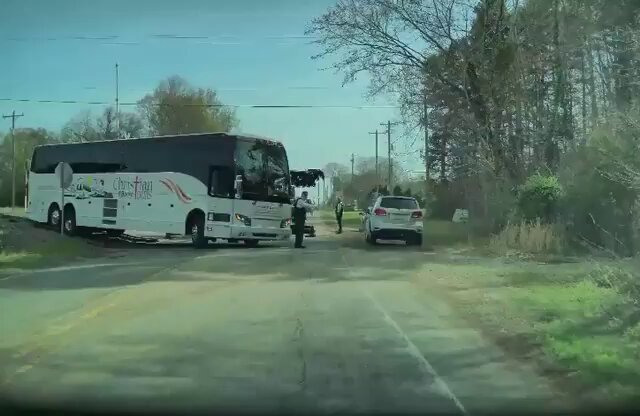
The News: A Tesla running Full Self-Driving autonomously steered onto a dirt shoulder to navigate around a bus crash blocking the road.
Why It Matters: This is a real-world example of FSD handling a genuinely unexpected, complex obstruction — not a controlled test, not a demo. It's the kind of edge-case behavior that separates a capable system from a truly autonomous one.
Source: @SawyerMerritt on X
Tesla FSD Navigates Around a Bus Crash by Driving Onto the Dirt Shoulder
Tesla's Full Self-Driving system just handled something that would challenge even an attentive human driver: a bus crash blocking the road ahead. Rather than stopping and waiting for human intervention, the FSD-equipped Tesla assessed the situation, identified a viable path, and drove onto the dirt shoulder to get around the obstruction — all autonomously.
The footage, shared by Tesla tracker Sawyer Merritt, is making the rounds for good reason. It's not a staged demonstration. It's FSD encountering a genuinely chaotic, unscripted road event and solving it.

🔭 The BASENOR Take
| Timeline | March 15, 2026 — real-world incident, uncontrolled environment |
| Impact Level | High — demonstrates genuine edge-case autonomy |
| Confidence | High — video evidence from a credible source |
What makes this clip significant isn't just the "wow" factor. It's what the behavior reveals about where FSD's decision-making actually stands.
Driving off the paved road surface onto a dirt shoulder requires the system to do several things simultaneously: recognize that the primary lane is impassable, determine that the shoulder is a viable alternative path, assess whether that path is clear of hazards, and execute the maneuver smoothly enough not to lose traction or clip the obstruction. That's a multi-layered judgment call — not a simple lane change.
For context, this is precisely the kind of scenario that critics of autonomous driving systems have long pointed to as a fundamental challenge. Unexpected, non-standard road events — crashes, debris, emergency vehicles, construction — require the system to reason about intent and improvise, not just follow painted lines. The fact that FSD handled this without a disengagement is meaningful data.
It's also worth noting the regulatory backdrop. NHTSA currently has an active preliminary investigation (PE25012) covering approximately 2.88 million Tesla vehicles, examining FSD-related incidents involving alleged traffic law violations. Tesla has been under pressure to provide crash data, with a compliance deadline of March 9, 2026. Clips like this one don't resolve that investigation — but they do illustrate that FSD's capabilities are not static. The system that regulators are scrutinizing is also the system that just navigated around a bus crash without human input.
The broader trajectory here matters for every FSD subscriber. Each real-world edge case that FSD handles correctly feeds back into Tesla's training pipeline. The fleet is enormous — millions of vehicles generating data daily — and incidents like this become training examples that make the next version of FSD more capable in similar situations. This is the compounding advantage Tesla has consistently pointed to, and this footage is a tangible illustration of it in action.
For owners currently on FSD, this is a reminder that the system's capabilities are best understood through accumulated real-world evidence, not just release notes. And for those still on the fence about subscribing, clips like this one are the most honest marketing FSD has: unscripted, unedited, and genuinely impressive. You can follow our FSD coverage for ongoing real-world performance updates.
📰 Deep Dive
The specific maneuver shown — leaving the paved surface entirely to bypass a crash — sits in a category of FSD behavior that has historically required human override. Earlier versions of FSD (Supervised) would typically slow, stop, and prompt the driver to take control when faced with an impassable lane and no clear paved alternative. The fact that this vehicle continued autonomously onto the dirt shoulder suggests meaningful progress in how FSD interprets and responds to unstructured road environments.
It's also worth considering the sensor and compute requirements for this kind of decision. The vehicle had to distinguish between the crash debris, the shoulder surface, and any potential hazards on that shoulder — all in real time, at road speed. Whether this was handled primarily by the camera array, the neural network's scene understanding, or some combination, the output was a confident, smooth maneuver rather than an abrupt stop.
What remains unknown from this single clip: whether the driver had hands on the wheel (FSD Supervised still requires driver attention and legal responsibility remains with the driver), what the exact road and speed conditions were, and whether the system flagged any alerts during the maneuver. Those details matter for a complete technical assessment. But as a demonstration of real-world autonomous capability, this footage stands on its own.
Related Gear
Gear up your Tesla with tested, custom-fit BASENOR accessories — shop Tesla accessories →
Sources & reporting notes
The links below identify the material source records used for this report.
- @SawyerMerritt on X (2026-03-15T15:38:33.000Z) — Direct source
Source links are preserved as published or accessed. See our editorial standards and corrections policy.
The BASENOR Editorial Desk covers Tesla, SpaceX, and related technology, curating reporting from primary sources — official accounts, regulatory filings, and software release data. Every article passes source-record and fact-checking review before publication. About the newsroom.
This report was curated by the BASENOR Editorial Desk from the sources listed above. Read our editorial standards or email editorial@basenor.com to report an error.