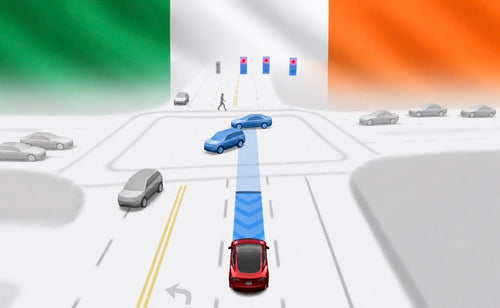
The News: Tesla has demonstrated that FSD can anticipate a pedestrian's intent to enter the road before they actually step off the curb — shifting from reactive braking to proactive prediction.
Why It Matters: Pedestrian-related incidents are among the highest-stakes scenarios in urban driving. A system that predicts rather than reacts gives your Tesla critical extra seconds to respond safely.
Source: @Tesla on X
Tesla FSD Now Predicts Pedestrian Intent Before They Step Off the Curb
For years, the benchmark for autonomous driving safety was simple: don't hit things. Detect an obstacle, brake. Detect a pedestrian in the road, stop. Reactive. Mechanical. Adequate — but not intelligent.
Tesla just showed something different. Full Self-Driving can now anticipate that a pedestrian intends to enter the road before their foot ever leaves the curb. That's not just a software improvement. That's a fundamental shift in how FSD understands the world around your car.

📊 What Changed: Reactive vs. Predictive
| Capability | Before | Now |
|---|---|---|
| Pedestrian detection trigger | Pedestrian enters roadway | Pedestrian shows intent to enter roadway |
| System response type | Reactive braking | Proactive deceleration / path adjustment |
| Cues analyzed | Position in road | Body posture, gaze direction, momentum cues |
| Safety margin | Minimum — reacts after risk materializes | Extended — acts before risk materializes |
How FSD Reads Pedestrian Intent
This capability isn't a simple rule-based trigger. It's the output of Tesla's end-to-end neural network — trained on billions of real-world miles — learning to interpret subtle human behavioral cues the same way an experienced human driver does instinctively.
Think about how you drive near a school zone. You don't wait for a child to step into the street before you lift your foot off the accelerator. You watch the body language — the lean toward the curb, the head turning to check traffic, the weight shift that telegraphs movement. FSD is now doing exactly that.
This builds on capabilities Tesla has been developing across vulnerable road user scenarios. Earlier versions of FSD v13.3 demonstrated the ability to predict cyclist intent by analyzing subtle body leans and head movements — enabling safer passes on narrow roads. Pedestrian anticipation is the next evolution of that same underlying intelligence, powered by what Tesla describes as a "primitive form of reasoning" about the physical world.
The current version, FSD v14 (running on the 2026.2 software branch), is built on a unified, end-to-end neural network architecture. Unlike earlier modular systems that processed perception, prediction, and planning as separate steps, this architecture reasons across all of them simultaneously — which is precisely what enables intent prediction rather than just object detection. You can follow all the latest developments in our FSD coverage.
Why This Matters More Than It Sounds
The difference between reacting to a pedestrian in the road and anticipating one about to enter may sound incremental. It isn't. At 25 mph, a car travels roughly 37 feet per second. An extra half-second of warning — the kind that comes from reading intent rather than waiting for a foot to cross the curb line — translates directly into stopping distance, smoother deceleration, and in worst-case scenarios, the difference between a near-miss and a collision.
It also changes the driving feel for passengers. Reactive braking is jarring. Predictive deceleration is smooth. Owners who've used FSD in dense urban environments know the difference between a system that lurches and one that flows — and this capability moves FSD firmly toward the latter.
It's worth noting that NHTSA currently has an active investigation into FSD's performance in low-visibility conditions, covering over 3.2 million Tesla vehicles. That investigation focuses on a specific, separate concern — camera visibility degradation. Pedestrian intent prediction addresses a fundamentally different challenge: behavioral interpretation in clear conditions. Both matter, and Tesla appears to be advancing on multiple fronts simultaneously.
🚦 Owner's Action Plan
Verdict: Informational — No action required. This capability is part of the FSD neural network and does not require a separate update or setting change.
- Check your FSD version. Go to Controls → Software on your touchscreen. You should be on the 2026.2 branch to have the latest FSD v14 capabilities. If you're behind, ensure your car is connected to Wi-Fi and check for pending updates.
- Enable FSD on urban routes. If you've been hesitant to use FSD in pedestrian-heavy areas, this capability is specifically designed for exactly those environments. City streets, crosswalks, school zones — these are now where FSD is most meaningfully improving.
- Stay subscribed to FSD. As of February 14, 2026, FSD is subscription-only at $99/month. Capabilities like pedestrian intent prediction are part of the active subscription — they are not available on Autopilot alone.
- Remain attentive. FSD remains a supervised system. Tesla's own designation — FSD (Supervised) — means you are required to maintain attention and be ready to take control. Predictive capability improves safety margins; it does not eliminate the need for driver oversight.
- Provide feedback. If you observe the system handling a pedestrian scenario particularly well or poorly, use the thumbs up/down feedback button on the FSD screen. Tesla's neural network training is directly influenced by fleet feedback.
📰 Deep Dive
The framing Tesla used in this announcement is deliberate and worth unpacking: "anticipate intent before a pedestrian even steps into the road." Intent is a cognitive concept. Attributing it to a software system — and demonstrating that the system can act on it — represents a meaningful claim about the maturity of FSD's world model.
Traditional ADAS systems, including earlier versions of Tesla's own Autopilot, operate primarily in the detection-reaction loop: identify an object, classify it, respond to its current state. What Tesla is demonstrating here is a shift to prediction — the system is modeling what an agent in the scene is likely to do next, not just what they are doing now. That's a harder problem, and solving it for pedestrians in real-world urban conditions is genuinely significant.
The timing of this showcase is also notable. With NHTSA scrutiny elevated and FSD's regulatory pathway in Europe actively progressing — Tesla is reportedly awaiting approval from the Dutch RDW authority with an expected green light by April 10, 2026 — Tesla has clear incentive to publicly demonstrate the system's proactive safety capabilities. Showing regulators and the public that FSD anticipates danger rather than just reacting to it is a powerful narrative, and the video evidence backs it up.
For owners, the practical takeaway is straightforward: FSD in urban environments is meaningfully better than it was six months ago, and pedestrian scenarios specifically are a focus area. The gap between what FSD can do today and what a careful human driver does is narrowing — and this capability is one of the clearest examples of that progress yet.
📋 Tracking Tesla software? See every firmware, FSD and app version in one place in our Tesla Software Update Tracker.
Related Gear
Gear up your Tesla with tested, custom-fit BASENOR accessories — shop Tesla accessories →
Sources & reporting notes
The links below identify the material source records used for this report.
- @Tesla on X (2026-03-29T05:06:44.000Z) — Direct source
Source links are preserved as published or accessed. See our editorial standards and corrections policy.
The BASENOR Editorial Desk covers Tesla, SpaceX, and related technology, curating reporting from primary sources — official accounts, regulatory filings, and software release data. Every article passes source-record and fact-checking review before publication. About the newsroom.
This report was curated by the BASENOR Editorial Desk from the sources listed above. Read our editorial standards or email editorial@basenor.com to report an error.