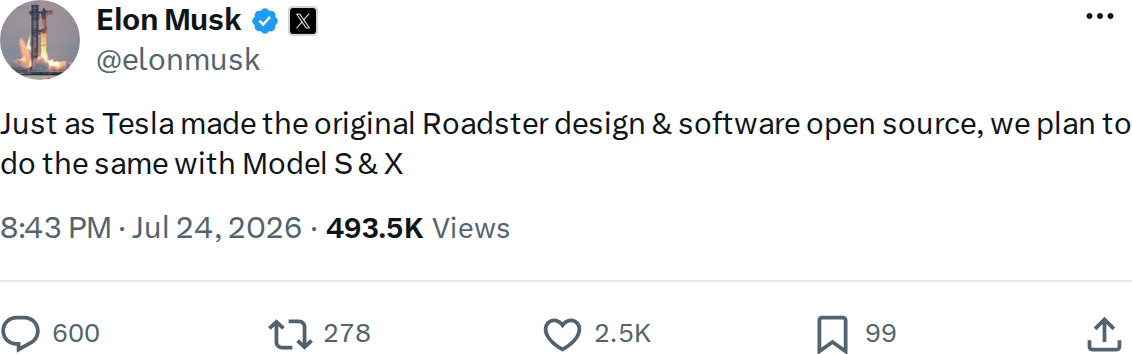
Elon Musk said Thursday that Tesla plans to release the design and software for the Model S and Model X as open source, mirroring the company's earlier decision to open source the original Roadster. The one-line post on X carries outsized implications for a pair of vehicles that just wound down production earlier this year, and it hands the aftermarket, tuning, and developer communities a potential playbook for keeping the flagship sedans and SUVs alive well beyond Tesla's own support horizon.

Musk's statement — “Just as Tesla made the original Roadster design & software open source, we plan to do the same with Model S & X” — arrives roughly two months after Tesla permanently shut down Model S and Model X production at Fremont. According to reporting compiled after Tesla's Q4 2025 earnings call, Musk confirmed the wind-down on January 28, 2026, and the last S and X units rolled off the line in May 2026 before the factory began a 46-day decommissioning to convert the space for Optimus humanoid robot production. Custom orders stopped being accepted on April 1, 2026, with sales rolling over to existing inventory.
Why This Matters
Open sourcing a flagship EV platform is not a normal move in the automotive industry. Automakers guard vehicle CAD, controller firmware, and diagnostic software as competitive assets, even for discontinued models. Tesla's Roadster precedent — the original 2008-2012 car — is the exception that proves the rule, and it directly enabled a small but active ecosystem of restoration shops, battery upgraders, and independent software tools for owners of the aging sports car.
Applying that same treatment to Model S and Model X is a much larger undertaking. The Model S platform dates to 2012 and has gone through multiple hardware revisions, from the original 60/85 kWh packs through Raven, Plaid, and the 2021 refresh. Model X shares much of that architecture but adds falcon-wing door mechanicals, a distinct HVAC layout, and its own controller stack. If Tesla releases meaningful portions of the design files and software, the practical outcome is that third parties gain a documented path to service, modify, and extend cars that Tesla itself has stopped building.
What Owners Should Read Into This
Tesla has already committed to continued OTA software updates, Supercharger access, and spare-parts availability for existing Model S and Model X vehicles for many years. Musk's open source pledge is best understood as a layer on top of that support, not a replacement for it. According to previous statements around the production shutdown, the company framed ongoing service commitments as a core part of the transition — open sourcing the platform extends that commitment into a form Tesla no longer has to staff.
Realistically, three groups stand to benefit first:
- Independent service shops. Access to service documentation, diagnostic protocols, and controller software would meaningfully lower the barrier to third-party S and X repair — a long-standing pain point for owners outside major metros.
- Battery and drivetrain specialists. Companies already doing pack rebuilds and motor swaps on older Model S units would gain formal reference material instead of reverse-engineering.
- Developers and researchers. Open software could enable community-built tools for logging, diagnostics, and even feature experimentation on cars whose owners opt in.
The Important Caveats
Musk's post is a statement of intent, not a release. There is no timeline, no scope definition, and no clarity on which specific components — CAD files, firmware, Autopilot stack, infotainment, HVAC controllers — would actually be published, or under what license. The Roadster open source release itself was narrower than the phrase suggests; it did not hand competitors a turnkey Tesla platform.
Several practical questions remain unanswered:
- FSD and Autopilot software almost certainly stay proprietary. The value of Tesla's autonomy stack across the entire fleet makes it implausible that safety-critical driver-assist code gets open sourced, even for a discontinued model line.
- Ongoing OTA features — the software that Tesla continues to push to existing S and X vehicles — is a separate track from any historical release. Open sourcing a snapshot is very different from open sourcing the live pipeline.
- Third-party liability is a genuine constraint. Any released design or software will come with limits on what modifications remain compatible with Supercharger access, warranty coverage on remaining parts, and safety systems.
The Strategic Read
Tesla's decision to end Model S and Model X was driven by a combination of an aging platform, sub-5% share of total deliveries, high per-unit production cost, and a company-wide pivot toward autonomy, robotics, and the Cybercab. Open sourcing the platform is consistent with that pivot: it lets Tesla walk away from the operational burden of a low-volume flagship while preserving goodwill with the owner base and the enthusiast community that built the brand's early reputation.
It also functions as a hedge. If independent shops and developers can keep tens of thousands of S and X vehicles healthy over the next decade, Tesla reduces the risk of a public backlash from stranded owners — the exact scenario that has hurt other automakers when they've discontinued halo products without a clear support plan.
What to Watch Next
Musk's open source announcements have historically preceded formal releases by months, sometimes longer. Watch for: a specific repository or filing from Tesla, clarification on which components are included, licensing terms (permissive vs. copyleft matters enormously for commercial aftermarket use), and any statement on how the release interacts with ongoing OTA support. Until any of that lands, this is a directional signal — a meaningful one for the S and X community, but not yet a product.
For current Model S and Model X owners, nothing changes today. The cars continue to receive updates, Supercharger access remains intact, and Tesla's parts commitment stands. What changes is the long-term outlook: for the first time, there's a credible path to a genuinely independent S and X ecosystem, on Tesla's own terms.
Related Gear
Gear up your Model S & X with tested, custom-fit BASENOR accessories — shop Model S & X accessories →
Sources & reporting notes
The links below identify the material source records used for this report.
- @elonmusk on X (2026-07-24T20:43:08.000Z) — Direct source
Source links are preserved as published or accessed. See our editorial standards and corrections policy.
The BASENOR Editorial Desk covers Tesla, SpaceX, and related technology, curating reporting from primary sources — official accounts, regulatory filings, and software release data. Every article passes source-record and fact-checking review before publication. About the newsroom.
This report was curated by the BASENOR Editorial Desk from the sources listed above. Read our editorial standards or email editorial@basenor.com to report an error.